404 Redirects and SEO: Redirect, Return 410, or Keep 404?
Use a decision framework, log queries, GSC workflow, server rules, and ecommerce edge cases to choose between 301, 404, 410, 503, or a restored page.
Read the guide
Topic
Research, workflows and tools for making websites crawlable, renderable and consistently indexable.
Start with the guide
The work starts before rankings. It makes discovery, rendering and URL signals dependable enough for search systems to use.
Robots rules, sitemaps and internal links that expose useful URLs.
Delivery patterns that keep primary content and metadata available.
Canonical, status and content signals that agree on the preferred page.
Audit and validation routines for launches, migrations and fixes.
Begin with the system model, then use the evidence and workflows below to diagnose a specific site.
Use a decision framework, log queries, GSC workflow, server rules, and ecommerce edge cases to choose between 301, 404, 410, 503, or a restored page.
Read the guideCompare six free EXIF and metadata viewers for private local checks, RAW files, GPS data, broad file formats, metadata removal and command-line work.
Read the guideCompare seven free image compressors for private browser processing, batch jobs, WordPress, exact file-size targets and hands-on codec control.
Read the guideCompare six free image croppers for private edits, exact ratios, profile photos, transparent PNGs, batch cropping and advanced browser work.
Read the guideCompare seven free image resizers for private batches, exact pixels, social presets, target file sizes, printing and advanced browser editing.
Read the guideCompare six free WebP converters for private browser batches, cloud format support, JPG and PNG output, quality control and design workflows.
Read the guideUse this tested decision system to choose a 301 redirect or rel=canonical, resolve conflicting URL signals, and validate pagination, facets, variants, JavaScript and CDN rules.
Read the guideMerge overlapping pages without losing useful query coverage. Use an intent test, query preservation ledger, redirect map, release gate and post-launch measurement plan.
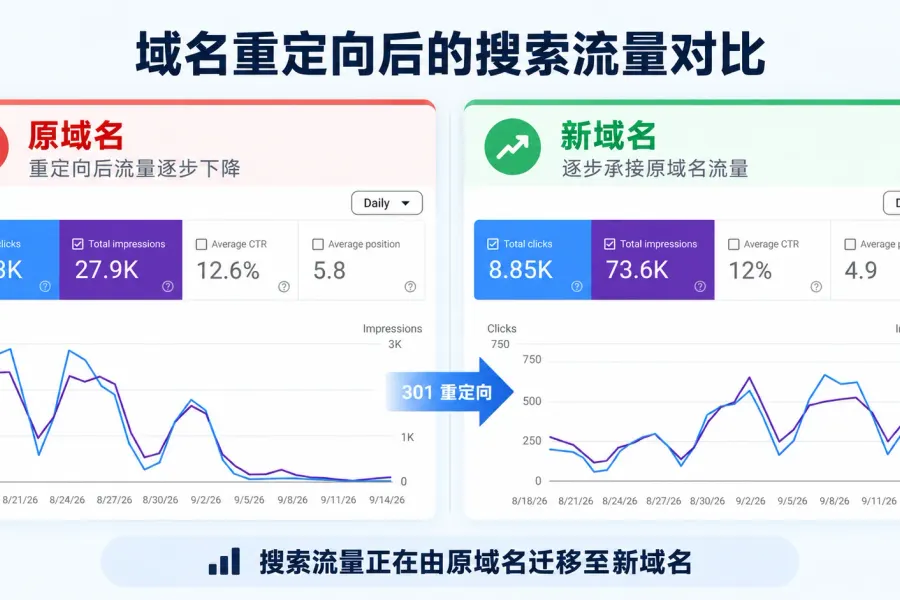
Read the guidePlan and validate domain forwarding with a URL-level map, one-hop permanent redirects, aligned canonical signals and evidence from Indexora's 22-day root-to-www study.
Read the guideCreate a URL redirect in NGINX, Apache, Cloudflare Pages or Shopify, choose the owning layer, and verify the live status, Location, final page and canonical.
Read the guideImplement and test an HTML redirect, understand meta refresh and JavaScript failure modes, and choose a server-side 301 when the source URL has permanently moved.
Read the guideChoose 301, 302, 303, 307 or 308 by separating SEO permanence from HTTP method behavior, then verify the public response, target and rollback path.
Read the guideDiagnose ERR_TOO_MANY_REDIRECTS by capturing the first repeated URL, assigning each response to its owning layer, removing the conflicting rule and retesting a full URL matrix.
Read the guideDiscovery runs as a pipeline from crawl to render to index. Here is where it breaks on modern sites and the signals that keep your content reachable.
Read the guideControlled comparisons show which implementation details changed discovery, rendering or canonical consolidation.
The old root host declined toward zero in both clicks and crawl demand while the canonical www host stayed stable and absorbed the crawl budget, indicating that traffic transferred rather than disappearing.
Delivery pattern mattered less than reliable discovery, stable metadata and complete rendered content.
The cleanest consolidation appeared when redirects, canonicals, sitemaps and internal links agreed.
Use defined inputs and outputs to turn a broad technical review into evidence another person can check.
A technical SEO audit workflow for validating crawl access, indexability, canonical URLs, rendering and site signals with reproducible evidence.
Screaming Frog, Sitebulb, Google Search Console, browser devtools
An internal linking audit for finding orphaned pages, weak crawl paths, broken destinations and unclear anchors, with recommendations tied to reader needs.
crawler export, analytics landing pages, content inventory, rendered HTML samples
Small utilities isolate redirects, canonicals, hreflang and sitemap behavior without adding a platform workflow.
View all toolsCompare requested, redirected and declared canonical URLs.
Open toolPrepare reciprocal annotations for language and regional pages.
Open toolCheck up to 20 URLs for HTTP status codes, redirect chains and final destinations.
Open toolReview URL format, response status and sitemap consistency.
Open toolCompress JPG, PNG and WebP images to a smaller file size.
Open toolConvert images to and from WebP for faster pages.
Open toolResize images by pixel or percent with handy presets.
Open toolCrop images to exact ratios and dimensions.
Open toolView photo metadata, camera info and GPS location.
Open toolPlaybooks put checks in sequence so technical findings become safe implementation and validation work.
A sequenced technical SEO audit playbook for crawling a site, diagnosing crawl, render and index problems, and validating each fix before it ships.
A website launch SEO playbook to protect crawlability, URL signals, redirects and measurement through a new site launch or a domain migration.