
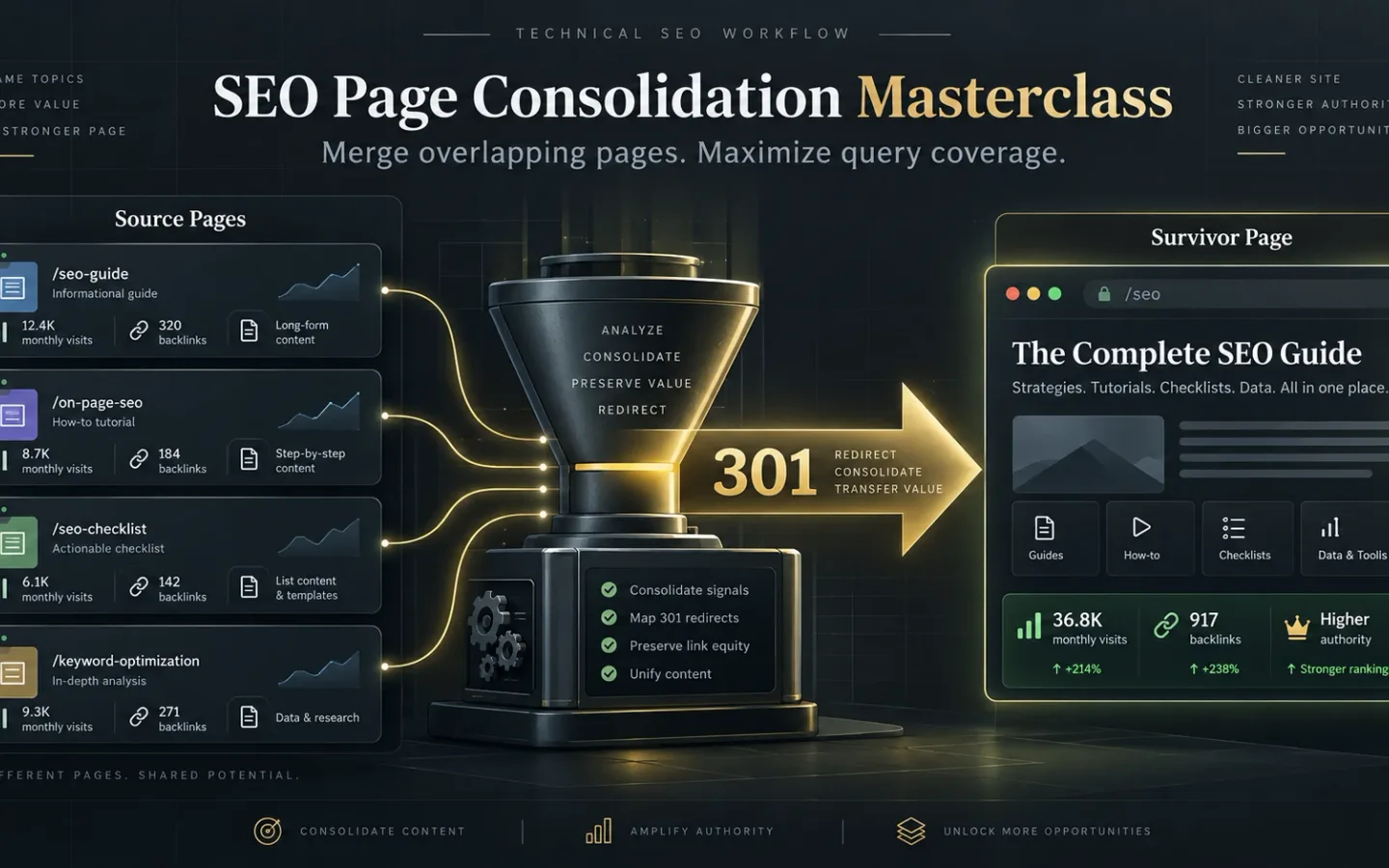
Consolidate pages only when they satisfy the same search task and the source pages have no independent job left. Select one durable URL, build a query preservation ledger, move every useful answer into the survivor, publish it, and then send each retired URL directly to that page with a permanent redirect. Similar keywords are evidence to investigate, not permission to merge.
This process separates two risks that teams often mix together. The content risk is losing useful answers, conversions or audience segments. The technical risk is sending old URLs to the wrong destination or publishing conflicting signals. A 301 can solve the second problem. It cannot repair the first.
How to Decide Whether Two URLs Should Become One Page

Run an intent test before comparing traffic or backlinks. For each candidate URL, record:
| Test | Question | Merge signal | Keep-separate signal |
|---|---|---|---|
| Search task | What is the visitor trying to complete? | Same task and expected outcome | Different action or decision |
| Result overlap | Do the same types of pages rank for both query groups? | Strong overlap across several representative queries | Tool pages, product pages and guides rank separately |
| Main content | Which sections answer the task? | Most useful sections can coexist without repetition | Each page needs a different structure or depth |
| Audience | Who needs the page? | Same role, market and stage | Different country, industry, expertise or funnel stage |
| Conversion | What action follows the answer? | Same next step | Different product, form, tool or transaction |
| Maintenance | Will both pages remain accurate for different reasons? | One owner and one update cycle | Separate owners, legal terms or release schedules |
A single veto can be enough to keep pages separate. A redirect checker, an explanation of redirect SEO and an NGINX configuration guide all mention redirects. They serve a tool task, a learning task and an implementation task. Combining them would weaken all three.
The search phrase seo consolidating pages 301 redirect keyword ranking compresses several decisions into one line. The sequence matters: prove shared intent, preserve query coverage, build the destination, and only then implement the redirect.
How to Build a Page-Consolidation Inventory
Create one row per live or historically valuable URL. Do not normalize away evidence before you understand it.
Recommended fields:
source_url
http_status
canonical_url
indexability
content_type
primary_task
clicks_90d
impressions_90d
query_count
quality_referring_domains
internal_link_count
conversions_or_key_action
last_material_update
proposed_outcome
decision_owner
Collect URLs from current and historical sitemaps, analytics landing pages, Search Console, backlink exports, server logs and the CMS. Keep protocol, hostname, case, slash and parameter variants in a separate raw column. A variant may look redundant but still receive external links or reveal a template defect.
Search Console data needs a limitation note. The Search Analytics API can group by page and query, but Google states that it returns top rows rather than guaranteeing every row. Its API documentation also caps rowLimit at 25,000 per request. Use the export to protect known demand, not to claim that the file contains every query ever associated with a URL.
How to Confirm Shared Search Intent With Query Overlap
Titles can hide overlap and exaggerate it. Use a page-query table instead.
For each candidate page:
- Export at least one stable comparison period.
- Keep query, clicks, impressions, CTR and average position.
- Label the search task for each meaningful query.
- Mark the page section that currently answers it.
- Compare task overlap, not only shared words.
- Review representative result pages for ambiguous query groups.
- Record queries that require a separate format, audience or conversion.
A useful worksheet has this shape:
| Query group | Source A answer | Source B answer | Same task? | Destination section | Decision |
|---|---|---|---|---|---|
| Definition | Introductory explanation | Repeated explanation | Yes | Direct answer | Merge and rewrite |
| Setup | Short checklist | Detailed procedure | Yes | Implementation | Keep detailed version |
| Tool use | Embedded interactive tool | No tool | No | Separate tool page | Do not merge |
| Regional rules | US requirements | EU requirements | No | Separate market pages | Do not merge |
Do not turn this into a mechanical similarity score. A high lexical overlap can still conceal different user jobs. A lower overlap can still represent the same task when one page is simply more complete.
How to Choose the Surviving URL
The survivor is the URL that should remain useful for years, not automatically the page with the most recent traffic.
Evaluate each candidate against:
- current clicks and impressions;
- query groups that the URL owns;
- referring domains and important external links;
- internal-link prominence;
- conversion or product value;
- URL stability and taxonomy fit;
- content completeness;
- localization, legal or product constraints;
- likelihood that another migration will soon be required.
Use a decision record rather than a secret weighted formula:
Surviving URL:
Decision date:
Decision owner:
URLs reviewed:
Shared search task:
Reasons this URL survives:
Known advantages of retired URLs:
Sections or assets that must move:
Redirect exceptions:
Measurement window:
Rollback trigger:
Weights create false precision unless your team has calibrated them against past projects. A written record exposes the tradeoff. For example, a lower-traffic product URL may still be the correct survivor if it is the stable route, completes the transaction and will receive future releases.
How to Preserve Query Coverage Before Rewriting
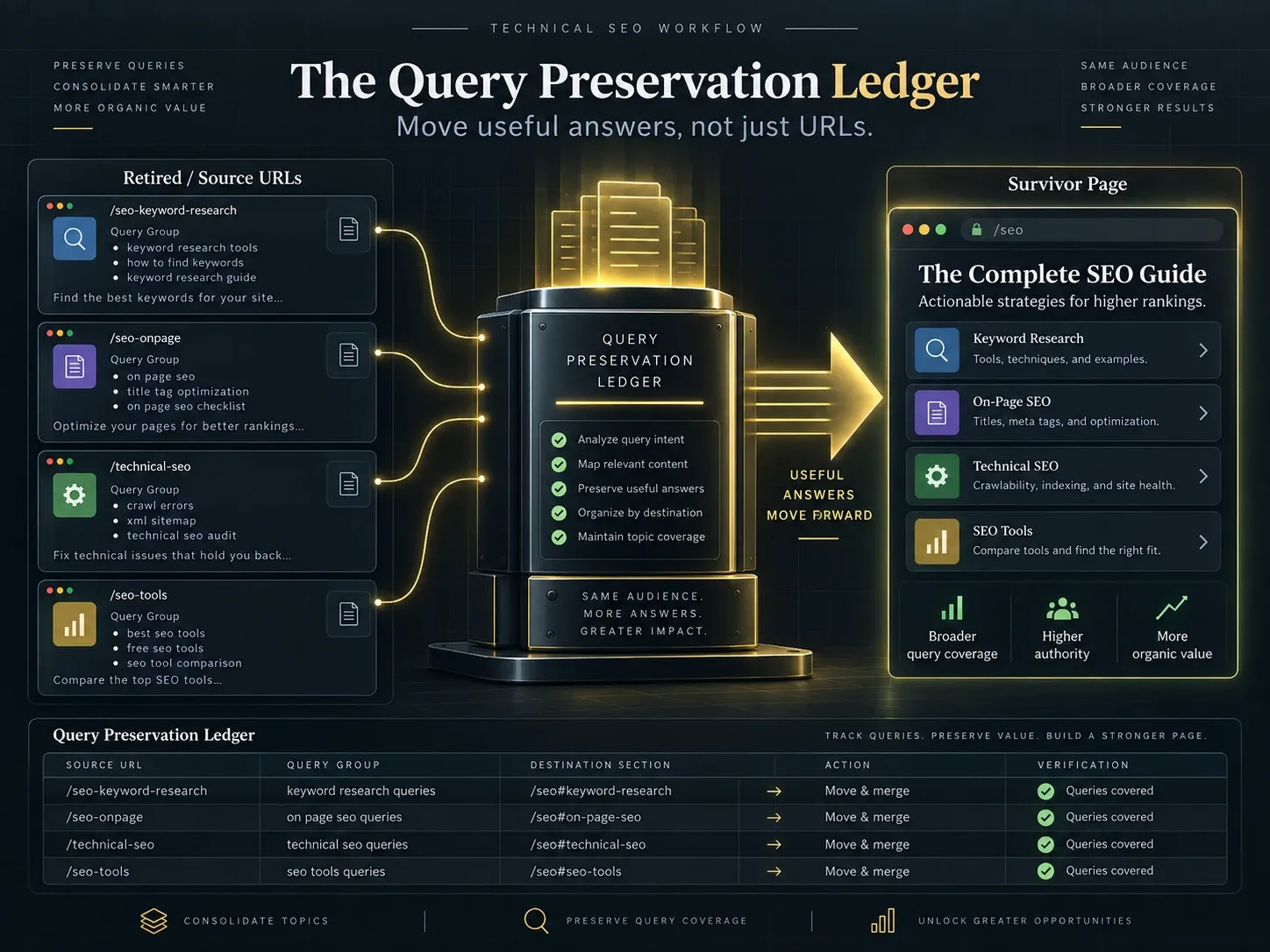
The ledger is the main defense against losing long-tail coverage.
| Source URL | Query group | Useful evidence or answer | Existing section | Destination section | Action | Verification |
|---|---|---|---|---|---|---|
/guide-a/ |
setup | Required sequence | Setup | Implementation | Rewrite and retain | Editor |
/guide-b/ |
error state | Diagnostic table | Troubleshooting | Failure modes | Merge | SEO reviewer |
/guide-c/ |
comparison | Selection criteria | Comparison | Decision matrix | Retain table | Product owner |
These rows are templates, not case-study results. Replace them with your own URLs and exported queries.
Record more than text. A source may contain a diagram, downloadable file, product comparison, calculator, user comments, citations or a conversion path. If that asset helped the page satisfy its task, either move it or document why it is no longer required.
Remove:
- repeated introductions;
- obsolete facts and screenshots;
- claims that conflict with current primary sources;
- sections that target a different task;
- internal links that only made sense in the old structure.
Preserve:
- unique steps and failure conditions;
- definitions needed by the combined audience;
- evidence and limitations;
- links that continue the same journey;
- passages associated with query groups the survivor does not yet cover.
How to Build and QA the Surviving Page
The destination must be complete before the sources stop serving content.
Use this editorial gate:
- the opening gives one direct answer to the shared task;
- every retained query group has a specific section;
- contradictory source advice has been resolved;
- repeated material has been compressed;
- unique examples and assets still work;
- the title and headings match the consolidated scope;
- the page has a self-referencing canonical;
- the final URL returns
200; - the page is indexable;
- links and forms complete the expected user task;
- mobile and desktop layouts preserve tables, code and controls.
Keep the survivor’s URL when it already has a durable path. Changing it during the consolidation adds another migration and makes the before-and-after comparison less clear.
A content diff belongs in the release record. Reviewers should be able to trace each important source section to its new location or see a reason for deletion. This is much stronger than approving a large new draft from memory.
How to Create a Source-to-Final Redirect Map
Every retired URL needs an explicit outcome.
| Source class | Correct outcome |
|---|---|
| Content fully merged into survivor | 301 or 308 to survivor |
| Direct successor exists | Permanent redirect to exact successor |
| No relevant replacement | 404 or 410 |
| Page still serves a distinct task | Keep live and self-canonical |
| Temporary route | 302 or 307, with an end condition |
| Parameter duplicate | Canonical or routing rule based on actual application behavior |
Google’s site-move guidance says several old URLs can redirect to one new page when that page genuinely consolidates their content. The same guidance warns against sending many unrelated URLs to a homepage because those responses can be treated as soft 404s. Use the 404, 410, or redirect decision policy when a source has no relevant replacement, and the HTTP redirect code guide when request semantics affect the permanent status.
A redirect map should include:
source_url
target_url
status_code
content_match_reason
query_handling
rule_owner
prelaunch_result
production_result
final_status
final_canonical
last_checked
Avoid:
- source A to source B to the survivor;
- broad wildcards that catch unrelated pages;
- parameters copied without deciding whether they change content;
- a destination that returns another redirect;
- locale pages sent across markets without equivalent content;
- retired URLs left in XML sitemaps.
Use 301 for normal permanent page moves. Use 308 when the request method and body must be preserved. Public editorial pages normally receive GET requests, so method preservation rarely decides the content consolidation itself.
How to Align Canonicals, Sitemaps, Internal Links, and Hreflang
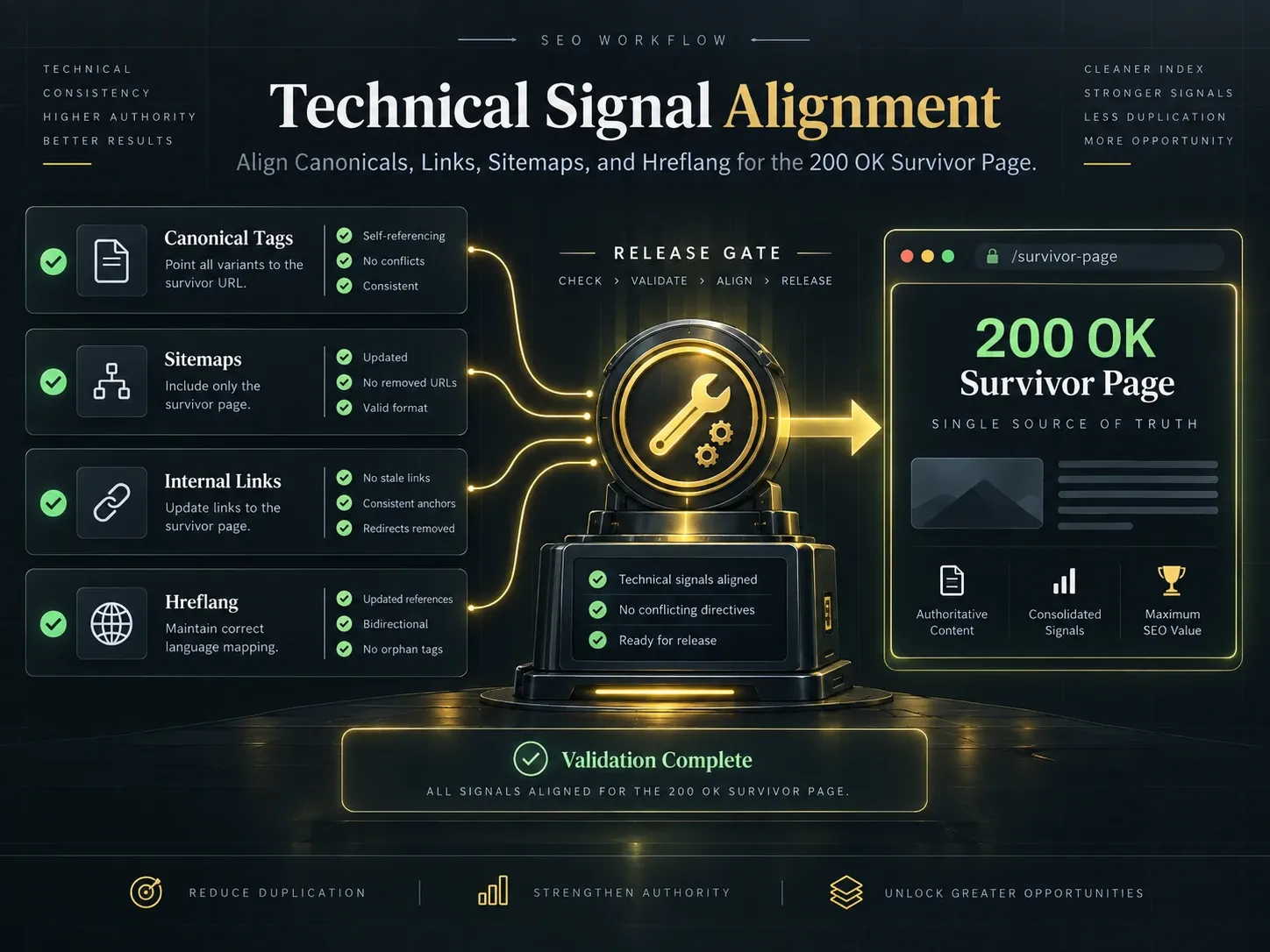
The live site should reference the survivor directly. The redirect exists for old links, bookmarks and crawl history. The canonical-versus-redirect guide explains why the surviving page should self-canonicalize while retired URLs redirect.
Update in the same release:
- navigation and breadcrumbs;
- contextual links;
- XML sitemaps;
- canonical tags;
- hreflang annotations;
- structured-data URLs;
- RSS, product and merchant feeds;
- paid and email campaign destinations;
- downloadable documents that you control.
For hreflang clusters, make the decision per language or region. If English pages A and B merge but the French versions remain distinct, do not copy the English redirect map across the entire locale structure. Each alternate should point to a canonical, indexable equivalent in its own market.
Do not leave a retired URL in the sitemap to help Google find the redirect. Sitemaps state which URLs you want indexed. Server logs, external links and previous crawl history can expose the redirect source.
Required Release Artifacts for Each Team
A consolidation often fails at the handoff between content, SEO and engineering. Assign deliverables:
| Owner | Required artifact |
|---|---|
| Content editor | Query preservation ledger and content diff |
| SEO reviewer | Survivor decision record and signal audit |
| Developer | Redirect map and deployed rule owner |
| Analytics owner | Baseline, annotation and report definition |
| QA | URL variant matrix and production evidence |
| Product or legal owner | Approval for changed conversions, claims or market rules |
One person can hold several roles on a small site. The artifacts still matter because they define what must be checked.
How to Validate Every Retired URL in Production
Use the batch link checker or a GET request that records response headers. For platform-specific deployment, use the URL redirect implementation guide.
curl -sS -D - -o /dev/null "https://example.com/retired-page/"
curl -sS -L -D - -o /dev/null "https://example.com/retired-page/"
Record these conditions for every mapped source:
- The first response is the approved permanent code.
Locationnames the approved destination.- The source reaches the target in one hop.
- The final response is
200. - The final page is indexable.
- Its canonical names the final URL.
- The site no longer links to the retired source.
Test variants that can bypass or duplicate a rule:
HTTP and HTTPS
preferred and alternate host
with and without trailing slash
known uppercase paths
encoded characters
content-changing parameters
tracking parameters
historical file extensions
Do not lowercase paths automatically. A case-sensitive server can treat /Guide and /guide as different resources.
How to Measure Consolidated Query Groups
Retired URLs should lose impressions and indexed status. That is expected. The useful question is whether their tasks and demand move to the survivor.
Build a prelaunch baseline with:
- each source URL’s query groups;
- total clicks and impressions for the group;
- the survivor’s existing coverage;
- conversion or key-action counts;
- referring domains and important referral paths;
- internal links to each source;
- crawl requests to source variants.
After launch, track:
- the survivor’s coverage for the combined query groups;
- queries that disappear rather than transfer;
- final URL indexing and Google-selected canonical;
- requests to retired sources;
- unmapped 404s;
- redirect chains;
- conversions or downstream actions.
Use the same Search Console search type, country, device and date logic in both periods. Annotate the release. Seasonality, SERP changes and content edits prevent a redirect from being the only possible cause of movement.
When a query group drops, compare the old answer with the current destination. A missing paragraph, table, example or title distinction is a content defect. Changing the redirect again will not restore information that the survivor no longer contains.
What Indexora’s Redirect Study Proves and Does Not Prove
Indexora’s 22-day root-to-www study observed a host consolidation, not a content-page merger. It used two Search Console properties, Google crawl statistics and about 5,200 referring links. The retiring host recorded 19.2K crawl requests at a 313 ms average response time during the observation window. The destination recorded 20.6K requests at 259 ms, while its rolling 28-day Search Console view showed 8.23K clicks and 70.2K impressions.
The study supports the redirect validation method: establish a baseline, map one source to one final destination, inspect both properties and watch crawl demand. It does not prove that merging two articles preserves every query, fixes keyword cannibalization or improves rankings. This page therefore treats query preservation as a separate editorial measurement problem.
When 301 Page Consolidation Is the Wrong Fix
Keep pages separate when:
- one query is informational and the other is transactional;
- a tool and its documentation serve different actions;
- countries require different offers, availability or legal language;
- product variants have distinct demand and substantial content;
- a short reference and a long tutorial are both useful;
- pagination pages expose different items;
- filtered categories are intentional search landing pages;
- one page is for developers and another for nontechnical users;
- a temporary campaign must expire without replacing an evergreen page.
Other remedies may work better:
- rewrite titles and headings to clarify scope;
- remove repeated sections while keeping both URLs;
- add contextual links between complementary pages;
- change internal anchor text;
- self-canonicalize both distinct pages;
- noindex a utility page that must remain accessible but has no search role;
- improve one page without redirecting the other.
How to Consolidate SEO Pages Without Losing Query Coverage
The decision is editorial before it is technical. Prove that the pages satisfy the same task, select a durable survivor, map every useful query and asset, and publish the complete destination before redirecting anything. Then use a direct permanent route and make every internal signal name the same URL. Measure the combined query groups and user actions, not the expected disappearance of the retired pages.
Frequently Asked Questions About SEO Page Consolidation
Should the Page With More Traffic Always Survive?
No. Current visibility is one input. URL durability, conversion value, content completeness, links, market constraints and future ownership can make another URL the better destination. Record the reason.
Can Five Old Articles Redirect to One Guide?
Yes, if the guide contains their useful content and completes the same search task. If the articles served different tasks, a shared target becomes a dumping ground.
Should a Source Canonicalize to the Survivor Before the Redirect Launches?
A staged canonical can create an unnecessary mixed state. Prepare the survivor and launch the content, redirect, sitemap and link changes together when practical. The final survivor should self-canonicalize.
How Long Should Permanent Consolidation Redirects Remain?
Google recommends keeping site-move redirects for at least one year and notes that longer retention helps users who follow old links. Stable page-level redirects can remain longer when old URLs still receive requests and maintenance cost is low.
What If Only Half of a Source Page Fits the Survivor?
Move the shared material and keep the source if its remaining task is still useful. A partial overlap is not enough reason to erase a distinct page.