
GIndexa’s Search Console property averaged position 64.21 in one four-week Web window. On a particular query and page, it averaged 19.57. Neither number is wrong. They describe different groups of impressions, which is why a sitewide “average rank” headline rarely tells an editor what to do.
SEO position becomes useful when you pin down the query, landing page, country, device, and dates. Read impressions and clicks beside it. The average records where a result appeared for those impressions. It cannot promise that every searcher saw the page in the same place.
What Search Console’s Average Position Actually Counts
Google defines position from the topmost link to your property on a result page and averages it across impressions in the selected report. The definition varies by result type. The official explanation also notes that scrolling or result layout can affect when an impression is counted. Do not equate the metric with a clean list of ten blue links.
The property chart blends every eligible query and page. Add a query filter, then a page filter, and you can ask, “How did this URL appear for this search task?” You are still looking at an average across observed impressions. A rank tracker checking once a day samples something else.
Imagine a hypothetical page that gets nine impressions at position 2 and one at position 20. Its simple impression-weighted mean is 3.8. A rank tracker that checks one search at noon could record 20 or 2. Neither instrument is inherently broken. They sampled different events. The actual Search Console calculation has additional result-type rules, so use the example only to understand why mix matters.
A high position does not guarantee clicks. The result page might answer the question before anyone visits a site, or the title link may promise the wrong answer. A lower result can still win a click from someone with a specific task. Look at the query, landing page, and visible results before diagnosing CTR.
See the Distribution Behind One Property Average
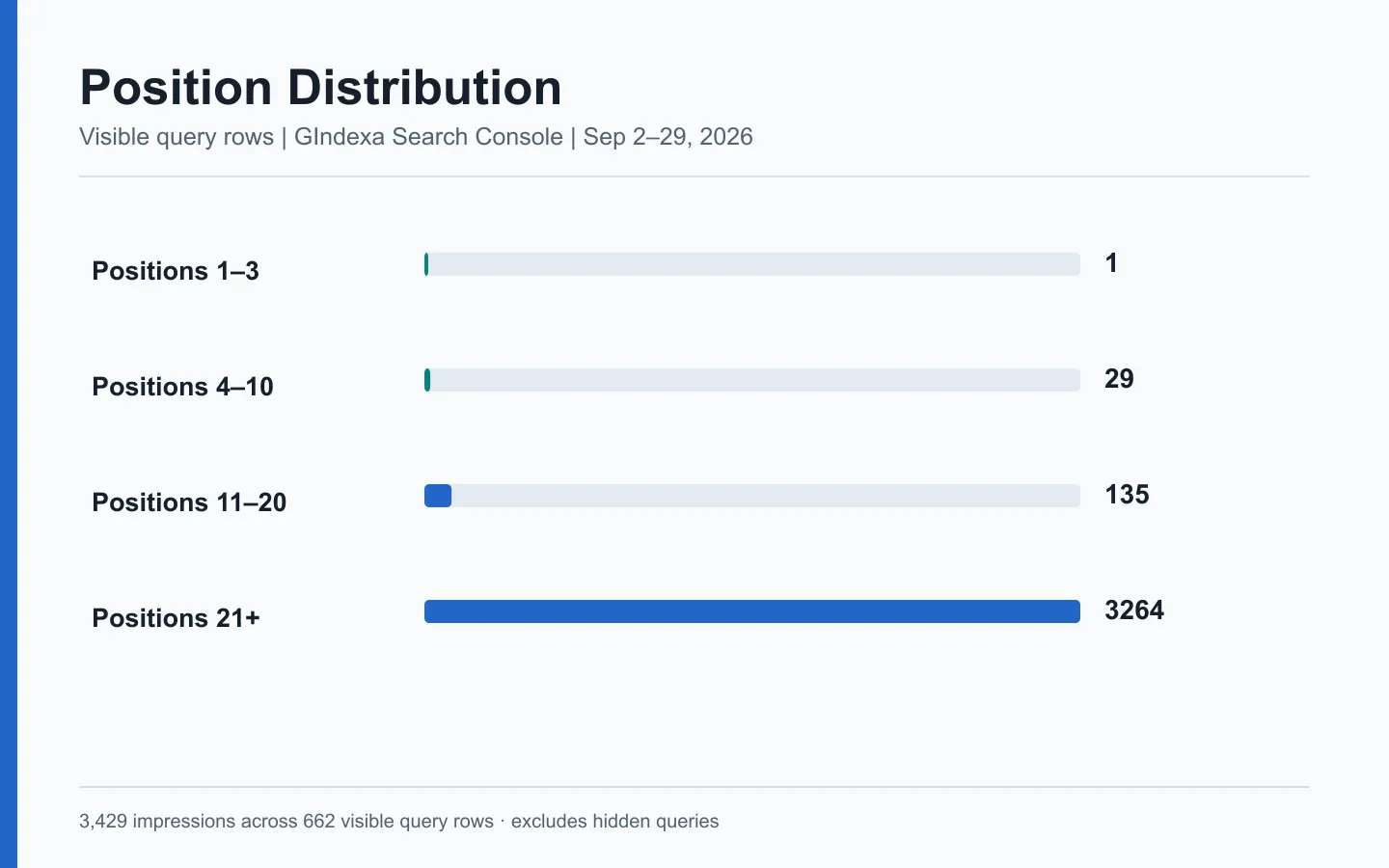
For September 2-29, 2026, GIndexa’s Web property recorded 3,748 impressions, 15 clicks, and 64.21 average position. The visible query export contained 662 rows, 3,429 impressions, and eight clicks. Within that visible subset, rows averaging positions 1-3 accounted for one impression. Positions 4-10 accounted for 29. Positions 11-20 accounted for 135. Rows beyond position 20 accounted for 3,264.
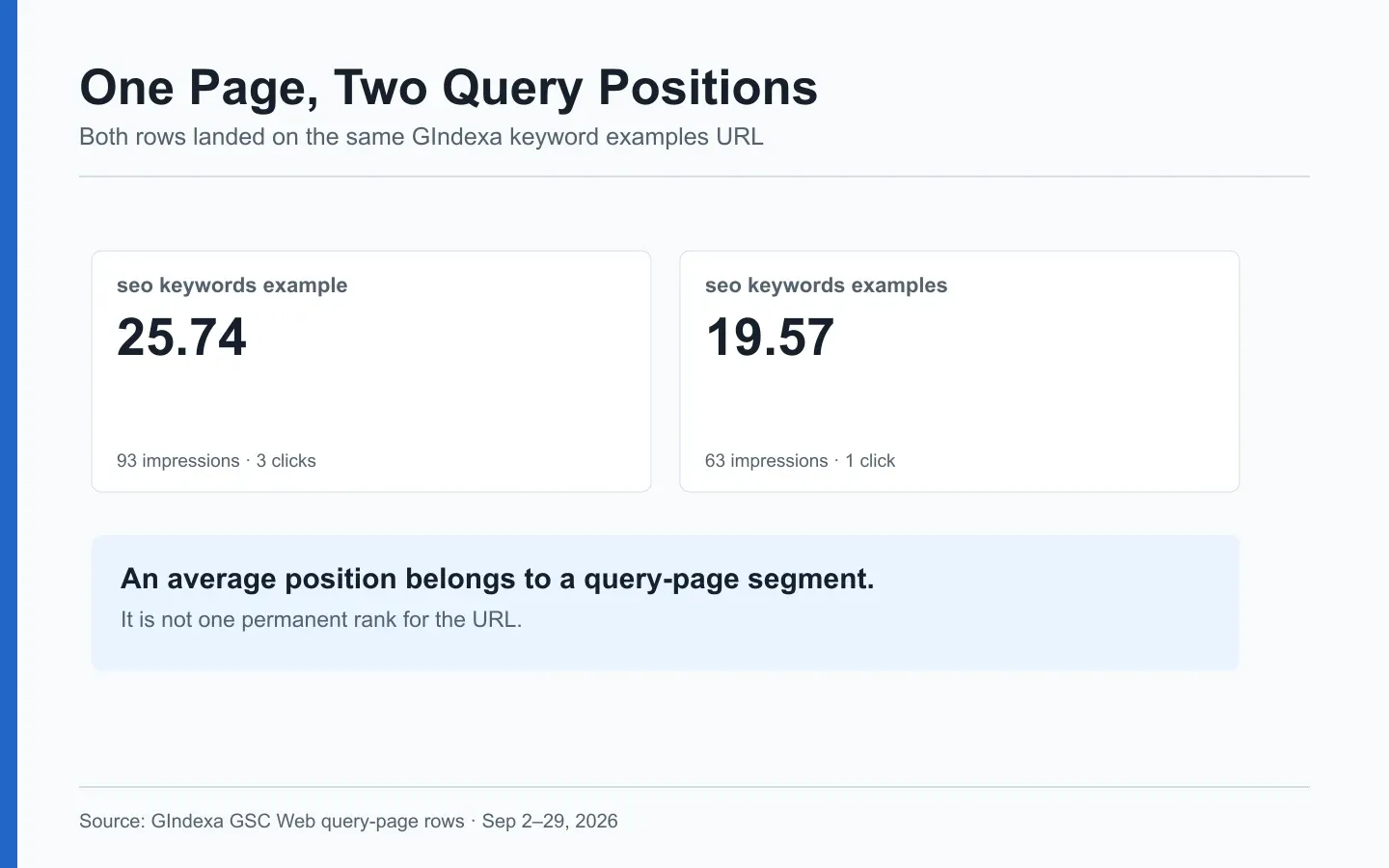
Source: GIndexa Search Console Web query-page rows, September 2-29, 2026. The figure compares two variants on the same landing page.
The bands are our editorial grouping of row averages, not Google’s official rank buckets and not a count of exact SERP positions. They show why the property mean sits far from page-one territory for the visible query mix. They cannot tell us the rank of every impression. Query rows omit anonymized queries, so their clicks and impressions do not reconcile to the property totals. The Performance report documentation explains the table limits.
When you present those bands, label the chart “impressions grouped by query-row average position.” Calling them “impressions at rank 21+” would claim a precision the export does not contain. That small label change matters when someone uses the chart to forecast clicks.
Where would we spend an hour first? Relevant query-page rows averaging 11-20 may merit an answer or title review. A historical /tools/redirect-checker/ URL had 1,330 impressions at 87.52 average position in the same window. That calls for a URL and indexing check before copy work. The Search Console row does not establish that the old path is today’s canonical tool URL.
Keep the Query and Landing Page Together
A query-only rank report hides which URL received the impression. Keep the landing page in the export. If two URLs share a query, you can then inspect whether they answer distinct tasks, redirect to one another, or compete for the same task.
For GIndexa’s SEO keyword examples article, seo keywords example produced 93 impressions, three clicks, and 25.74 average position. The plural seo keywords examples produced 63 impressions, one click, and 19.57 average position. Those numbers do not prove singular users have a different intent. Both rows point to the same examples page and ask a closely related task. They do show that one property average would conceal different query performance.
If two pages repeatedly alternate for the same task, inspect their actual answers and canonical choices. Consolidate when they substantially duplicate the answer. Keep both when the task and result expectations differ. The decision follows the SERP and page job, not a rule that every keyword deserves a URL. The keyword opportunity workflow adds a practical grouping process.
A page filter also lets you separate a real change from a portfolio shift. If a new article enters the property with many low-position impressions, the property average can worsen while an older target page improves. Report both the property trend and a fixed page cohort. Never tell a page owner that their page fell solely because the property mean rose numerically.
Build an Apples-to-Apples Position Comparison
Use equal date lengths and allow the newest data to settle. Fix search type, country, device, query rule, and page rule. Compare the same query-page cohort in both periods. Then show impressions, clicks, CTR, and average position together. A position movement supported by two impressions deserves a different tone from one supported by hundreds.
In the work table, keep the query and landing page next to country and device. Add current and prior impressions, clicks, and position, then a SERP note and action. Leave missing rows visible. If a query appears in one period only, mark it as newly observed or absent. There is no rank gain to calculate from a blank cell.
| Observed pattern | Why it may happen | Next check |
|---|---|---|
| Position improves, impressions drop | Fewer low-position impressions remain in the average | Compare query-row counts and demand patterns |
| Position worsens, clicks rise | More broad queries enter at lower positions while strong rows still click | Split new and established query cohorts |
| Position holds, CTR falls | Result layout, title link, or competitor offer changes | Inspect a dated SERP and page promise |
| Position changes on one device only | Query mix or mobile layout differs | Match query-page rows by device |
| Tool rank and GSC position disagree | Snapshot location and time differ from impression sample | Align location, device, and query spelling |
Google’s comparison controls help define a view, but exports make it easier to verify cohort membership. Save your filter rules with the file. If a regex was changed, the comparison is a new definition and should carry a new label.
Check the Search Result Before Assigning a Rank Ticket
The same numerical position can represent very different visibility. Ads, local results, images, video blocks, shopping units, and AI features can change what appears above or around a page. A position average does not describe those elements. Google’s visual elements guide is the reference for naming what you see, while a dated capture documents what actually appeared for your test.
Record exact query, device, location, date, and whether the target URL appeared. Note the title link and surrounding features. A single manual search is a diagnostic observation, not proof of what every user saw throughout the month. For a recurring query panel, sample at a consistent cadence and store both the result and the GSC row. The SERP meaning guide explains the result anatomy. The SERP feature tracker gives a measurement protocol.
If the page appears at an acceptable position but does not get clicks, compare the snippet promise with the page’s answer. If the page is absent from the observed SERP, check the chosen location and device, query spelling, and current index state. Do not rewrite content based on one personalized search.
Decide What the Position Data Can Support
A rank finding needs its sample size. An illustrative statement would be: “Nine of 12 matched query-page rows with at least 20 impressions in both periods improved.” A colleague can inspect those rows. “Rankings are up” gives them nothing to verify. Choose the impression threshold before you know which rows won.
The GIndexa baseline supports a narrow statement: most impressions in the visible query export belonged to rows averaging below the top 20 positions. The keyword examples variants are worth inspecting. We have no controlled before-and-after test that credits an edit with a lift, and no revenue data that prices it. The report should leave those fields open and name the next check.
Move from position to a page decision only when the query is relevant and the page has a plausible answer gap or technical issue. The SEO visibility guide covers the exposure side. Put both observations in the reporting work queue with the URL and a check someone can own.
Frequently Asked Questions About SEO Position
Why Can an Average Position Improve After a Page Loses Impressions?
The low-position impressions may have disappeared, leaving a smaller set of stronger impressions to average. Compare the query-page cohort and impression count in both periods. Do not celebrate the mean until you know whether useful exposure survived.
How Should I Handle Queries That Appear in Only One Comparison Period?
Mark them as new or missing observations. Do not assign a numeric rank change from an absent row to the current position. Review reporting thresholds, anonymization, and query relevance before calling the difference a win or loss.
Does a Position of 1 Mean My Result Was at the Top of the Screen?
It means Search Console recorded the topmost link to your property at position 1 under its result-type counting rules. Other elements can still occupy screen space, and a single average hides variation. Pair the number with a dated SERP observation when screen placement matters.
How Do I Reconcile a Rank Tracker With Search Console?
Align query spelling, country, city, device, and date first. Then distinguish the tracker’s snapshot from Search Console’s impression-weighted observations. Keep both with their methods attached. A mismatch is often a sampling difference, not a faulty instrument.
Can Multiple URLs From My Site Distort the Property Average?
Yes. Property-level position is based on the topmost link to the property, while page-level views refer to a specified URL. Compare property and page views before diagnosing cannibalization. Export the query-page rows to see which URL actually received impressions.
When Should I Use a Median or Position Band Instead of a Mean?
Use bands or a median of matched query-page rows when you want to show distribution, but label the calculation as your own. The row averages are not individual impression positions. Keep Search Console’s official average beside any editorial summary so readers do not confuse the two.
Should I Report a Ranking Gain Without a Click or Lead Gain?
Report the observed position change and its sample size. Then check impressions, CTR, SERP layout, and conversion data separately. A gain can be a useful leading signal, but it is not proof of business impact without a linked outcome.