
SEO keywords are the words and phrases people search for, such as “how to find keywords,” “best keyword research tools,” or “buy running shoes.” A useful example connects the phrase to the reader’s task and the page that can help them complete it.
SEO Keyword Examples at a Glance
| Example keyword | What the searcher wants | Suitable page |
|---|---|---|
| how to find keywords for a website | A research process | Step-by-step blog guide |
| seo keyword list example | A sample list to adapt | Examples article with a downloadable list |
| best keyword research tools | A comparison before choosing | Tested tool comparison |
| google search console login | A specific website | Official login page |
| buy running shoes | Products to purchase | Shop category or product page |
| emergency plumber austin | A local service they can contact | Service page for the area actually served |
| free redirect checker | A tool to run now | Working redirect tool |
These opening examples illustrate intent; they are not search-volume estimates. The downloadable dataset below contains 100 terms from our September 2026 research, with US volume, difficulty and page-type suggestions.
Download the free 100-keyword CSV · See examples by page type
What Counts as an SEO Keyword
A keyword is any word or phrase a person enters into a search box. It can be one word or a full question. Understanding keywords starts with a simple truth: the phrase is a stand-in for a need, and your job is to answer that need better than the pages already ranking.
A keyword is not the same as a topic. A topic is the whole subject, and a keyword is one doorway into it. “Keyword research” is a topic. “How to do keyword research for a new blog” is one keyword-sized doorway into that topic. You plan pages around topics and target specific keywords within them, which keeps a page focused instead of trying to answer everything at once.
Broad terms often leave the task unclear. A more specific phrase can reveal the format a reader needs, but length alone does not tell you its volume, difficulty or conversion potential. Check the search results and your own audience before choosing a target.
The table below shows how one topic stretches from a broad head term to an exact long-tail phrase.
| Example keyword | Type | Why it behaves this way |
|---|---|---|
| seo | Head term | Huge demand, unclear intent, very hard to rank |
| keyword research | Body term | Clear topic, still broad and competitive |
| how to do keyword research for a new blog | Long-tail | Specific task, a guide can win it |
| do colleges use ai detectors | Specific question | Wants an explanation of college practices |
| free pdf ocr translate eng to kor | Specific tool request | Wants OCR and English-to-Korean translation |
Download a 100-Keyword List With Research Metrics
The dataset combines two US keyword screens: our SEO research and an anonymized AI-tools client screen. Each row includes an intent label, use case, suggested page type, Semrush volume, difficulty and CPC estimates, and the source screen. Metrics are a September 2026 snapshot, not a live feed or a forecast of traffic to your site. The selection covers these two niches; it is not a representative sample of all searches. Recheck the current results before adopting a page-type recommendation.
Use the 100-keyword dataset (CSV) to filter by intent or difficulty. It also has three blank scoring columns and a formula for the weighted total. Import it into a spreadsheet and enable formula calculation if your importer treats those cells as text. The tables below show a selection of the rows.
Transactional Keyword Examples
Ready-to-act queries that belong on a product, tool, or signup page.
| Keyword | Use case | Best page type | Volume (US) | KD | CPC (USD) |
|---|---|---|---|---|---|
| transcribe video russian to english | Video to text | Product / tool page | 2,400 | 13 | 0.00 |
| ai video detector | AI video detection | Product / tool page | 1,900 | 15 | 1.89 |
| youtube transcript download | YouTube transcript | Product / tool page | 1,900 | 26 | 0.62 |
| translate in english to hindi sentence pdf | Document translation | Product / tool page | 1,600 | 25 | 0.00 |
| wav files to mp3 converter | File conversion | Product / tool page | 1,600 | 26 | 0.38 |
| college ai detector | AI content detection | Product / tool page | 1,300 | 22 | 0.00 |
| prompt to humanize ai text | AI humanizer | Product / tool page | 590 | 25 | 1.97 |
Commercial Investigation Keyword Examples
Comparison and research queries that reward a review, listicle, or comparison page.
| Keyword | Use case | Best page type | Volume (US) | KD | CPC (USD) |
|---|---|---|---|---|---|
| best free seo tools | SEO tools | Directory / comparison | 5,400 | 32 | 6.65 |
| seo web design | Technical SEO | Technical guide | 2,900 | 26 | 14.07 |
| link building tools | Links and authority | Guide / workflow | 2,900 | 29 | 5.34 |
| search engine ranking reports | SEO measurement | Measurement workflow | 1,900 | 23 | 0.00 |
| seo best practices 2025 | SEO strategy | Guide / framework | 1,600 | 28 | 2.15 |
| best humanizing ai | AI humanizer | Comparison / review | 260 | 22 | 2.07 |
| what is the best ai flashcard generator | Flashcards | Comparison / review | 260 | 20 | 1.17 |
Informational Keyword Examples
Learning queries that a guide, tutorial, or FAQ can win.
| Keyword | Use case | Best page type | Volume (US) | KD | CPC (USD) |
|---|---|---|---|---|---|
| google discover | Publisher SEO | Publisher guide | 6,600 | 38 | 2.54 |
| seo content strategy | Content SEO | Workflow / guide | 4,400 | 29 | 6.22 |
| seo plan | SEO strategy | Guide / framework | 4,400 | 35 | 5.83 |
| mobile seo | Mobile SEO | Technical guide | 4,400 | 33 | 0.00 |
| serps | SERP features | SERP analysis | 3,600 | 22 | 4.40 |
| seo visibility | SEO measurement | Measurement workflow | 3,600 | 31 | 6.06 |
The dataset focuses on non-brand opportunities, so navigational examples are shown separately below. A search for another company’s login normally belongs to its official page; a relevant comparison query may still be worth considering.
Turn a Keyword Into a Content Outline
The dataset does more than sort. Paste any row into the prompt below and it returns an outline that matches the intent, not just the topic. Fill the four braces with values from the sheet.
You are an SEO content strategist. I will give you one keyword, its search intent,
and the page type it should map to. Produce a content outline that matches the intent.

Keyword: {keyword}
Search intent: {informational | commercial investigation | transactional}
Best page type: {guide | comparison | product or tool page}
Audience and product: {one line about your site}

Return:
1. A working title under 60 characters that leads with the keyword.
2. An H1 and 5 to 8 H2 headings that answer the intent, not just the topic.
3. For each H2, one line on what to cover, plus any entity or subtopic to include.
4. Three "people also ask" style questions for an FAQ.
5. One internal link to a page of the opposite intent, with the anchor text to use.
Do not invent statistics. Mark any spot where a real number or screenshot belongs.
A transactional row returns a tool-page outline, while an informational row returns a guide. That is the intent framework doing the work before you write a word.
SEO Keyword Examples by Search Intent
Every query fits one of four intents. Informational searches want to learn. Navigational searches want a specific site. Commercial searches compare options before buying. Transactional searches are ready to act. Intent decides the format that ranks, so a buying query will not reward a glossary page no matter how well it matches the words.
Intent also explains where demand concentrates. A study by SparkToro of 332 million queries found that just over half of searches are informational, about a third are navigational, and roughly 15 percent are commercial. That split tells you most content pages should answer questions well, while a smaller set should target buyers directly.
These examples of SEO keywords group the same set of terms by the intent a searcher carries.
| Intent | Example keywords | Page that tends to win |
|---|---|---|
| Informational | how does seo work, what is a backlink, keyword research checklist, how to use keywords, types of search intent, seo glossary, seo for beginners | Guide, tutorial, or FAQ |
| Navigational | google search console login, semrush pricing, gindexa keyword skills, ahrefs free tools, yoast settings wordpress, google keyword planner login, google trends | Brand or product page |
| Commercial | best keyword research tool, semrush vs ahrefs, cheapest seo software, surfer seo review, keyword tools for small business, best seo software 2026, keyword tool comparison | Comparison, review, or listicle |
| Transactional | buy semrush subscription, keyword tool free trial, seo audit service near me, hire seo consultant, keyword research template download, start free seo trial, seo package pricing | Product, pricing, or signup page |
Read the results page before you commit. If page one for a term shows product listings, Google reads that phrase as commercial, and your how-to draft will struggle there. If it shows guides and a “people also ask” box, the term is informational and rewards depth.
SEO Keyword Examples by Page Type
Intent tells you the job. Page type tells you which page on your site should hold each term. When you assign terms to the right template, you stop two pages from fighting for the same query and you give each page one clear purpose.
The table maps common page types to the keyword examples they should own.
| Page type | Example keywords it should target | Intent it serves |
|---|---|---|
| Homepage | gindexa, gindexa seo lab, gindexa search tools | Navigational |
| Category or collection | keyword research tools, technical seo guides, ai search insights, content seo articles, link building resources | Informational and commercial |
| Product or service | keyword clustering tool, seo audit service, content brief generator, rank tracking software, serp checker | Transactional and commercial |
| Blog guide or tutorial | how to find keywords, keywords for content writing, on-page seo examples, search intent guide, long-tail keyword ideas | Informational |
| Comparison or review | semrush vs ahrefs, best free keyword tools, surfer seo alternative, moz vs ubersuggest, ubersuggest vs semrush | Commercial |
| Local or service area | seo agency austin, seo consultant near me, local seo services chicago, seo company london, local keyword research | Transactional and local |
| FAQ or support | why is my page not indexed, how long does seo take, what is keyword cannibalization, how often to publish blog posts | Informational |
Notice the pattern. A homepage should own the brand, not a broad head term. A product page should hold the phrases a buyer uses at the moment of action. A blog guide is where on-page SEO examples and how-to phrases belong, because a reader there wants to learn and act. Google’s own SEO Starter Guide makes the same point in plain terms: use the words your readers use, and give each piece of content one clear home.
Keyword Categories Beyond Intent: Questions, Modifiers, and Related Terms
Intent and page type do most of the sorting, but a few more keyword categories help you cover a topic in full. Each one adds a different kind of phrase to your plan, and together they catch demand a single head term would miss.
| Category | What it adds | Example keywords |
|---|---|---|
| Long-tail phrase | Often specific and individually lower demand; word count alone is not the definition | how to find low competition keywords, keyword research for a new blog, transcribe video russian to english |
| Question keyword | Who, what, why, how, and often an AI answer | what is search intent, how many keywords per page, why is keyword research important |
| Modifier keyword | Best, cheap, free, near me, a year | best keyword tool 2026, free keyword research, cheap seo services |
| Comparison keyword | Versus, or, alternative | ahrefs vs semrush, moz or ubersuggest, semrush alternative |
| Branded keyword | A brand plus a feature | semrush keyword magic, ahrefs keywords explorer, google keyword planner |
| Related or semantic term | The entities Google expects near a topic | search volume, keyword difficulty, serp analysis, click-through rate |
| Seasonal keyword | Time-bound demand that spikes | black friday seo deals, 2026 keyword trends, holiday content calendar |
Question and modifier phrases deserve extra care in 2026. Question keywords are the ones most likely to trigger an AI answer, so a page that gives a clean, direct reply has a real shot at a citation. Modifier words like “best”, “free”, and “near me” reveal budget and urgency, which is why they read as commercial or transactional even when the root term looks plain. Related terms matter for a different reason. Google reads the concepts around a topic, so a keyword research page that never mentions search volume or keyword difficulty reads as thin, even if the exact head term appears.
How to Choose the Keyword Examples Worth Targeting
A list of 100 phrases is a menu, not a plan. Three questions turn examples into decisions, and they work whether you run a new blog or an established store.
First, does the term match something you sell or explain well? A keyword that misrepresents your page is a liability, because a mismatch between the query and the answer sends readers back to search. Second, can your site realistically compete with the pages already ranking? A new site should start with lower-difficulty long-tail phrases and build authority before chasing head terms. Third, is there real demand and a real reason behind the phrase? A term with modest volume and sharp intent often returns more than a loud head term that never converts.
Score each candidate from one to three on those three questions, then weight the total so business fit counts double. A term you cannot monetize is not worth ranking even when its volume is high, and doubling business fit is what pushes those vanity keywords down the list. The downloadable dataset carries this exact formula in its total column, so you can rank all 100 terms in one sheet.
Here is the weighted score on five real terms, scored for the AI-tools site so business fit means something concrete.
| Keyword | Volume (US) | Business fit (x2) | Odds | Real demand | Weighted total | Verdict |
|---|---|---|---|---|---|---|
| transcribe video russian to english | 2,400 | 3 | 3 | 3 | 12 | Write first |
| college ai detector | 1,300 | 3 | 2 | 3 | 11 | Write |
| prompt to humanize ai text | 590 | 3 | 2 | 2 | 10 | Write |
| best free seo tools | 5,400 | 1 | 1 | 3 | 6 | Cut, off-topic vanity |
| google discover | 6,600 | 1 | 1 | 3 | 6 | Cut, off-topic vanity |
The two highest-volume terms score lowest in this example because they are a weak fit for the AI-tools site. These editorial scores set a work queue; they do not predict rankings or conversions. Another business could reasonably assign different scores.
Our guide on how to build a keyword demand map shows how to group the winners into clusters your site can own, and our keyword research skills collect the tools that make the sorting repeatable.
Check which existing pages already answer each query group. Multiple ranking URLs are not automatically a problem. Investigate when the wrong page keeps appearing or closely overlapping pages alternate without serving distinct needs.
A Worked Example: One Topic, Two Intents, Two Pages
Take a real topic from the client screen: AI detectors, in a college setting. The keywords around it split by intent, and that split decides the pages. All figures are Semrush US estimates from September 2026.
“college ai detector” is transactional. The searcher wants a tool to run right now, so it maps to a product or tool page. It carries 1,300 US searches at a difficulty of 22, which made it a first-priority target. Sitting right beside it are queries built from almost the same words but a different job: “do colleges use ai detectors” at 390 searches and “do college admissions use ai detectors” at 720, both informational at a difficulty of about 20. Those want an explanation, not a tool, so they belong in a supporting article or FAQ.
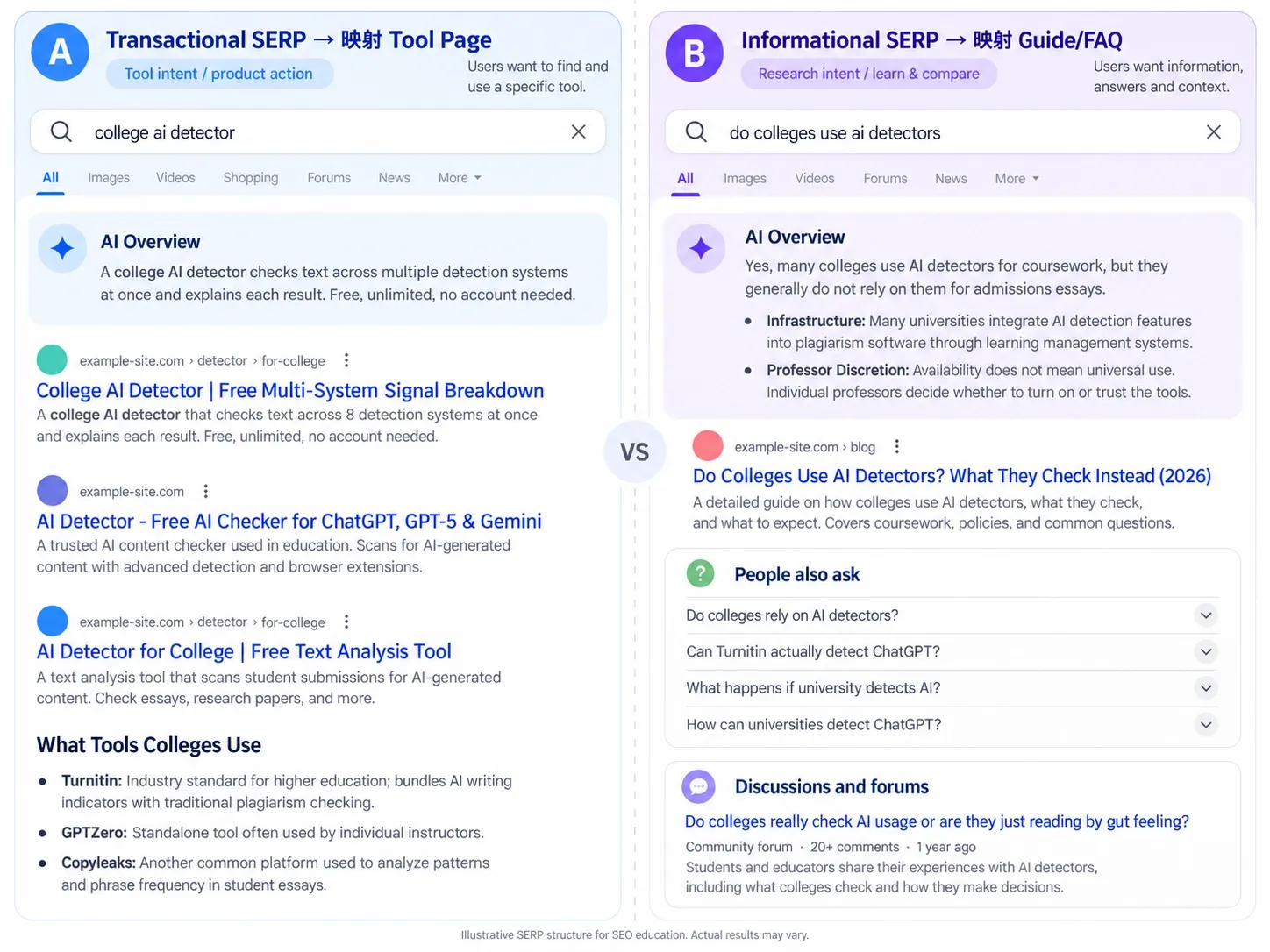
Illustrative SERP structure for the two intents. The transactional query points to a tool page, the informational one to a guide or FAQ. Actual results vary.
In this proposed structure, the tool handles the task and a supporting guide explains college practices. A short question may fit in the tool’s FAQ instead. Split it into a separate page only when readers need a fuller answer and the search results support that format.
The three pages form one small architecture. The tool page is the parent, the two guides are children, and the internal links run both ways with anchors that match each page’s intent.
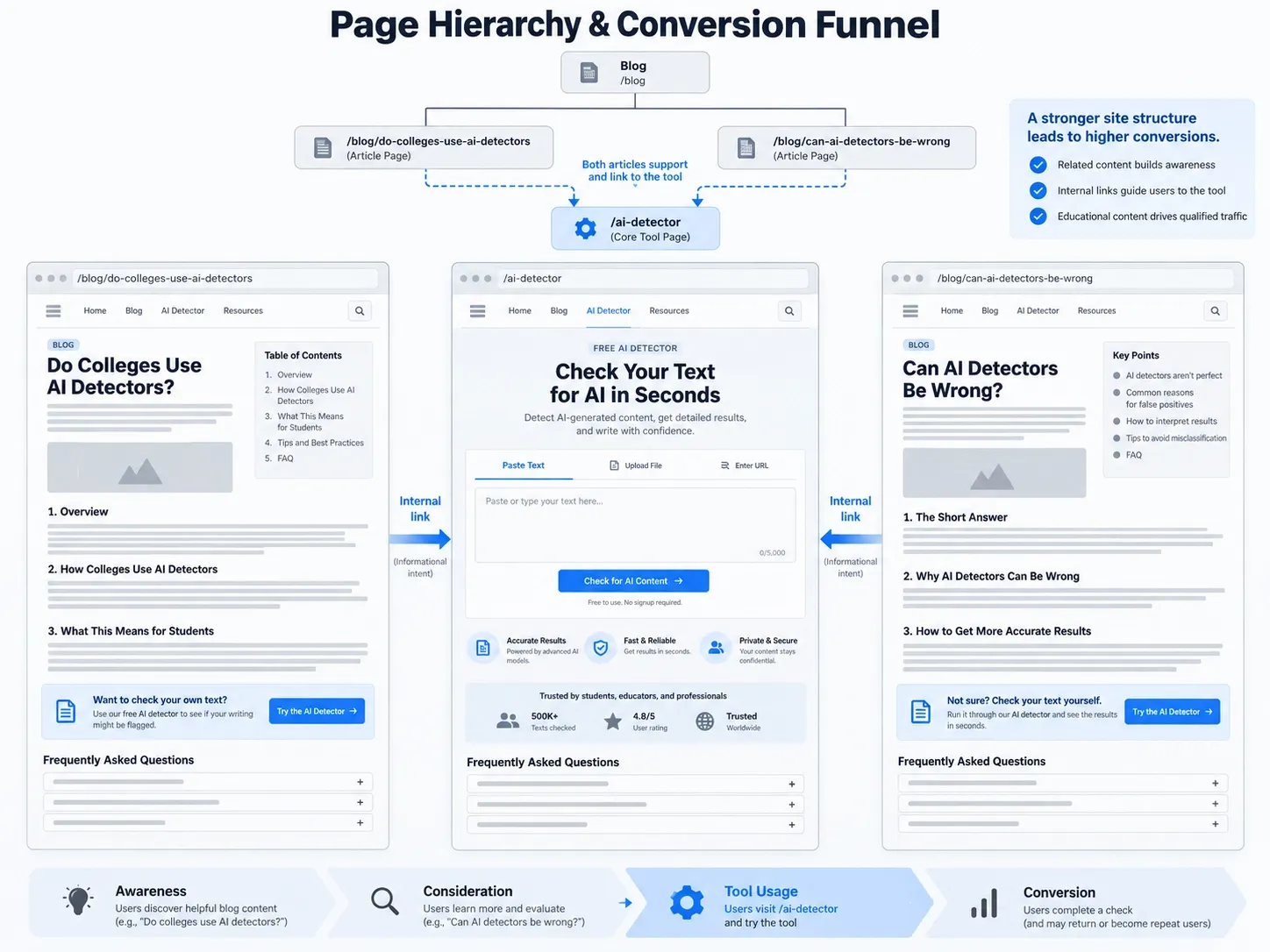
The tool page is the parent, the two guides are children, and internal links run both ways. Educational content builds awareness, then guides users down to the tool.
What to Do When a Keyword’s SERP Mixes Intents
Some terms do not sort cleanly. Search “keyword research tool” and page one mixes product pages, listicles, and how-to guides, because Google is still unsure what most searchers want. A mixed result page is a signal to read, not a problem to fear, and three checks turn it into a decision.
Count the result types on page one first. Whatever format fills the most slots is the intent Google currently favors, so match that format. Then look at the top three results on their own, since they take most of the clicks. When those three share one format, treat the term as that intent even if lower results vary. Last, decide whether the mix earns two pages. If the term draws both a clear buyer and a clear learner in real numbers, build the dominant-intent page first, then a second page for the other intent, and link them.
Intent also drifts over time. “ai detector” leaned informational when the tools were new and now leans transactional as people arrive ready to use one. Re-check the results page each quarter for your money terms, because a page built for last year’s intent slowly stops matching what Google shows.
Turning SEO Keyword Examples Into Ranked Pages
Choose a small set of relevant examples, check their current results and assign each group to an existing or planned page. For the next step, follow the keyword mapping and publishing workflow. Once a page has an assigned topic, use the keyword placement guide to write its title, headings and body naturally.
Frequently Asked Questions About SEO Keyword Examples
How Many Keywords Should One Page Target?
One primary intent, not one keyword. A strong page naturally ranks for dozens of related phrases that share the same need, so you write for the topic and let the variations follow. Split into a second page only when a phrase points to a clearly different intent, such as a buying query next to a how-to question.
Are Head Terms or Long-Tail Keywords Better for a New Site?
Neither type wins automatically. A specific query can reveal a clearer task, but it can still have strong competitors. A young site should keep broad category pages where they serve a real need, then add focused pages for distinct narrower tasks after checking the current results. Our long-tail versus short-tail guide shows the page-mapping decision.
Do Exact-Match Keywords Still Matter in 2026?
Placement matters more than exact repetition. Google reads meaning and related entities now, so a page can rank for a phrase it never states word for word. Use the searcher’s actual terms once or twice where they read naturally, then cover the topic in full rather than repeating one string.
How Do I Know a Keyword’s Intent Without a Tool?
Search it and read page one. The formats Google shows reveal the intent it assigns. Product listings mean commercial or transactional, guides and a “people also ask” box mean informational, and a single brand result means navigational. That live check beats any label a tool prints next to the phrase.
How Do I Revamp an Old Article When Its Keyword Drifts From Informational to Transactional?
When a term you rank for starts showing product and tool results, Google has re-read its intent, and your explainer will slide no matter how good it is. Do not delete the page, split it. Keep the article for the “what” and “why” versions of the query it still earns, then build a separate transactional page, a tool, product, or comparison, for the buying version, and link the article up to it with an anchor that names the action. Move any commercial subsections off the old page so each page serves one intent. Watch Search Console for about four weeks after the split, since the two pages trade impressions before they settle.
How Do I Tell a Vanity Keyword From a Winnable One?
Score it against your business, not the volume chart. A vanity keyword pairs big numbers with a weak fit: high volume, high difficulty, and little tie to what you sell or convert. Run it through the weighted score above, and if business fit is a 1, no amount of volume saves it. Ranking for a term you cannot monetize spends effort you could have put on a smaller term that pays, which is why the 6,600-volume term that scored a 6 lost to the 1,300-volume term that scored an 11.