
Start with the searcher’s task, then choose a phrase. A broad page can serve broad exploration; a focused page can answer a specific need. “Medium-tail” is a useful planning label between the two, but it has no fixed Google classification. Word count helps sort candidates. Intent, demand, and the search results help decide which page fits.
What Long-Tail and Short-Tail Keywords Actually Mean
Short-tail usually describes a broad, frequently searched topic such as running shoes. Long-tail describes narrower demand spread across many less common searches, such as how to clean waterproof trail running shoes. A longer phrase often adds context, but it does not prove that demand or competition is low. A two-word query can be niche; a six-word query can still be popular.
People use “long-tail” in two ways. One counts words; the other refers to the long tail of a search-demand distribution. Ahrefs explains its volume-based usage: a long-tail keyword can contain two, three, or ten words. For content planning, track specificity, intent, and observed demand separately. A three-word cutoff will not tell you which page to build.
“Medium-tail” is a useful internal label for a phrase between a broad topic and a narrow need. It has no universal word-count boundary. Here, trail running shoes sits in the middle because it narrows the product category but leaves fit, weather, and use case open.
Long-Tail vs. Short-Tail Keywords in One Worked Example
Imagine an online running shop with category pages, product filters, and a care guide. The queries below are illustrative; they are not search-volume estimates or claims about current rankings.
| Query | Specific need | Suitable page | Why |
|---|---|---|---|
running shoes |
Explore a broad product category | Main running-shoes category | The query can fit many uses and buyers. |
trail running shoes |
Shop a defined type | Trail-running category | It narrows the product set. |
women's waterproof trail running shoes |
Compare products with two constraints | Useful filtered category or dedicated collection | The visitor needs matching products and clear filters. |
how to clean waterproof trail running shoes |
Complete a care task | Care guide | A product grid cannot answer the question. |
The last query calls for a separate page because the task shifts from shopping to cleaning. The first three may need different category views, but word count alone cannot decide that. Check whether the products, page content, and search results actually differ. The broader SEO keyword examples by intent and page type offers another page-map model.
What GIndexa’s Own Query Data Shows
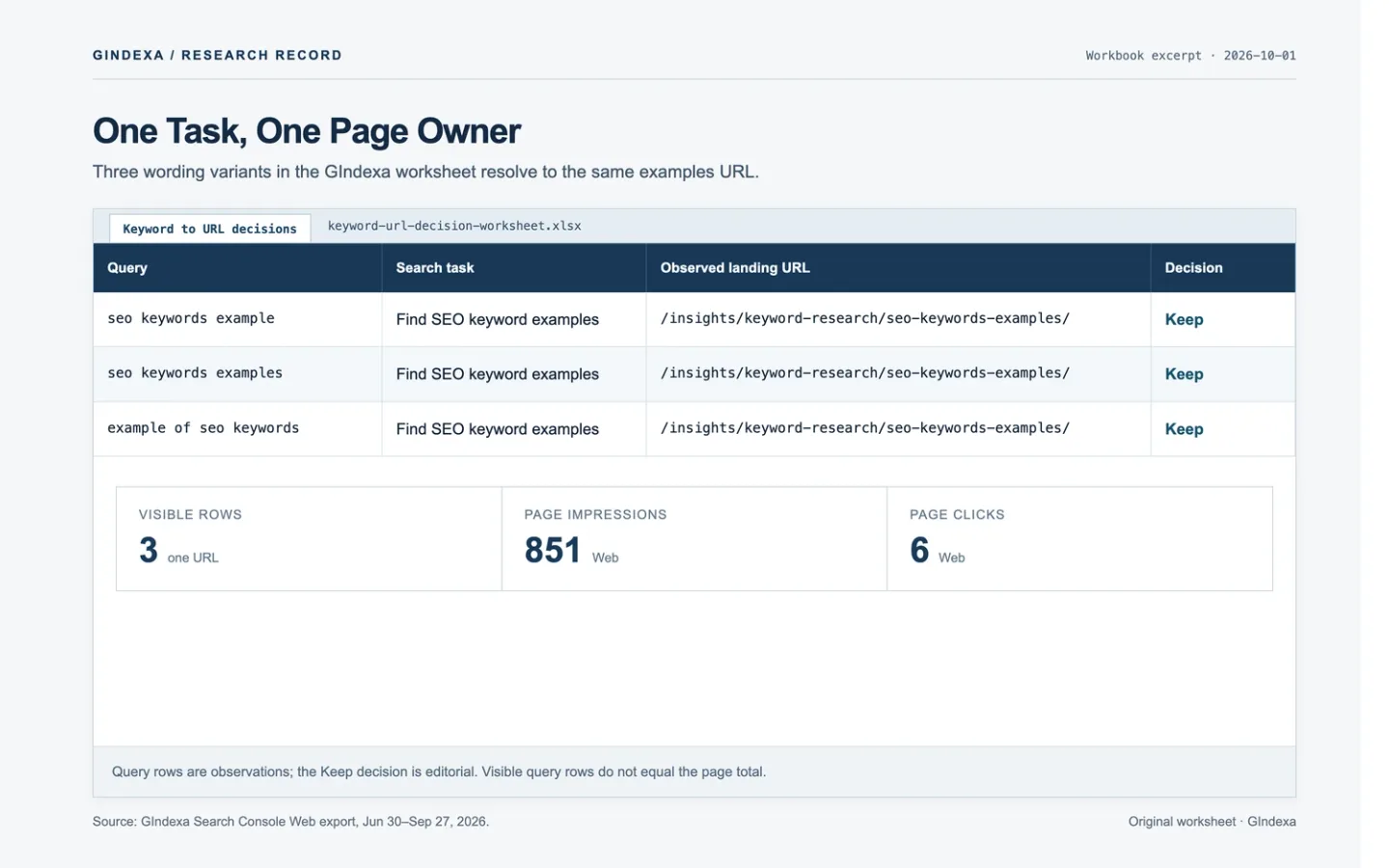
We checked GIndexa’s Search Console Web query-by-page export for June 30–September 27, 2026. During that period, the existing SEO keyword examples page received 851 impressions and 6 clicks at page level. Each query below pointed to that same URL:
| Search query | Impressions | Clicks | Average position | Observed landing page |
|---|---|---|---|---|
seo keywords example |
84 | 3 | 24.68 | SEO keyword examples |
seo keywords examples |
60 | 1 | 19.18 | SEO keyword examples |
example of seo keywords |
45 | 1 | 19.67 | SEO keyword examples |
The singular, plural, and reordered phrases ask for the same thing. Our decision was to keep one examples page and improve its coverage instead of publishing three near-duplicate URLs. In the same export, what to do after keyword research appeared for the separate post-research workflow page with 8 impressions and no clicks. That query asks for a next-step process, so it has a different page owner. These rows show observed query-to-page matches; they do not show that consolidation caused a ranking gain. Search Console can omit anonymized queries, so visible rows may not add up to the page total.
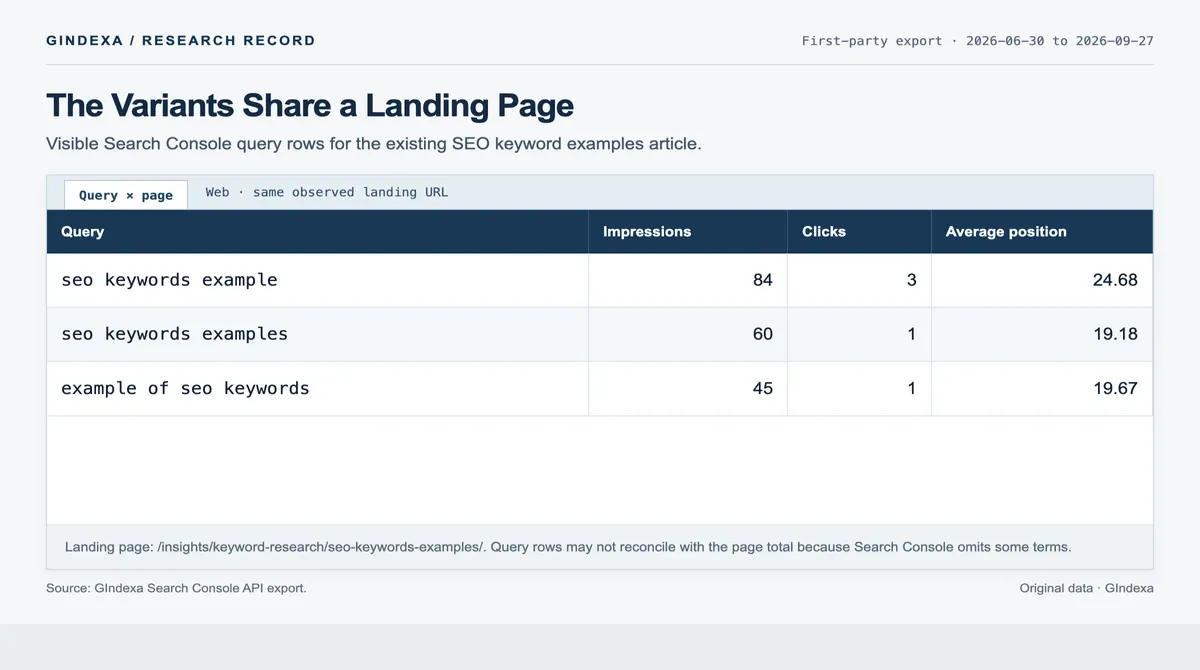
Source: GIndexa Search Console Web query-by-page export, June 30–September 27, 2026. This is a rendered excerpt of our data record; the figures above remain available as text.
Decide Which Keyword Fits the Page’s Job
Before assigning a phrase, describe the page’s job in one sentence: “Help a visitor compare waterproof trail shoes available in their size.” Then search the candidate phrase and note the dominant page types, whether results show product listings or explanations, and which constraints the top pages address. A phrase may look informational in a spreadsheet yet return mostly product pages.
For two phrases with similar word counts, compare results in the same country and language, on the same device, and around the same date. In the worksheet, note the top five result types and any shopping results, local results, discussion threads, or guides. If one query returns product collections and the other returns care guides, they call for different page formats even if they are equally long. Repeat the check before creating a URL; results can vary by location and time.
Use this decision test:
- Same task, same useful answer: Keep the variants on one page.
women's waterproof trail shoesandwaterproof women's trail running shoesusually describe the same shopping task. - Same topic, different decision: Create a separate page only when it serves a distinct product set, comparison, or answer. A care guide has a different job from a category page.
- Unclear or mixed results: Search the phrases before building another URL. “Long-tail” cannot resolve mixed intent by itself.
A new site does not need to avoid broad terms. A category still needs a plain name that describes its products, even if its first supporting guides answer narrower questions. Google recommends using the words people use to search in prominent page locations while keeping the page useful to visitors.
Measure Demand Without Treating a Difficulty Score as a Verdict
Collect estimates for the same country and date, then check the search results and your own Search Console data. Volume and difficulty scores help screen candidates; they cannot tell you whether a page answers the query or matches the format people see in search. Do not add volumes for near-identical phrases and treat the sum as available traffic. One page may rank for several variants, and estimates can overlap.
The October 2026 US keyword export used for this article lists short-tail keywords at 590 estimated monthly searches / difficulty 39, long tail short tail keywords at 320 / 26, and medium tail keywords at 260 / 9. These are three queries in one tool’s snapshot, not universal difficulty scores for each keyword length. The phrase containing “long tail” is not automatically the hardest or easiest.
If your site has Search Console history, inspect each query alongside its landing page. Impressions for a narrow query may point to an update opportunity. A broad query without a matching page may call for a category or overview page. No impressions do not prove there is no demand; check an external source and live results as well.
Group Variants Before Creating More Pages
Start with one row per query. Group phrases when they call for the same answer or product set, then choose one primary page for each group. Give a new URL a distinct job; reordering the same words in a title is not enough.
| Query pair | Decision | Evidence to inspect |
|---|---|---|
long-tail vs short-tail keywords / short-tail vs long-tail keywords |
One comparison page | Same definition and decision task. |
trail running shoes / best trail running shoes for mud |
Check before splitting | Category shopping and comparative advice may call for different pages. |
waterproof trail running shoes / how to clean waterproof trail running shoes |
Separate pages | Product selection and care instructions are different tasks. |
Link a focused page to its useful parent with descriptive text. The parent should link back where a reader needs more detail. These links give readers a route through the topic and help search engines discover the relationship. Google’s link guidance recommends crawlable links and descriptive anchor text. Treat a keyword cluster as a map of pages and tasks, not a quota for near-duplicate articles.
When the Keyword Is an Ecommerce Filter
The page map also affects indexing. A filter can generate hundreds of color, size, and sort URLs, even when only a few combinations deserve search landing pages. Start with distinct demand and product sets, then choose the technical treatment:
| Filter URL’s job | Treatment | Check before implementation |
|---|---|---|
| Stable, useful collection with its own search demand | Allow crawling and indexing; give it a self-referencing canonical and descriptive content | The filtered products and search results differ meaningfully from the parent category. |
| Near-duplicate view that must remain accessible | Point rel="canonical" to the preferred category or collection |
Google treats canonical as a signal, not a guarantee; it does not prevent crawling every combination. |
| Utility-only result that must be excluded from search | Use noindex while the URL remains crawlable |
Googlebot must fetch the page to read noindex; a robots block would hide that directive. |
| Large parameter space with no search value | Prevent crawling of the unwanted patterns | Keep valuable product and collection URLs crawlable; test rules against real URL samples. |
Google’s faceted-navigation guidance recommends preventing crawling when filtered URLs need not appear in Search. It also explains why canonical tags are less effective across large crawl spaces. Google’s canonical guidance reserves canonicalization for duplicate or very similar pages, while its noindex guidance requires crawl access for the directive to work. If Google has already indexed a URL you need removed, let it recrawl the noindex before blocking its crawl path. Applying all three controls to one URL can keep Google from reading the signals you intend it to see.
Run a 20-Minute Keyword Selection Pass
- List the page you already have. Note its audience, task, and the products or answer it can provide.
- Collect ten candidate queries. Use customer wording, site search, Search Console, and one keyword source. Record the country and date for any estimates.
- Group by task. Mark each query as browse, compare, buy, learn, or troubleshoot. Write a more precise task when those labels are too broad.
- Inspect three representative results pages. Compare page types and check whether a query needs a distinct answer or product set.
- Assign one owner URL per task. Update an existing page when it already fits. Create another page when a distinct need remains unanswered.
- Set one measurable check. After publication, review the query-page pair for impressions, clicks, and changes in the queries that page attracts.
Download the keyword-to-URL decision worksheet (XLSX) and open it in Excel or import it into Google Sheets. It contains the three GIndexa query examples above, editable rows, and columns for Query, Intent / Task, Target URL, SERP Match Type, and Keep / Split Decision. Use the evidence fields to record the country, device, and inspection date so another editor can repeat the check. The examples are observations, not a traffic forecast.
Use the seven-step keyword discovery workflow to build an initial list. Once you have one, the keyword-to-publishing plan can help sequence the pages.
Use Long-Tail and Short-Tail Keywords Together
Give broad tasks a page that can serve them, and give a focused page to each distinct narrow need. Connect related pages where readers would naturally move between those tasks. Word count can help sort the list; intent and page fit should settle the choice.
Frequently Asked Questions About Keyword Decisions
What if Near-Identical Queries Appear for Two Different URLs?
Export query × page rows for the same search type, country, device, and settled period. Compare what each page answers and the result types for those queries. If both URLs serve the same task, choose the stronger owner, move any missing material there, and update internal links before considering a redirect. If one page is a product category and the other is a care guide, keep their separate jobs. Two URLs getting impressions is a signal to investigate, not proof of harmful cannibalization.
What if a Filtered Product URL Is Indexed but No Longer Deserves Search Traffic?
First decide whether the URL duplicates a useful collection or serves only as a utility view. For a duplicate, use a canonical signal to the preferred URL and align internal links. If the page should disappear from Search, keep it crawlable while Google reads noindex, and remove it from the sitemap. Blocking the URL in robots.txt first can stop Google from seeing the directive. Check which URLs are already indexed before handling large unwanted filter patterns.
How Do You Estimate Demand When Several Variants May Reach the Same Page?
Group the variants by task and compare their results pages before looking at volume estimates. Record each tool’s country, date, and volume separately; do not sum the estimates into a traffic forecast. For an established site, review the group’s observed Search Console query-to-page rows and the owner’s total clicks over a settled period. Those clicks show current reach, not the market ceiling: missing or anonymized queries and rankings outside the visible range leave uncertainty.
What if a Newly Published Page Has No Impressions for Its Target Phrase?
Check URL Inspection for indexability and Google’s selected canonical, then confirm the page is linked and the date range excludes recent, incomplete days. If the page is indexed, inspect every query landing on that URL. It may appear for related wording while the exact phrase is absent or anonymized. Recheck live results for page-type fit and consult an external demand source before deciding the phrase lacks demand. Record the targeting question as unresolved instead of creating another URL immediately.
What if a Category and a Comparison Guide Both Appear for One Query?
Compare the query’s live result mix with the decision each page helps a reader make. Keep the category for product browsing and the guide for evaluation criteria or trade-offs; link between them when a reader might move from one task to the other. In Search Console, inspect which URL gets each query variant instead of judging from a property total. If both pages give substantially the same answer, combine the duplicated material. Keep a genuinely useful guide canonicalized to its own URL, even when it shares terms with a category.
What if the Same Phrase Has Different Intent by Country or Device?
Segment Search Console by country and device, then inspect representative results in those markets. A mobile-heavy local result and a desktop-heavy research result may call for a different emphasis or a localized offer, but the segment difference alone does not justify duplicate pages. Note the task, available products, language, and observed result types in each segment. Create a separate URL only when it can give a distinct answer or market-specific offer that the existing page cannot.
How Can You Evaluate a Page Split Without Mistaking Seasonal Growth for Success?
Save the pre-split query group and both planned owner URLs. After both pages are indexed, compare equal-length settled periods for the same country and device. Review combined clicks and impressions across the old and new URLs, along with each query-to-page pair. Check whether the new page attracted the intended task or simply moved impressions from the original. If available, compare conversions and a similar unchanged page group. A short before-and-after position change alone is not causal evidence.