
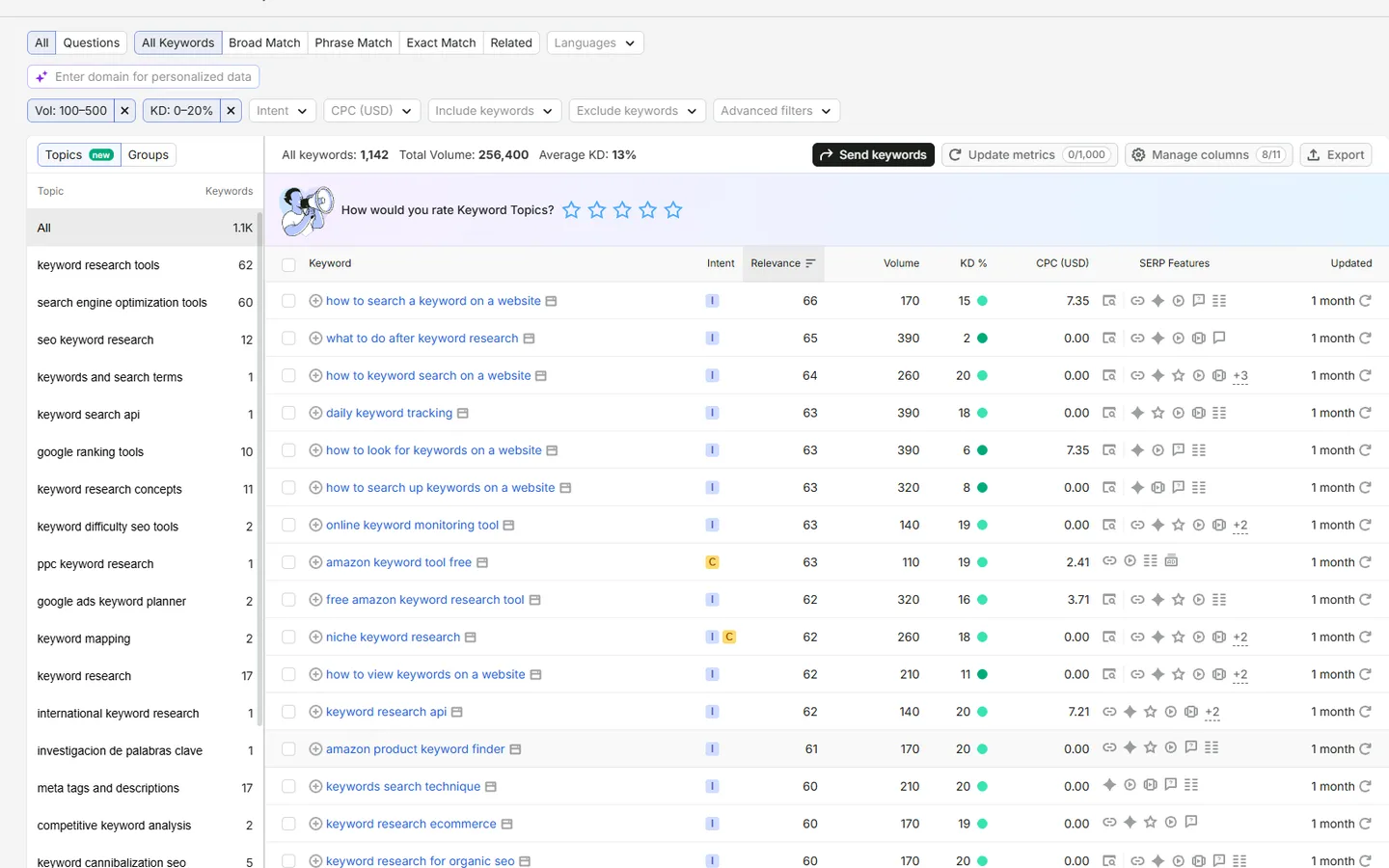
A keyword list used to be the whole job. You pulled a few thousand terms, sorted them by search volume, and wrote a page for the biggest numbers. That method slowly stopped paying off. Google reads the meaning behind a query now, and an AI answer often sits at the top of the page before a reader scrolls. The work moved with it. Good keyword research today means you figure out what people actually want, group those wants into topics your site can own, then check the whole plan against what search really returns.
The demand map in this guide is not a hypothetical. It comes from a real screen we ran in the GIndexa Lab: 1,259 qualified US keywords grouped into 23 clusters, each tied to a pillar term and a target section. We run the same process on client work, where a recent AI-tools screen cut a collected universe down to 87 qualified terms and dropped 199 that failed on difficulty, brand, demand, or intent. Every figure below is a Semrush US estimate.
Why Volume-Based Keyword Research Stopped Working
The volume-first habit had one goal: find a big number and chase it. That worked when Google matched the exact words in a query to the exact words on a page. It does not match that way anymore. The engine reads entities, which are the people, products and concepts a page is about, and it judges whether your page answers the need behind the words.
Two changes hit the old method hardest. First, AI Overviews and chat answers now handle a large share of simple questions right on the results page, so a term with high volume can send far fewer clicks than its number suggests. Second, one page can rank for hundreds of related phrases at once, which makes a one-keyword-per-page plan wasteful.
A quick example shows the gap. “What is a sitemap” might report tens of thousands of searches a month, yet Google answers it in two lines at the top, so the clicks left over are thin and mostly curious readers who never buy. Meanwhile “sitemap not updating in search console” reports a fraction of that volume and pulls in people with a real problem and a reason to trust whoever solves it. The bigger number is the worse target.
The size of that leak is now measurable. A 2025 Pew Research Center study found that when an AI summary appears, searchers click a regular result on about 8 percent of visits, against 15 percent when none shows, and only 1 percent click a source inside the summary. Definition-style queries draw those summaries most, so their real click potential is a fraction of the volume a tool reports. Problem-shaped queries like the sitemap error above still send people looking for a full answer.
So a raw list of high-volume terms tells you less than it used to. A term can look valuable and still lose, because the answer already appears above the links or because ten other phrases share the same intent and belong on the same page. The fix is not a bigger list. The fix is a map of demand that shows what people want and which of your pages should serve each want.
How to Find the Search Intent Behind a Keyword
Every query carries a reason. Someone wants to learn a fact, find a specific site, compare options, or buy. That reason is the search intent, and it decides which page format has a chance to win. A buyer who types “best crm for real estate” does not want a definition, so a glossary page will lose no matter how strong its keyword match looks.
The four classic buckets, informational, navigational, commercial, and transactional, still describe queries, but they are too broad to act on in 2026. Read the live results, note the format Google rewards, then move straight to the narrower need.
Match the Micro-Intent and the Follow-Up
The pages that win match a micro-intent: a comparison, a step-by-step fix, a “does this work with X” check, or a reassurance like “is this safe.” Ask what the searcher does in the ten seconds after they read, and build for that.
Follow-up prompts matter more than ever, because answer engines treat a search as a thread, not a single question. Someone who asks “how does schema markup work” almost always asks “how do I add it in WordPress” or “schema vs structured data” next. A page that answers the first question and its two or three follow-ups is the one an assistant keeps citing, since it can satisfy the whole thread from one source. Map the follow-ups, not just the head question.
For a worked set before you group your own export, use our 100 SEO keyword examples by intent and page type. The downloadable list includes the suggested page type for each term.
How to Group Keywords Into Topic Clusters
Once you sort terms by intent, related phrases start to clump together. Those clumps are your clusters. A cluster gathers every phrasing of the same need into one place, so you write for the topic instead of chasing near-duplicate keywords across ten thin pages.
Map Every Sub-Intent to a Page and an Anchor
A cluster is not a pile of synonyms. It is a pillar term plus the sub-intents around it, each pointing to a page format and a spot in your internal links. Here is one real cluster from our screen, keyword research, mapped that way with live figures.
| Keyword | Volume / KD | Micro-intent | Target page format | Internal link anchor |
|---|---|---|---|---|
| how to search for keywords | 720 / 13 | Learn the whole process | Pillar workflow guide | links down to each support page |
| seo keywords example | 2,900 / 20 | See concrete examples | Support article | “keyword examples by intent” |
| striking distance keywords | 1,300 / 13 | Fix near-miss rankings | Support article | “striking-distance keywords” |
| how to use keywords | 880 / 16 | Apply keywords on a page | Support article | “how to use keywords” |
| keyword categories | 1,300 / 38 | Understand the types | Section inside the pillar | “keyword types” |
| keywords in url | 1,000 / 40 | Answer one technical question | FAQ entry | “keywords in the URL” |
These six share one topic, so they belong to one pillar with linked support pages, not six thin posts. The pillar targets the process query and links down, each support page answers one sub-intent and links back up, and the anchor text names the sub-intent rather than repeating the pillar term. Our keyword research skills turn this mapping into a repeatable step.
Zoom Out to the Whole Demand Map
One cluster is a single tile. The map is every cluster your site could own, each with a pillar, a target section, and a priority. Our own screen produced 23 of them, and a sample shows the shape.
| Cluster | Pillar keyword | Volume / KD | Target page |
|---|---|---|---|
| SEO Strategy & Fundamentals | organic seo | 3,600 / 22 | /insights/seo/ |
| Keyword Research & Search Intent | how to search for keywords | 720 / 13 | /skills/keyword-research/ |
| Content SEO & Editorial Systems | seo publishing | 1,900 / 9 | /skills/content/ |
| Site Architecture & Technical SEO | on site seo | 1,600 / 11 | /insights/technical-seo/ |
| SERP Features & Ranking | serps | 3,600 / 22 | /insights/seo/ |
| AI Search & Answer Engines | google sge | 1,600 / 27 | /insights/ai-search/ |
| Website Launch & Migrations | seo ready | 1,300 / 6 | /playbooks/website-launch/ |
Build your own from the same structure: download the demand map template (CSV). It carries all 23 pillar rows, blank score columns, and a live priority formula, so you can adapt the map to your niche and rank the clusters in one sheet.
Why One Page Rarely Wins Alone
A lone article on a broad topic tends to stay invisible. A pillar page plus a handful of linked support pages covers the topic with enough depth that search engines read your site as a real source on it. That coverage, not a single keyword, is what earns steady rankings and the trust that AI answers pull from.
How to Choose Keywords You Can Realistically Rank For
A demand map can hold more opportunity than any team can chase, so the next call is where to spend effort. Three questions sort the map fast. Does the term match something you sell or explain well? Can your site compete with the pages already ranking? And does enough real demand sit behind it to matter?
Difficulty deserves an honest look. A term with strong volume and ten established brands on page one is a poor first target for a young site. A quieter term with clear intent and weaker competition often returns more, sooner.
Watch for overlap too, because two pages aimed at one need split signals and fight for the same spot, a problem known as cannibalization. One question settles most overlaps: do the two terms share a micro-intent, or just words? Same micro-intent means one page, so merge them and target the clearer phrase. Different micro-intent means a pillar plus a linked support page, so each ranks for its own need. A buying query and a how-to that share a keyword are the classic split, and forcing them onto one page is the fastest way to rank for neither.
A light score keeps the order honest. Rate each cluster from one to three on those same three questions, business fit, your odds against the current page one, and real demand, then add the marks. A cluster that scores high on fit and demand but low on odds still earns a spot on the list, just a later one, so you build authority on easier wins first and return to it with more weight behind you. This beats sorting by volume alone, which buries the terms that actually convert under loud ones that do not.
The point is to trade a fantasy list for a fundable one. You want terms you can win this quarter and terms worth building toward, sorted so the team knows what to write first.
How to Validate a Keyword List Against Live Search
A plan on paper means little until real results confirm it. This is where research turns into evidence. Run your priority terms through a live search and read the page. Note the formats that rank, the questions in the “people also ask” box, and whether an AI Overview appears. Those signals tell you what the engine expects an answer to look like.
Push the check further and ask the answer engines directly. Use one fixed prompt so the checks stay comparable across terms and across months. We run this in ChatGPT and Perplexity for each priority term.
For the search query "{keyword}", act as the answer engine.
1. Write the 2 to 4 sentence answer you would show a user.
2. List the sources you would cite, and label each one's page type
   (guide, tool, forum, docs, product).
3. Name the single format most likely to be cited for this query.
4. List the 3 follow-up questions the user would ask next.
Then open the pages it cites and read their structure, not just their words. The cited pages usually share a handful of traits: a direct answer in the first hundred words, a heading that matches the query, a table or list, and a visible author or source. Those shared traits are the citation features to copy into your own page. Keep a simple record as you go, the term, the date, the cited formats, and whether an AI Overview showed, then repeat monthly so you see demand and competition move before your rankings do. Our note on what AI search citations reward shows how we run and record those checks.
How to Turn Keyword Clusters Into Content Pages
A validated map is a publishing plan. Each cluster head becomes a pillar page, each sub-intent becomes a support page, and the links between them tell readers and crawlers how the topic fits together. A clear brief keeps every page tied to its intent, and our content skills hand writers that structure before they start.
The map also ages. SERPs shift, AI answers widen their reach, and fresh sub-intents show up every quarter, so a once-a-year audit falls behind. Treat keyword research as a habit. Review core clusters each quarter, watch rankings monthly, and update pages before they slide. Our guide to content refreshes covers how to update a page without dropping the terms it already ranks for. A demand map that stays current is the difference between a page that ranks once and a topic your site holds for years.
Frequently Asked Questions About Keyword Research
How Many Keywords Should One Page Target?
One primary intent, not one keyword. A strong page naturally ranks for dozens or even hundreds of related phrases that share that intent, so you write for the topic and let the variations follow. Split content into a second page only when a phrase points to a clearly different need, such as a buying query versus a how-to.
Are Keyword Research Tools Still Worth Paying for in 2026?
Yes, for the data you cannot see by hand. Paid tools give you volume trends, difficulty estimates, and the phrases competitors rank for, which no amount of manual searching matches at scale. AI helps you cluster and read intent faster, yet it still guesses at demand without that underlying data, so the two work best together.
How Do I Find Keywords for a Brand-New Site With No Data?
Start from the questions your customers already ask you by email, chat, and on sales calls, because those are real queries with proven intent. Read the “people also ask” boxes and related searches for your seed terms, then check a competitor’s top pages to see which topics send them traffic. This gives you a first map without any ranking history of your own.
Should I Target Keywords With Almost No Search Volume?
Often, yes. Many valuable terms show a volume of zero in tools because they are new, very specific, or asked in too many phrasings to count cleanly. A term like “does x integrate with y” may report no volume and still bring the exact buyer you want. Judge these by intent and fit, not by the number next to them.
How Is Keyword Research Different for Voice and AI Chat?
People speak in full questions and follow-ups, so voice and chat reward natural, conversational phrasing over clipped keywords. Cover the direct question, the likely next question, and the reason behind both, because chat assistants stitch an answer from sources that handle the whole thread. A page that reads like a clear reply to a spoken question tends to get pulled into those answers.
How Do I Tell if a Keyword Is Losing Clicks to an AI Overview?
Watch for a page in Search Console that holds a high rank and a high impression count while its click rate drops over time. That split usually means an AI answer or a rich result now sits above your link and satisfies the reader before they click. When you spot it, shift effort toward the follow-up questions the AI answer leaves open, since those deeper queries still send people looking for a full source.