
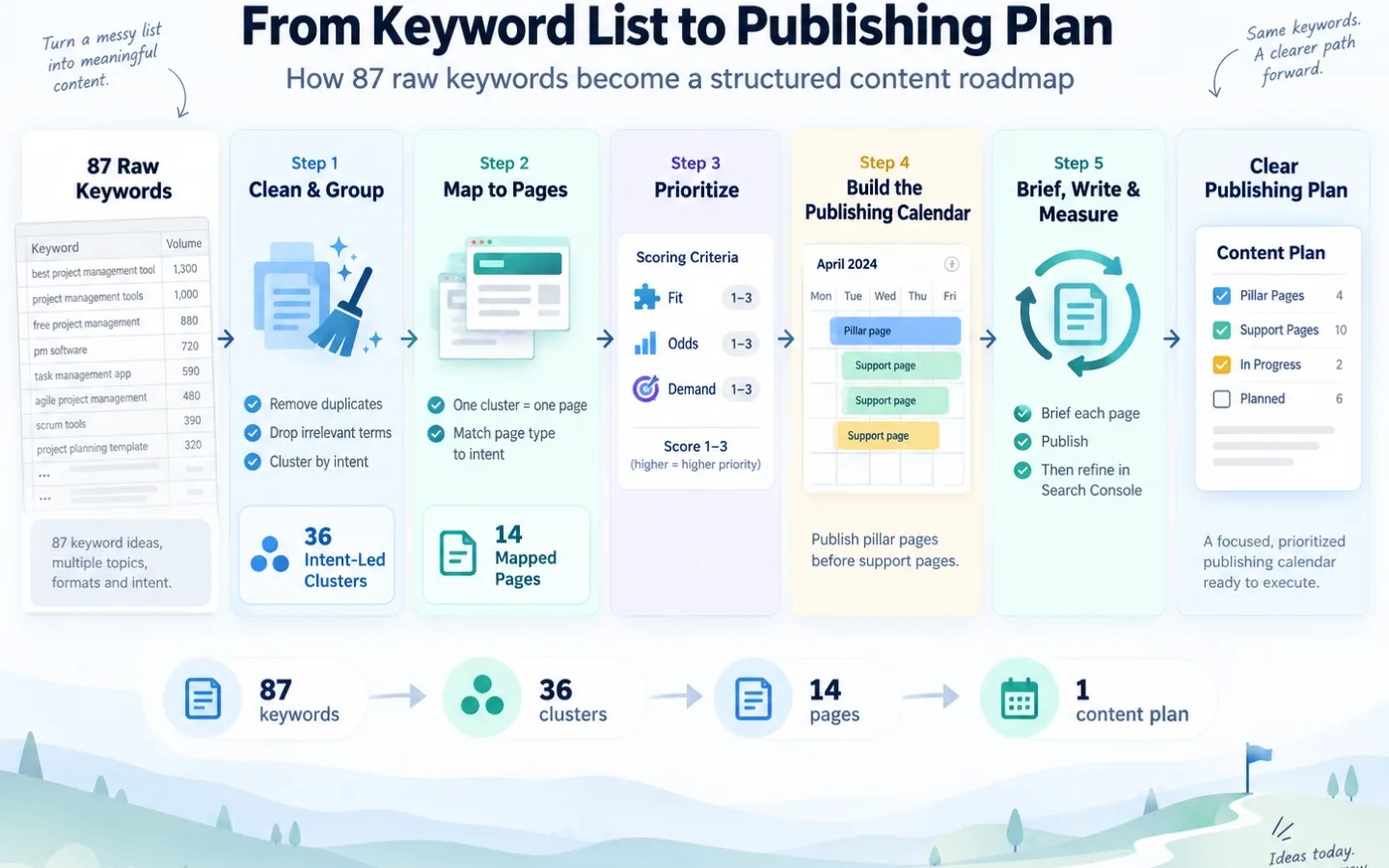
The honest answer to what to do after keyword research is this: stop researching and start mapping. A keyword list is raw material, not a plan. On its own it tells you what people search but not which page should answer each term or what to write first. The work now is to clean the list, group it into clusters, assign each cluster to a page, and sequence the whole thing into a publishing order. That turns a spreadsheet into a schedule your team can act on this week. Here is how to move from a keyword list to a real publishing plan without losing the intent behind each term.
The examples below are not invented. They come from a real client run in the GIndexa Lab, where a collected keyword universe for an AI-tools brand was screened to 87 qualified terms, grouped into 36 intent-led clusters, and mapped onto 14 pages. Every figure is a Semrush US estimate from September 2026, with the client anonymized.
Why the Work Does Not End at a Keyword List
A finished keyword list feels like an accomplishment, and that feeling is the trap. Most teams sort the list by volume, pick the biggest numbers, and start writing. The result is a pile of pages that compete with each other and miss the terms that actually convert. Volume alone hides intent, difficulty, and overlap, so it is the worst single sort you can use.
The list also says nothing about structure. Two hundred keywords might belong on forty pages or on twelve, and only grouping tells you which. Without that step you either split one topic across thin pages or cram unrelated intents onto one. Both weaken the page. The steps below fix this by turning the list into a map before a single word gets written.
A Real Example: 87 Keywords Onto 14 Pages
Most of the work after research is collapse, not expansion. On that client run, dozens of phrasings folded into a handful of tool pages and a few supporting guides. The screened workbook below tags every term with a cluster and an intent before any of it becomes a page.
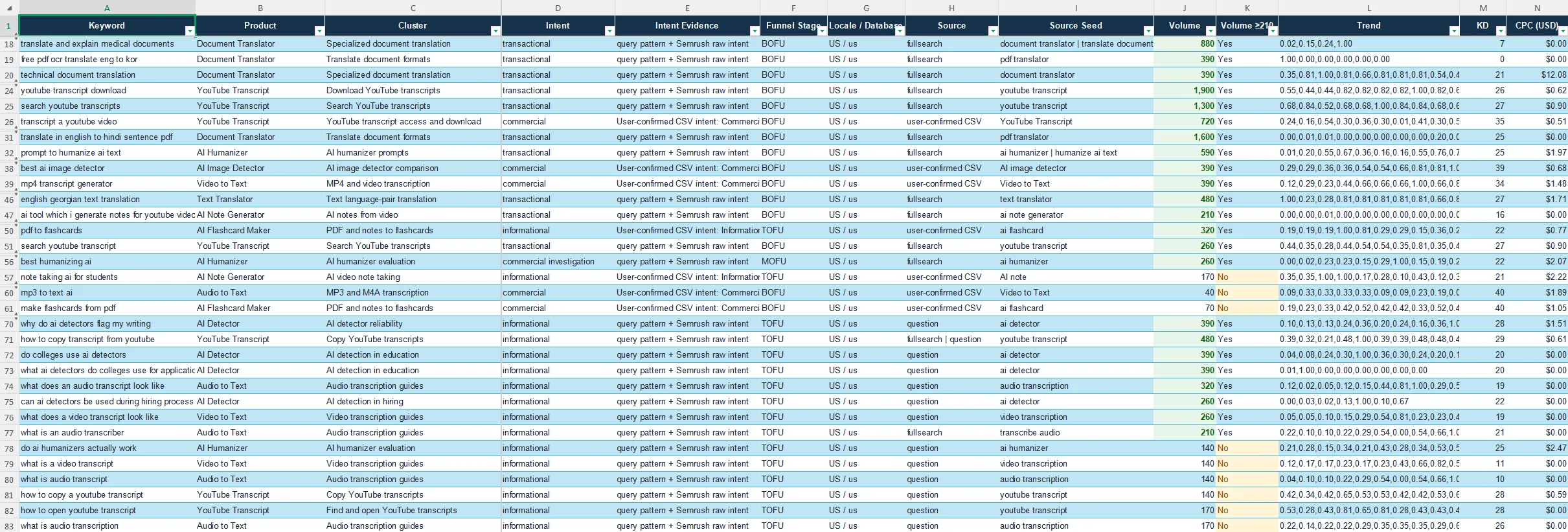
The workbook behind the map. Each of the 87 qualified terms carries a cluster and an intent before it is assigned to a page.
A slice of the finished map shows how it lands. Several clusters point at the same tool page, and the question-shaped clusters become supporting FAQs rather than rival pages.
| Cluster | Keywords | Target page | Page type |
|---|---|---|---|
| Translate document formats | 6 | /document-translator | Tool page |
| Legal document translation | 5 | /document-translator | Tool page |
| Download YouTube transcripts | 6 | /youtube-transcript | Tool page |
| Copy YouTube transcripts | 3 | /youtube-transcript | Supporting FAQ |
| AI detection in education | 5 | /ai-detector | Tool page |
| Audio transcription guides | 4 | /audio-to-text | Supporting FAQ |
Two document-translation clusters and several YouTube-transcript clusters share one tool page each, while the how-to clusters become FAQ sections that link up to the tool. Eighty-seven terms did not need eighty-seven pages. They needed fourteen, mapped by intent. The steps below are how that map gets built.
Step 1: Clean and Group Your Keyword List
Before you build a keyword list into a plan, tidy it. Remove duplicates, drop terms that do not match what you offer, and merge near-identical phrasings that mean the same thing. A clean list is shorter and far more useful than a bloated export. If you searched how to build a keyword list in the first place, this cleanup is the half most people skip, and it is where the plan gets its focus.
Then group by shared intent, not by shared words. This is the step people get wrong, because two phrases can look alike and still belong on different pages. On the client list, “youtube transcript search” and “how to copy youtube transcript” share most of their words, but the first is a transactional tool query and the second is a how-to, so they split into two clusters that map to two different page types.
| Raw keyword | Intent | Cluster |
|---|---|---|
| youtube transcript search | Transactional | Search YouTube transcripts |
| how to copy youtube transcript | Informational | Copy YouTube transcripts |
| legal document translation | Transactional | Legal document translation |
| how to translate legal documents | Informational | Legal document translation |
| college ai detector | Transactional | AI detection in education |
| do colleges use ai detectors | Informational | AI detection in education |
Each cluster now points to one clear job, and the intent tag decides whether it becomes a tool page or a supporting FAQ. That is exactly what the next step needs.
If you need a sample list to practice on, the SEO keyword examples and free CSV pair each phrase with an intent and a suggested page type. Use those labels as a starting point, then check the results for your own market.
Step 2: Map Each Keyword Cluster to a Page
Keyword mapping is the step that prevents most SEO mistakes. Assign every cluster to one page, either a new one you will create or an existing one you will strengthen. One cluster maps to one page, and one page owns one primary intent. That rule alone stops cannibalization, the problem where two of your pages chase the same query and neither ranks.
Decide new versus existing with a quick search of your own site. If a page already covers the intent, improve it rather than publishing a rival. Google’s SEO Starter Guide makes the same point about keeping one clear page per piece of content, so readers and crawlers never wonder which version to trust. Record the mapping in a simple table so nothing slips. Here is that slice of the real map.
| Cluster | Primary keyword | Target page | Page type | New or update |
|---|---|---|---|---|
| Translate document formats | free pdf ocr translate eng to kor | /document-translator | Tool page | Update |
| Legal document translation | legal document translation | /document-translator | Tool page | Update |
| Copy YouTube transcripts | how to copy youtube transcript | /youtube-transcript | Supporting FAQ | New |
| AI detection in education | college ai detector | /ai-detector | Tool page | Update |
| AI video detection | ai video detector | /ai-video-detector | Tool page | New |
The table is the plan’s backbone. Anyone on the team can read it and see which page owns which terms, which removes the guesswork that leads to duplicate pages. Notice that two clusters map to the same document translator page, because they share one intent, and the copy-transcript how-to becomes an FAQ that links to the transcript tool rather than a page that competes with it.
Step 3: Prioritize What to Publish First
A map can hold more work than any team can handle, so the next call is order. Score each cluster on three questions. Does it fit what you sell or explain well? Can your site beat the pages already ranking? Is there real demand behind it? Rate each from one to three and add the marks.
Quick wins rise to the top with this method. A cluster with low difficulty and clear intent is a first draft, even if its volume looks modest, because it can rank within weeks and build momentum. Harder clusters with big volume move later, after your site earns some authority. This order protects your effort and gives the team a clear answer to the question of what to write next.
The three scores only help if one and three mean the same thing every time, so pin them down before you rate anything.
- Fit (1 to 3): 3 means the cluster maps to a page you convert on, a tool, product, or lead page. 2 means it supports a converting page as a guide or FAQ. 1 means it is only loosely related to what you sell.
- Odds (1 to 3): read the lowest difficulty in the cluster and the page-one domains. 3 is a KD in the teens or lower, or a page one your authority can match. 2 is a KD in the twenties. 1 is a KD above 30, or a page one owned by high-authority brands.
- Demand (1 to 3): judge real click potential, not raw volume. 3 is healthy volume that still clicks, usually transactional, commercial, or problem-solving. 2 is moderate, or volume partly eaten by an AI Overview. 1 is high volume that mostly leaks to an AI answer, or near-zero real searches.
Scored that way, the real clusters sort themselves.
| Cluster | Total volume | Min KD | Fit | Odds | Demand | Score | Order |
|---|---|---|---|---|---|---|---|
| Translate document formats | 2,270 | 0 | 3 | 3 | 3 | 9 | First |
| AI detection in education | 3,280 | 20 | 3 | 2 | 3 | 8 | Next |
| Download YouTube transcripts | 2,270 | 25 | 3 | 1 | 3 | 7 | Later |
| Copy YouTube transcripts | 1,100 | 25 | 2 | 1 | 2 | 5 | Backlog |
Translate document formats leads because its easiest term sits at KD 0 and it maps straight to a tool page, so it is both winnable and revenue-linked. Download YouTube transcripts carries the same demand but a KD of 25, so it earns a later slot, not the first one. The copy-transcript FAQ is useful yet neither urgent nor hard to add, so it waits in the backlog. Scoring surfaces the winnable work rather than the loudest.
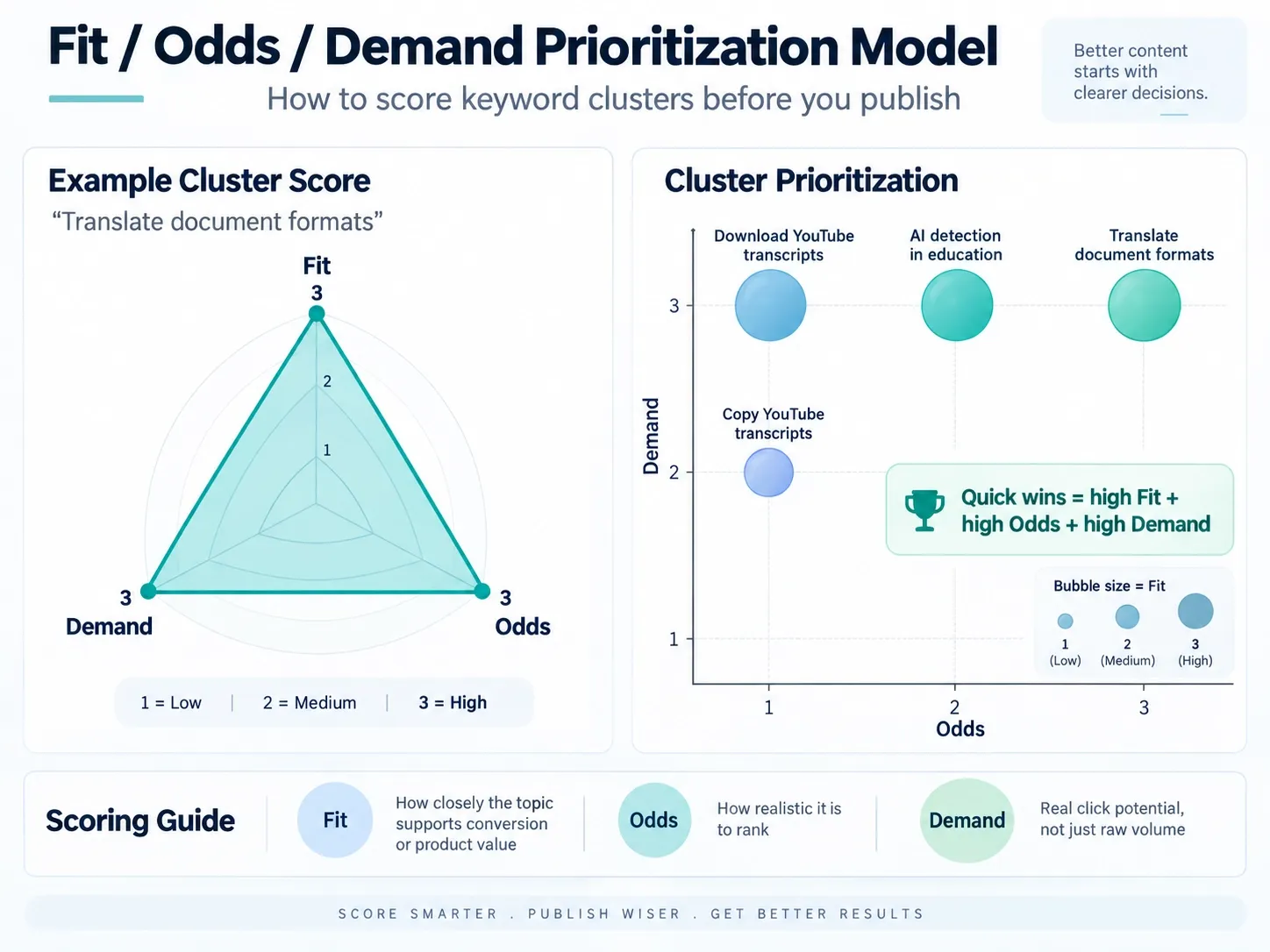
Score every cluster on Fit, Odds, and Demand. The quick wins sit high on all three.
Copy the model with the real 36-cluster map already inside it: download the mapping and priority template (CSV). It carries every cluster with its page, intent, and volume, blank fit, odds, and demand columns, and a priority formula that totals them as you type.
Step 4: Turn the Plan Into a Publishing Calendar
A prioritized map becomes a calendar once you attach dates. Good SEO publishing is a rhythm, not a burst, so set a realistic cadence your team can hold, whether that is one page a week or three a month. Consistency signals to search engines that your site stays active and current.
Sequence the calendar by two rules. Publish pillar pages before the support pages that link to them, so the internal links have a target. Then group related clusters close together in time, because a burst of connected pages builds topical depth faster than scattered posts. Handling publishing SEO this way, in linked batches rather than random singles, is what turns a content calendar into ranking gains. Map the cadence against your wider content plan so each publish reinforces the last.
Step 5: Brief, Write, and Measure Each Page
A calendar still needs a brief per page, or writers drift from intent. Each brief should name the primary keyword, the intent, the questions to answer, and the pages to link. Our content skills hand writers that structure before they start, so every draft stays tied to the cluster it serves.
A brief in 2026 also has to plan for how AI search reads the page. Google’s AI Mode breaks one question into many with a technique called query fan-out: it fires related sub-queries, then assembles a single answer from the pages that cover the whole set. A page that answers only the head term loses to one that also answers the fan-out. So the brief should list the sub-queries and follow-ups the page must cover, not just the primary keyword, and it should tell the writer to format the page for extraction:
- Open each section with a direct-answer block, a two or three sentence answer right under the heading that a summary can lift word for word.
- Put comparable facts, such as steps, specs, prices, or options, in a fact table an answer engine can quote cleanly.
- Write headings as the questions people actually ask, so each heading matches a likely sub-query.
- Keep every answer self-contained, because a summary may lift one passage out of its surrounding context.
None of this is keyword stuffing. It is structure, and our note on what AI search citations reward shows the same traits in the pages these systems quote.
Then measure and improve with three concrete checks. After a page has run for a few weeks, open the Search Console performance report, filter to that page, and run them in order. First, sort its queries by impressions to see what the page actually earns, which is rarely only the term you targeted. Second, find queries where it sits between position 8 and 20 with a low click rate, because one focused revision can push those onto page one. Third, look for queries you never planned that already show, and give the strongest of them its own section or a linked page. Because demand keeps shifting, treat every page as a living asset, and our guide to content refreshes shows how to update one without dropping the terms it already ranks for.
How to Handle Overlap Between Pages
Even a careful map produces overlap, because real topics rarely split into clean boxes. Two clusters may share a phrase, or an old page may already rank for a term you assigned somewhere new. Catch this before you publish, since two pages aimed at one intent split your signals and hold each other down.
The reliable way to decide merge or split is to read the SERP, not to guess. Open both queries in an incognito window and compare the top ten organic results, then count how many URLs appear for both. Three or more overlaps out of ten means Google already treats the two terms as one intent, so build one page and target the stronger phrase. Almost no overlap means the intents differ, so give each its own page and link them. One or two overlaps is the gray zone: lean toward one page if the shared results sit in the top three, since those positions define the intent.
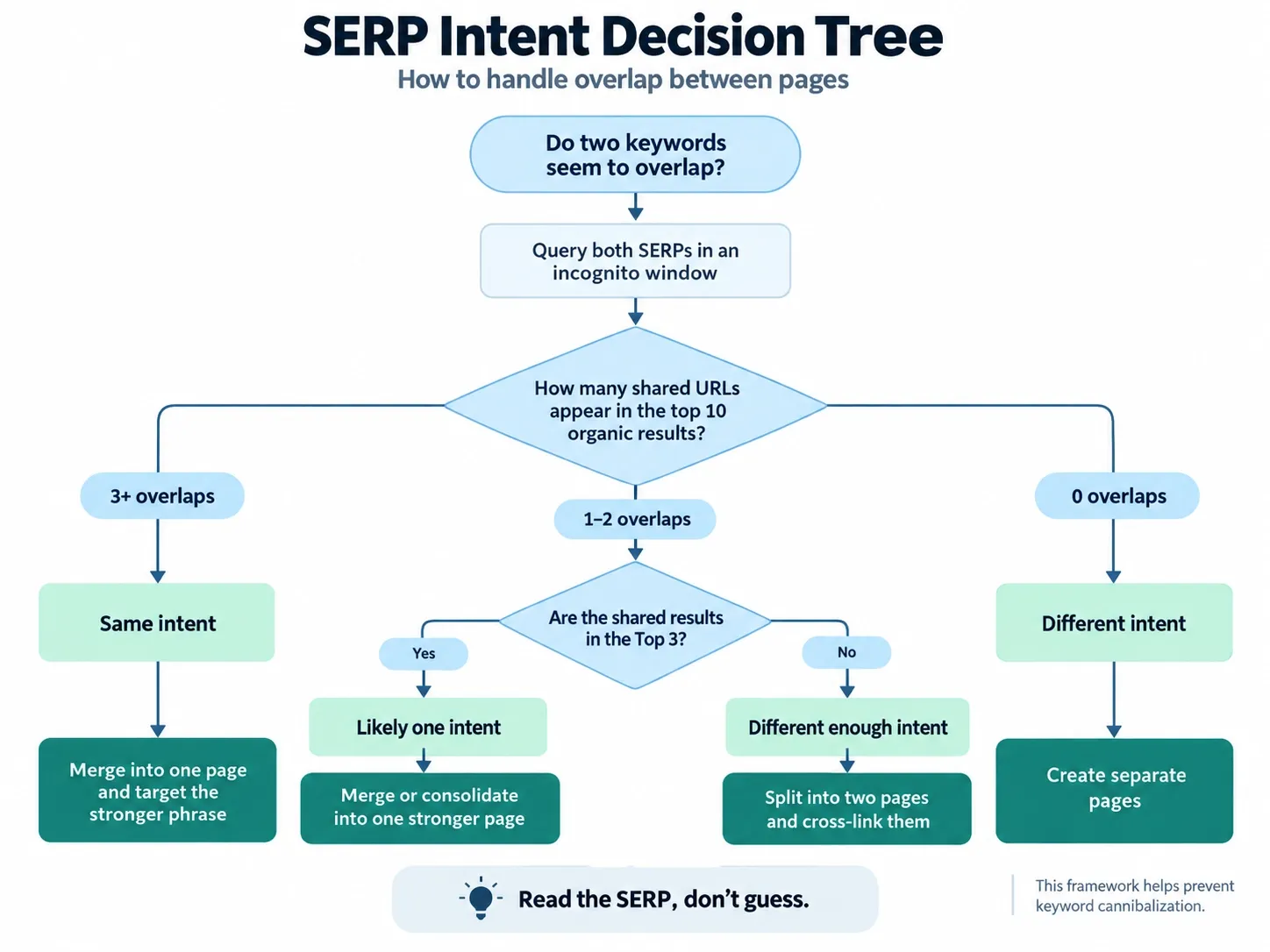
Read the SERP, do not guess. The overlap count in the top 10 results decides merge or split.
Once you know merge or split, the fix follows the case. When an existing page already ranks for a cluster, fold the new terms into it instead of building a rival. When two planned pages overlap heavily, merge them into one deeper page and redirect the weaker idea. When they overlap only a little, sharpen each page’s angle so the intent is distinct and add a link between them.
The Awkward Case: A Page That Ranks but Has a Bad URL
An existing page that ranks well but carries a dated or over-narrow slug, like /keyword-guide-2024, is its own decision, and the instinct to “fix” the URL often costs more than it saves. If the page still earns traffic and the slug is merely ugly, rewrite it in place and keep the URL, because every 301 leaks a little equity. If the slug names a year that will roll over, move it to an evergreen URL with a 301 before its traffic peaks, not after it has faded. And when two of your own pages both rank for the cluster, merge the weaker into the stronger with a 301 rather than leaving them to split the signal. Change the URL only when the gain clearly beats the redirect cost.
What to Do After Keyword Research to Keep Momentum
The move after keyword research is always the same: convert the list into a map, the map into a schedule, and the schedule into published pages you measure and refresh. Clean and cluster first, map one cluster to one page, prioritize the quick wins, then publish in linked batches on a steady cadence. Done this way, the answer to what to do after keyword research is not more research. It is a publishing plan that keeps your best terms moving from a spreadsheet onto pages that rank.
Frequently Asked Questions About What to Do After Keyword Research
How Do I Turn a Keyword List Into a Content Plan?
Group the list into clusters by shared intent, then assign each cluster to one page. Add a priority score based on fit, difficulty, and demand, and place the highest scorers first on a calendar. The plan is the mapping plus the order, so a list of terms becomes a sequence of briefs your team can write against.
Should Every Keyword Get Its Own Page?
No. Many keywords share one intent and belong on the same page, so one strong page can rank for dozens of related phrases. Give a keyword its own page only when it carries a clearly different intent, such as a buying query separate from a how-to. Fewer, deeper pages beat many thin ones.
How Do I Decide Which Content to Publish First?
Start with clusters that fit your offer, sit within your reach, and carry real demand. Low-difficulty terms with clear intent are quick wins that build momentum, so they lead. Save high-volume, high-difficulty clusters for later, once your site has earned enough authority to compete for them.
How Long Before New Pages From My Plan Rank?
Plan for three to six months before a new page finds a stable position, and longer for competitive terms. Low-difficulty pages can move faster, sometimes within weeks. A new site waits longer than an established one, because trust builds slowly, so sequence easy wins early to see results while harder pages mature.
What Do I Do With Keywords I Have No Page For Yet?
Park them in a backlog tied to their cluster, not the trash. They become future briefs as your calendar advances and your authority grows. Revisit the backlog each quarter, since a term you could not target at launch often becomes reachable once related pages start ranking and linking to each other.
Where Does Internal Linking Fit Into the Plan?
Internal links are part of the mapping, not an afterthought. As you assign clusters to pages, note which pages should link to which, so a pillar page connects to its support pages and back again. Add those links the moment each page publishes. This is why sequencing matters: publish the pillar first, then every support page has a clear target to point to, and the cluster reads as one connected topic to both readers and crawlers.
Should I Update Old Pages or Only Publish New Ones?
Do both, and often the update wins. A page that already ranks on page two needs a stronger version, not a brand-new rival that splits its signals. Check your map against existing pages first, fold new terms into what already performs, and reserve new pages for clusters your site does not cover yet.