
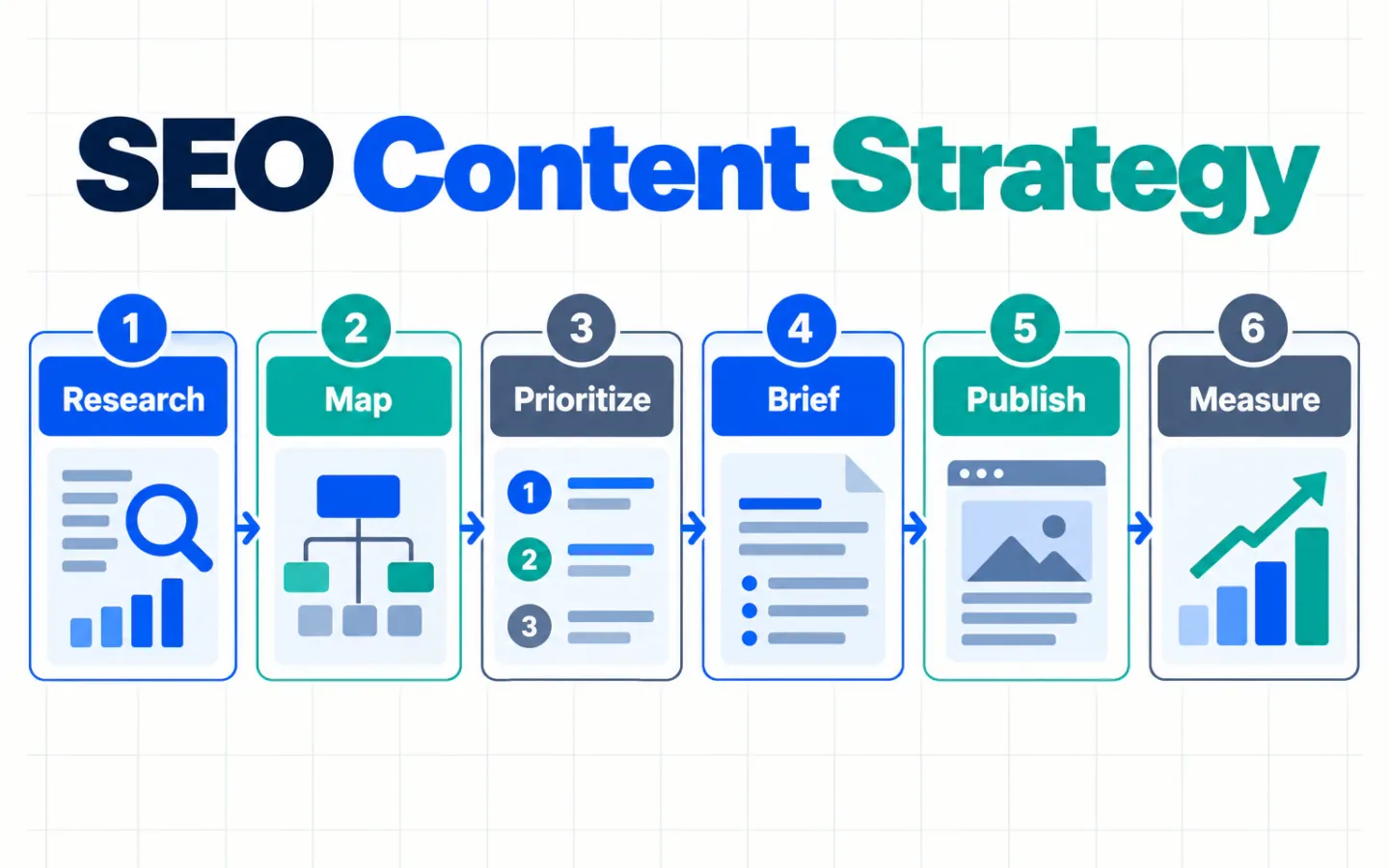
An SEO content strategy decides what your site should publish, which existing pages should change, and what each page must achieve. It connects search demand to business value, evidence, page type, internal links, and measurement. A calendar only assigns dates. A strategy explains why a page deserves to exist and what you will do if it fails.
Consider an illustrative failure case. A team finds 500 keywords, turns the highest-volume phrases into article titles, and publishes weekly. Six months later, several pages compete for one query, product pages lack support, and nobody can trace which posts influenced a sale.
The framework below treats every URL as a decision. You will build a demand map, assign one page owner to each search job, set a publishing order, define the evidence each page needs, and keep an update rule beside the original brief.
What Is an SEO Content Strategy?
An SEO content strategy is a documented system for matching valuable search demand with useful pages and maintaining those pages over time. Its output is a controlled portfolio of new pages, updates, consolidations, and deliberate exclusions.
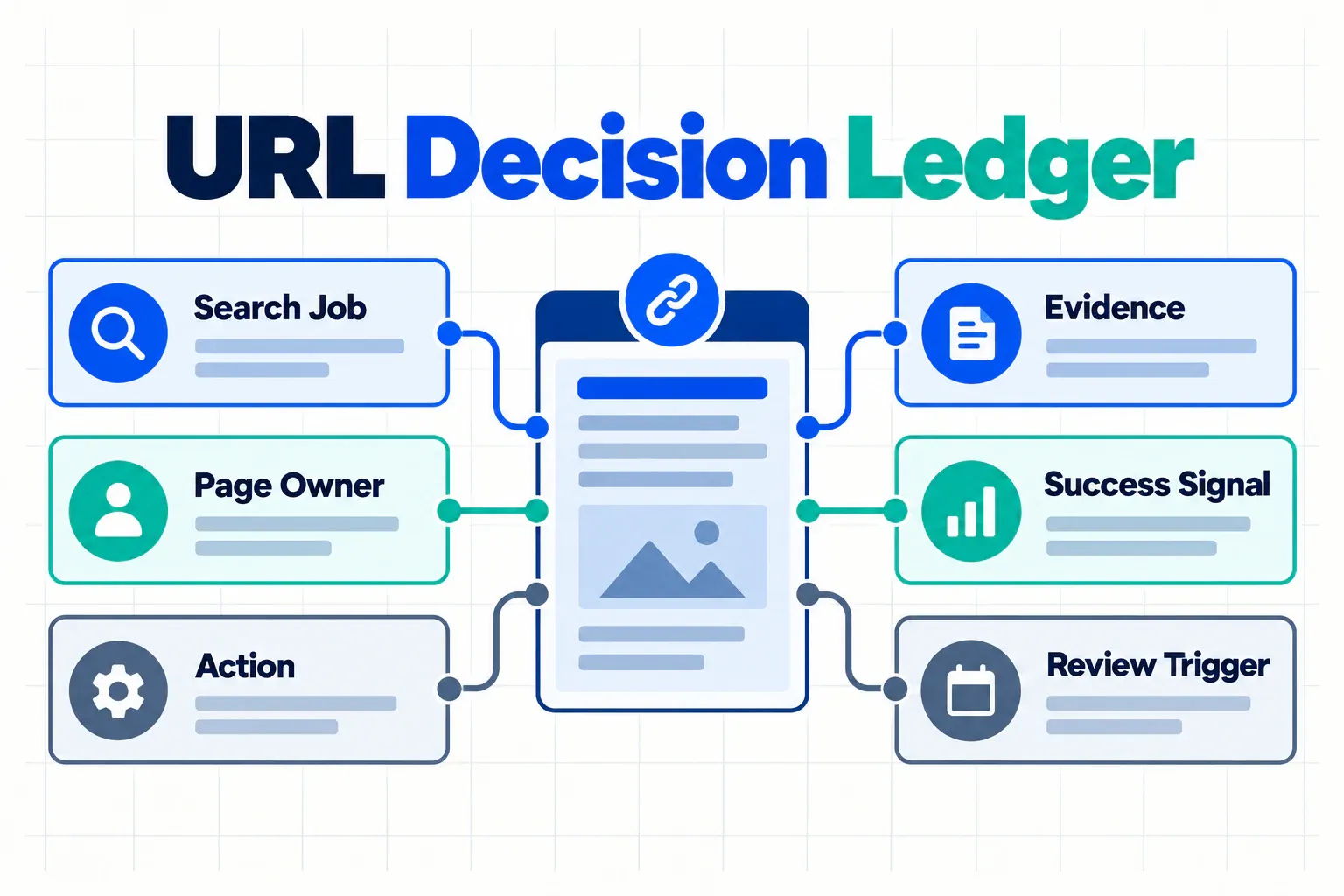
Keep one row per proposed or existing URL in a decision ledger:
| Field | Decision to Record |
|---|---|
| Search job | What the user must learn, choose, or do |
| Page owner | The one URL responsible for that job |
| Action | Keep, refresh, consolidate, create, or exclude |
| Distinct contribution | Evidence, experience, tool, or judgment the page adds |
| Link role | Required inbound, outbound, and hub relationships |
| Success signal | The observable result tied to the page goal |
| Review trigger | The date or event that reopens the decision |
The ledger is the operating layer between research and production. It prevents a keyword variation from becoming a page by default, and it makes exclusions as visible as publication ideas.
How to Set Goals for SEO Content
Choose a page-level outcome before choosing a topic. “Grow traffic” cannot guide a brief because it does not define the right visitor or their next action. A developer documentation page and a commercial comparison can both earn clicks, but they support different decisions.
| Content Goal | Useful Leading Signal | Business or Editorial Outcome |
|---|---|---|
| Build qualified visibility | Relevant nonbrand impressions and query coverage | More target users enter the site |
| Support product evaluation | Visits to feature, pricing, or comparison pages | Trials, demos, or assisted revenue |
| Earn subscriptions | Search visits from a defined problem set | Newsletter or account signups |
| Become a cited source | Citations, attributed mentions, and cited URLs | Research reuse and qualified referral visits |
| Reduce support demand | Successful help-page visits and fewer repeated tickets | Faster task completion and lower support load |
Write the goal as a testable sentence: “Help security leads comparing audit-log platforms reach the integration documentation, then measure qualified visits and demo assists.” That sentence fixes the audience, decision, destination, and measurement. It also makes irrelevant high-volume topics easier to reject.
How to Find Search Demand Worth Targeting
Start with customer tasks, not a keyword database. Collect questions from sales calls, support tickets, site search, Search Console, community discussions, and the language used in product documentation. Then use keyword tools to estimate demand and find variants.
The detailed discovery process belongs in the guide to finding keywords for your website. At strategy level, screen each query through four checks:
- Does the query come from an audience you can serve?
- Can the site complete the task better than a search summary alone?
- Is there a credible path from this topic to an editorial or business outcome?
- Do you have evidence, expertise, or a useful tool that makes the page defensible?
Volume is only one input. In an illustrative comparison, a 70-search buyer query may matter more than a 7,000-search definition with weak click potential. Record a range when tools disagree, and note whether the results page resolves the task without a click.
How to Group Keywords Into Topic Clusters
Cluster by shared search job, not repeated words. If two queries need the same answer, evidence, page type, and next step, they probably belong on one URL. Different tasks deserve separate owners.
How to Map Keywords to the Right Page Type
Review the live results page to see which formats satisfy the task, but do not copy their structure. Choose the smallest format that can complete the job.
| Search Intent | Likely Page Type | Required Value |
|---|---|---|
| Learn a concept | Explainer or glossary entry | Definition, boundaries, and examples |
| Complete a task | Tutorial, tool, or playbook | Steps, decisions, and verification |
| Compare choices | Comparison or review | Shared criteria, evidence, and tradeoffs |
| Evaluate a solution | Feature, use-case, or category page | Fit, proof, and next action |
| Use an asset | Template, checklist, or calculator | A working artifact with instructions |
Search the site for an existing owner before creating a URL. Compare its queries, links, conversion role, and freshness. Refresh it when the task still matches. Consolidate pages that serve the same job. Create only when the task, evidence, format, or next action is distinct, and record that reason in the ledger.
How to Prioritize What to Publish First
Avoid a single proprietary score that hides judgment behind decimals. Use five visible gates instead:
| Gate | Question | Stop Condition |
|---|---|---|
| Audience fit | Does the target user matter to the site? | The audience is irrelevant or too broad |
| Outcome fit | Can the page support a defined goal? | No credible next action exists |
| Competitive opening | Can you add material value? | The plan only restates current results |
| Evidence readiness | Can you support the important claims? | Required data or expertise is unavailable |
| Delivery cost | Can the team build and maintain it? | Cost exceeds likely value or ownership is unclear |
Rank the pages that pass all five gates by urgency and dependency. Publish foundational hubs before narrow spokes when the spokes need somewhere useful to link. Fix an established page before creating a replacement. Ship a high-intent page with ready evidence before a broad article that needs months of research.
Record the reason for each priority. When conditions change, you can change the order without pretending the original score was objective.
How to Build an SEO Content Brief
A useful brief reduces unresolved decisions without scripting every sentence. It should tell the writer what the page must do, what it must prove, and where it sits in the site.
Include the primary search job, audience state, recommended page type, proposed URL, unique angle, essential questions, claim-level sources, internal links, conversion or editorial next step, and measurement plan. Add a “do not repeat” field that points to neighboring pages. This field prevents a hub article from swallowing the tutorials it should support.
Separate facts from editorial hypotheses. A source can support a platform rule or dataset. It cannot prove your recommended workflow is universally best. Label worked examples as illustrative, and give any original research its sample, method, date, and limits.
End the brief with a completion test. For example: “A reader can choose whether to update, merge, or create a page and can record that decision in the ledger.” This is more useful than a generic instruction to be comprehensive.
How to Optimize Content for Search and AI Overviews
Write for the reader’s task, then make the answer easy to locate. Google’s guidance for AI features says normal SEO fundamentals still apply and adds no special technical requirement for inclusion. Indexed, snippet-eligible pages remain the foundation.
The practical change is editorial. Put a direct answer near the question, then add conditions, evidence, and the next decision. In an illustrative image audit, compressing a 1.8 MB hero file to 180 KB removes 1.62 MB from the uncached transfer. That calculation is useful only after you confirm the actual file and delivery path.
Use headings to guide reading, not to repeat every keyword. Tables should compare consistent attributes. Lists should describe a real sequence. Structured data must match visible content. None of these choices guarantees an AI Overview, citation, or ranking.
How to Build Internal Links Around Topic Clusters
Internal links distribute discovery, context, and reader attention. Give each cluster a clear hub, then connect a spoke where the reader needs deeper execution. Plan inbound links in the brief so a new page does not launch as an orphan.
Place links at the moment of need. An anchor such as “validate search intent” explains more than “learn more.” Google’s crawlable link guidance recommends ordinary anchors with resolvable destinations.
Audit orphan pages, redirected destinations, repetitive anchors, and hubs filled with weak spokes. A cluster is useful paths between related decisions, not a folder diagram.
How to Update and Consolidate Existing Content
Every URL needs a maintenance rule. Set its first review by how quickly the facts change. Pricing may need monthly checks, while a stable definition may wait for a platform or standards change.
- Keep the page when intent, facts, and performance remain sound.
- Refresh it when the task still matches but evidence or coverage has aged.
- Consolidate it when another URL serves the same job more completely.
- Retire it when demand, fit, and useful inbound value no longer justify maintenance.
Save the current query baseline before a major rewrite. The guide to what to do after keyword research connects page mapping to publication. If consolidation changes a URL, preserve useful material, redirect to the closest destination, and update internal links.
How to Measure an SEO Content Strategy
Measure the chain from eligibility to outcome. One headline traffic number cannot show where the system failed.
| Layer | Question | Evidence |
|---|---|---|
| Production | Did the team ship the planned asset correctly? | Status, owner, publish date, QA record |
| Eligibility | Can search systems access and index it? | Status code, canonical, index state, rendered HTML |
| Discovery | Does it appear for the intended demand? | Relevant impressions, queries, cited URLs, mentions |
| Engagement | Do visitors continue the task? | Useful next-page visits, downloads, tool use, signups |
| Outcome | Did it support the stated goal? | Qualified leads, assisted revenue, retained users, reduced tickets |
Compare each page with its own baseline and with the cluster it supports. Record material updates beside performance changes. A rise after a rewrite is an observation, not proof that one edit caused it.
Set decision thresholds in advance. A page that remains unindexed needs a technical diagnosis. An indexed page with irrelevant impressions needs intent work. A visible page with no useful next action needs a content or offer change. This turns reporting into an improvement queue.
A 90-Day SEO Content Strategy Template
The first 90 days should create a working system, not maximize publishing volume.
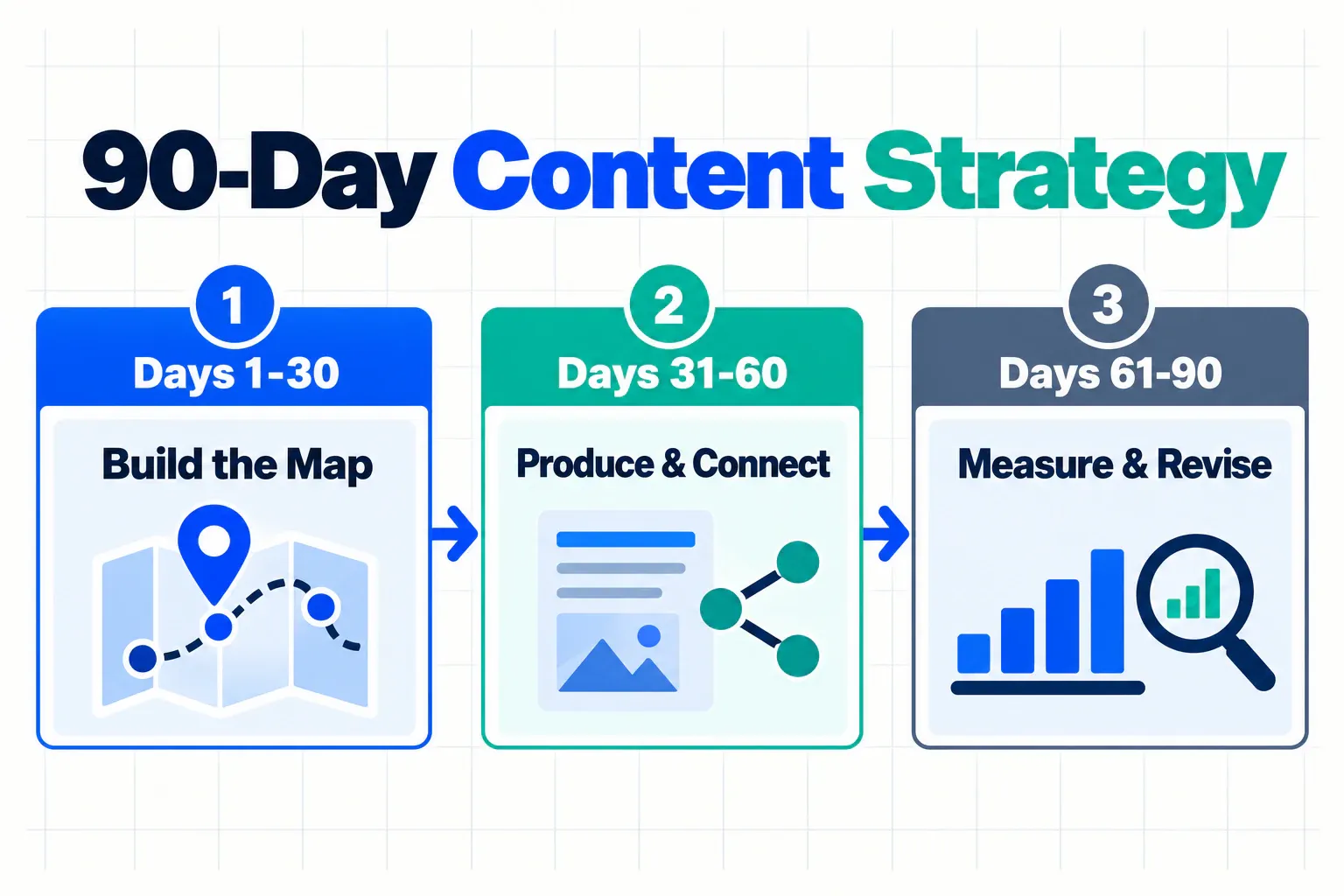
Days 1 to 30: Build the map. Define the audience and outcomes. Inventory current URLs, queries, conversions, links, and update dates. Group demand by search job, assign one owner per cluster, and label every row keep, refresh, consolidate, create, or exclude. Select three to five pages that pass the five gates.
Days 31 to 60: Produce and connect. Brief the strongest existing opportunity first, then build the highest-value missing page. Specify evidence, completion criteria, inbound links, metadata, canonical URL, rendered content, and analytics events before release.
Days 61 to 90: Measure and revise. Check indexing and query fit against the saved baseline. Fix access first, then intent mismatch, incomplete answers, and weak next steps. Record each change and its next review date.
At day 90, the deliverable is a governed queue with evidence and owners. A pile of disconnected posts is not a strategy.
Frequently Asked Questions About SEO Content Strategy
Should You Add Keyword Volumes Across a Cluster?
Use the sum only as a planning indicator. Similar queries can overlap, and tool estimates do not represent distinct people or guaranteed visits. Keep the row-level inputs so readers can see what the total contains.
When Should Similar Queries Get Separate Pages?
Split them when they require a different user task, evidence set, page format, or next action. Keep variants together when one page can answer them fully without mixing intent.
Should a Zero-Volume Query Be Excluded?
No. Tool databases miss new, narrow, and low-frequency demand. Keep the query when it reflects a verified customer task and the page supports a useful outcome.
SEO Content Strategy Is a Page-Decision System
An SEO content strategy works when every URL has a user task, an owner, a reason to exist, a place in the link graph, and a response to failure. Build the demand map, make the page decisions, publish the evidence-ready priorities, and measure each layer separately. The calendar should follow those choices, not replace them.