
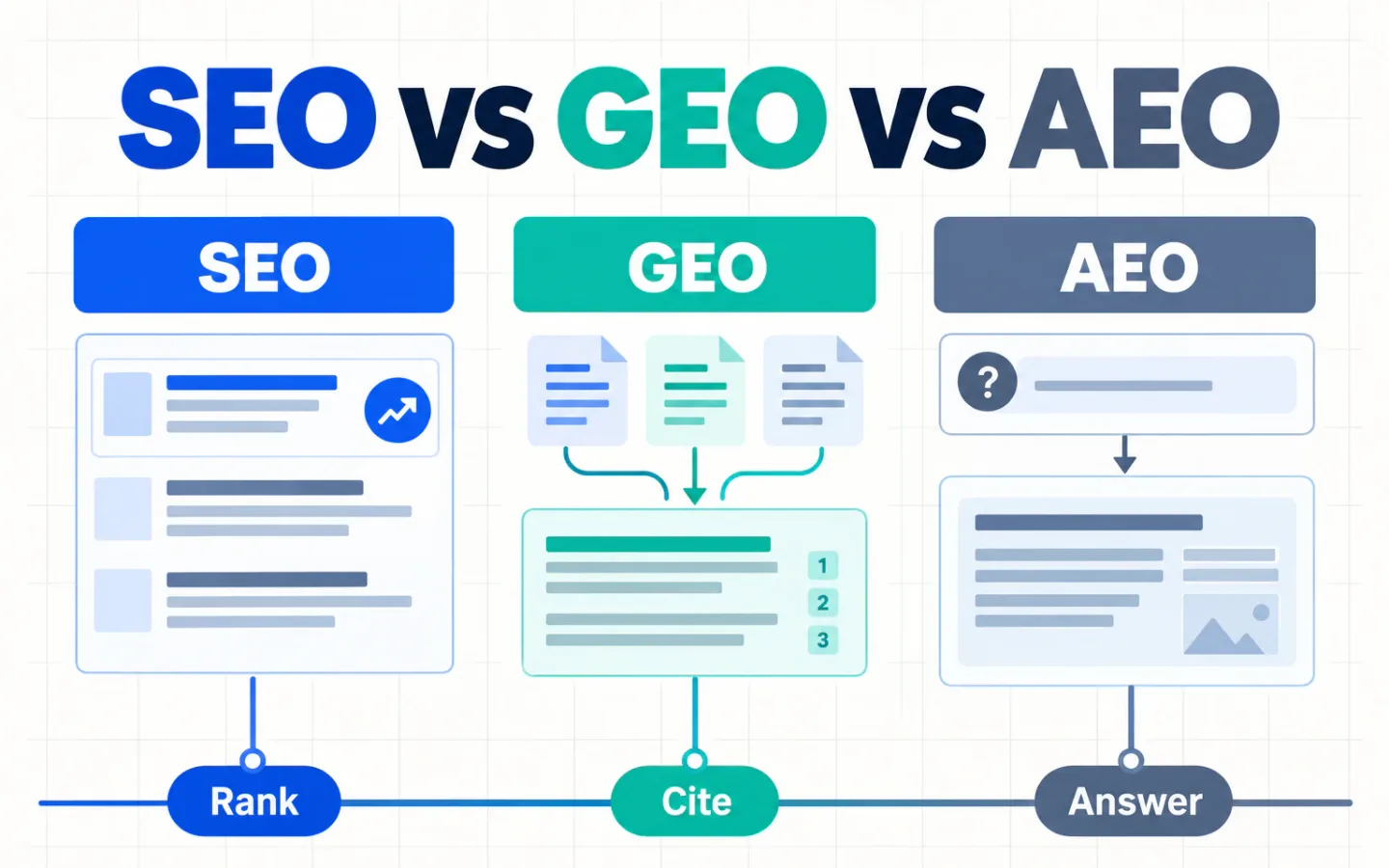
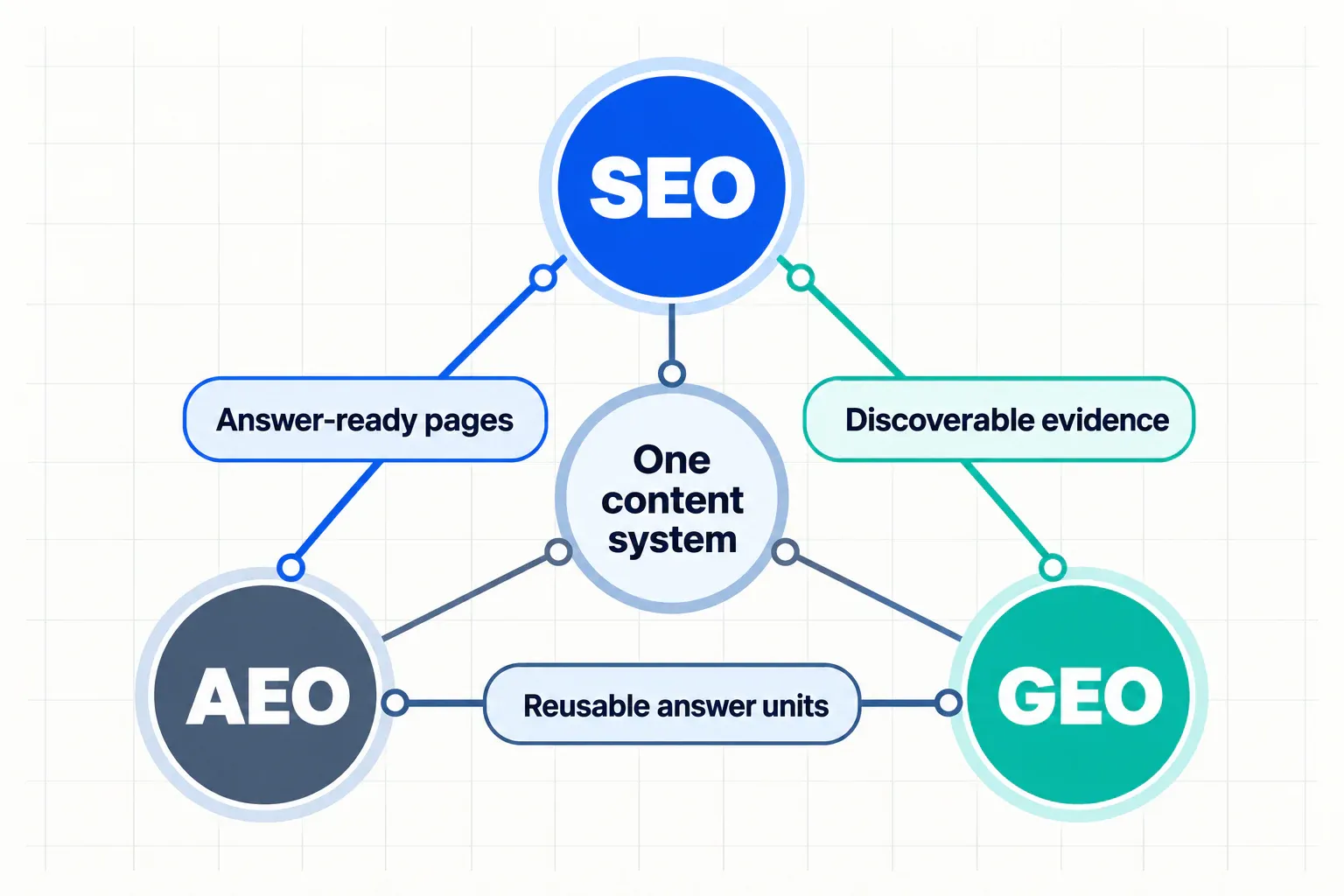
Treating SEO, GEO, and AEO as three competing strategies creates unnecessary work. Most teams need one accessible, well-supported body of content, then separate ways to diagnose its appearance in ranked results, direct answers, and generated responses.
Start with SEO for crawl-and-index systems such as Google and Bing. Add AEO for short, direct answers and GEO when generated systems must retrieve or cite your evidence. Keep them in one content program.
This split matters most for high-consideration, documentation-heavy products, where a single decision draws on many pages: technical B2B tools, developer platforms, and complex hardware or software with deep knowledge bases. In those markets a generated answer that names or cites you can seed a qualified evaluation long before a click shows up in analytics. Transactional or thin-catalog sites feel the difference far less, so treat the guidance below as heaviest where the buying decision is slow, technical, and research-led.
The Short Answer
This guide uses operational definitions, not platform standards. SEO targets ranked search visibility. AEO tests whether a bounded answer is easy to select and present. GEO tests whether a source, claim, or entity appears in a generated response.
Those outcomes overlap. For Google AI Overviews and AI Mode, a page must be indexed and eligible to show with a snippet. Google’s AI features guidance adds no technical requirements beyond normal Search. Its generative AI guide describes AEO and GEO as terms used for AI-search visibility work, while keeping SEO fundamentals at the center.
The useful split is the target output and the way a team diagnoses and measures it.
A Quick Comparison
| Discipline | Primary Output | Unit You Improve | Main Diagnostic Question | Useful Metrics |
|---|---|---|---|---|
| SEO | Ranked search result | Page and site relationship | Can the engine crawl, understand, rank, and earn clicks for this page? | Impressions, position, clicks, CTR, conversions |
| AEO | Direct answer or answer feature | Answer passage and supporting context | Can the system identify a complete, accurate answer? | Appearance rate, attribution rate, accuracy, attributable actions |
| GEO | Citation, mention, or recommendation in a generated response | Claim, source, and entity evidence | Does the response use, cite, and represent us accurately? | Citation rate, mention rate, cited URLs, accuracy, referral conversions |
These are proposed diagnostics, not platform standards. The same URL can rank in ordinary results, lose the direct answer, and still be cited by a generator. Capture the query, engine, mode, date, and locale before deciding which outcome failed.
What Each Discipline Is Designed to Achieve
SEO Builds Search Eligibility and Ranked Visibility
SEO connects demand to crawlable, indexable pages that can compete in ranked results. Technical access, intent, links, experience, content, and authority shape the outcome. Search Console reports impressions, clicks, CTR, and average position. Analytics can connect those signals to conversions. See the broader SEO strategy.
AEO Makes a Complete Answer Easy to Select
Under this working definition, AEO tests whether a bounded answer stays clear outside its surrounding paragraph. Direct wording and structure create testable answer units, but do not guarantee selection. Google’s featured snippet documentation states that its systems choose the page. The AEO guide covers answer structure.
GEO Improves Visibility Inside Generated Responses
Under this taxonomy, GEO tests retrieval and representation inside a synthesized answer. The observed event may be a citation, attributed claim, brand mention, or recommendation. Original analysis and verifiable facts provide distinct claims to test, but do not guarantee inclusion. The GEO guide explains the mechanics across platforms.
SEO vs GEO: What’s the Difference?
SEO competes for a page’s position in a ranked list. GEO competes for a source’s contribution to a generated response. A typical organic result presents a title, snippet, and link. A generated response may combine sources, paraphrase claims, name a brand, and cite only selected statements.
That changes the unit of success. An SEO audit asks why a page was not crawled, indexed, ranked, or clicked. A GEO audit asks whether the engine retrieved the page, used its evidence, attributed the claim, and described the entity correctly. Track organic clicks and AI citations separately because they record different events.
For Google and Bing’s crawl-based AI surfaces, GEO still depends on search foundations. Google’s systems use the Search index, and Microsoft’s Webmaster Guidelines extend crawl and indexing advice to Copilot grounding. A summary box alone does not guarantee that a hidden or weak page becomes competitive.
The paper that introduced GEO created a 10,000-query benchmark, evaluated its 1,000-query test split, and reported visibility gains of up to 40 percent for some changes. Much of the evaluation used fixed source sets and proxy measures, not long-term traffic or conversions. A later NeurIPS benchmark found weak or negative effects for many rewrites across its tested tasks and domains. GEO tactics are hypotheses, not universal ranking factors.
SEO vs AEO: What’s the Difference?
SEO asks whether the whole page is a strong result for the query. AEO asks whether a specific passage resolves the question cleanly enough to present as an answer. The same page can satisfy both, but each failure leaves a different trace.
Consider an article that ranks for “how long does a 301 redirect last” but opens with five paragraphs of history. Its answer is hard to isolate. A direct sentence followed by conditions and exceptions creates a better answer unit for both systems and readers. No separate AEO page is required.
Structured data has a supporting role. Google’s structured data documentation says markup helps Search understand a page and can make it eligible for enhanced displays. It does not turn weak copy into the chosen answer. Mark up information that users can see, use supported types, and validate the implementation. Do not add FAQ markup or dozens of question headings solely to make a page look optimized.
Answer appearance and organic CTR record different events. Measure answer ownership and business actions separately from organic CTR.
GEO vs AEO: What’s the Difference?
We found no standards-body definition that establishes a universal GEO and AEO boundary. Usage varies across publishers and platforms, so platform-based labels break quickly. The same surface can present a direct answer, a multi-source synthesis, or both.
For this guide, classify the output:
- Use AEO when the target is a bounded answer to a specific question. The test asks whether the system selected the answer unit and preserved its meaning.
- Use GEO when the target is inclusion within a synthesis, comparison, recommendation, or multi-source explanation. The test asks whether the system retrieved, used, cited, and accurately represented the source or entity.
For example, “What does a 301 redirect do?” calls for a stable definition. That is an AEO-shaped task. “Which redirect plan is safest for a marketplace migration?” requires constraints, tradeoffs, and evidence from several sources. That is GEO-shaped. Either question could appear on the same platform.
In this measurement model, a direct answer appearance, brand mention, citation, and accurate claim are separate events. The source-selection explainer shows why retrieval, use, and attribution can diverge.
Diagnose the Failure Before Choosing a Label
Consider a hypothetical SaaS comparison page with a current feature table, stated review method, and dated pricing evidence. The same page can fail in four different ways.
| Observed Result | Likely Bottleneck | First Check |
|---|---|---|
| Excluded from the index and earning no impressions | SEO eligibility | Status, canonical, robots rules, rendered content, and internal links |
| Earning impressions while another source supplies the direct answer | AEO-shaped selection | Whether the answer is complete, isolated, and supported by nearby context |
| Generated comparisons omit the brand or cite other sources | GEO-shaped retrieval or representation | Whether the page carries distinctive evidence and consistent entity facts |
| Visible across surfaces while qualified trials stay flat | Intent or conversion fit | Whether the query, answer, recommendation, and offer serve the same decision |
Work in dependency order. Confirm eligibility, relevant impressions, answer completeness, generated retrieval, and qualified action. Stop at the first failed check. Keep the page, query set, prompt set, conditions, and measurement window stable before changing one material element. This avoids creating separate SEO, AEO, and GEO pages when the real problem is access, intent, evidence, or the offer.
What a Live Field Test Reveals About the Three Layers
Since August 2026, GIndexa has run a new-site citation test on a fixed weekly schedule. Before publishing the test pages, we saved baseline answers and named sources for fixed informational prompt families across ChatGPT, Perplexity, Google AI Mode, and Claude. We then repeated the prompts and logged the engine, date, full response, shown sources, mention, and citation, inferring retrieval only when a live-search surface exposed it.
The design maps the three layers. Google and Bing indexing test SEO eligibility. Direct-answer placement is the AEO-shaped passage variable. Retrieval, mentions, and citations are the GEO outcomes. We also vary source specificity and internal links while keeping the claims and publishing identity stable.
The study is still running. Early logs show engines can disagree on the same prompt and that eligibility can fail before wording matters. One new site in one topic cannot prove a general rule, and sampled answers vary. The public protocol and limits define the method and the threshold for a final result.
Which Approach Should You Prioritize?
Prioritize the bottleneck that prevents the next observable outcome. Do not choose the newest acronym.
| Current Condition | First Priority | Why | Next Check |
|---|---|---|---|
| Important pages are blocked, unindexed, duplicated, or poorly matched to intent | SEO | The content is not reliably eligible for discovery | Index coverage, canonical URL, internal links, impressions |
| Pages earn impressions, but answer features select other sources | AEO | The answer may be buried, incomplete, or hard to extract | Fixed question set, answer placement, factual completeness |
| Pages rank, but generated comparisons omit or misstate the brand | GEO | The system may lack retrievable evidence or corroboration | Mentions, citations, cited claims, representation accuracy |
| Visibility grows, but qualified actions do not | Conversion and content fit | More exposure will not repair a weak offer or wrong intent | Leads, sales, signups, assisted conversions |
If you are asking, “Do I need both SEO and GEO for my website?” test the premise against audience behavior. Use both when ranked and generated discovery affect decisions. Keep SEO as the eligibility layer for crawl-based surfaces, add GEO measurement for citations or representation, and test AEO where direct answers matter.
How to Make All Three Work Together
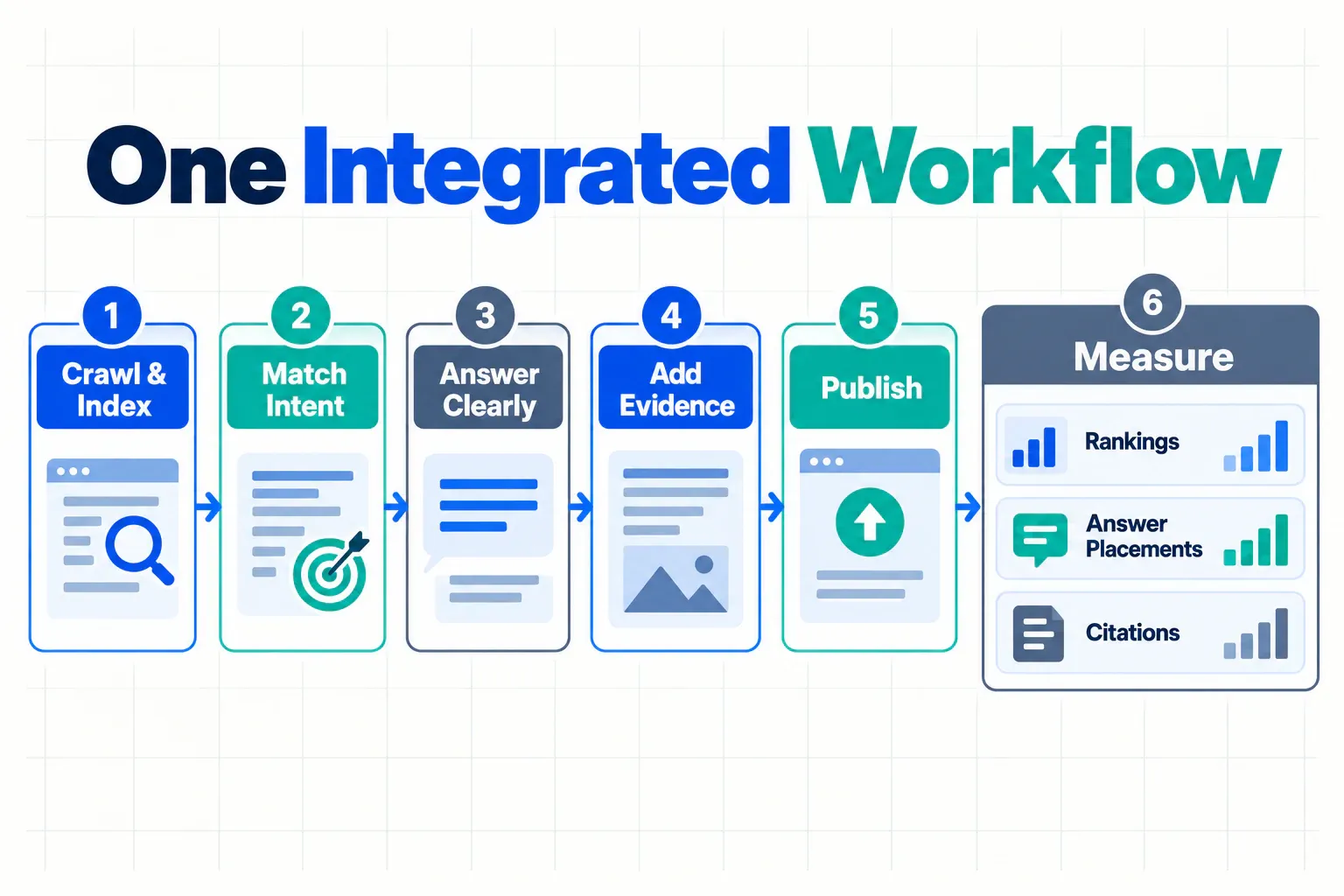
This is a proposed publishing workflow, not a proven ranking sequence.
- Map the task and expected output. Group real queries by intent, then mark each as ranked-result, direct-answer, synthesis, or mixed.
- Secure technical eligibility. Use a stable canonical URL, crawlable links, indexable HTML, descriptive metadata, and a clear place in the site hierarchy.
- Write the answer layer. Put a direct response near its question, followed by conditions, exceptions, evidence, and the next decision.
- Add material worth citing. Publish a method, calculation, test, worked example, or editorial judgment with its sample, date, and limits.
- Connect the evidence. Keep entity facts consistent and earn relevant references where another publisher has a genuine reason to cite the work.
- Test one change against a frozen baseline. Save prompts, conditions, responses, citations, and landing-page outcomes before and after the edit.
Use intent and cluster research to decide whether questions belong on one page. Use the AI visibility audit for the capture method. Split pages only when the user task or required depth genuinely differs.
Where Optimizing for One Hurts Another
Most improvements reinforce each other, but over-optimization creates predictable conflicts.
| Move | Failure | Better Choice |
|---|---|---|
| Compress every answer into one sentence | AEO gains an extractable line while GEO loses evidence and qualifiers | Keep the direct answer, then retain support beside it |
| Stack question headings, FAQs, and repeated variants | The page becomes padded and hard to read | Let structure follow the reader’s task |
| Pack citations, statistics, and entity names into every paragraph | The copy looks engineered and claims lose hierarchy | Use only evidence that changes the decision |
A merged page can also blur two genuinely different intents. Split it when a definition and a complex decision require different depth, evidence, or next actions. Optimize the reading experience first, then confirm that machine-facing changes did not damage it.
What to Measure Without Mixing the Signals
For SEO, use Search Console impressions, clicks, CTR, and average position, then connect landing pages to conversions in analytics. Google’s metric definitions explain the standard fields.
For AEO, define one question-run as one saved result for one question, engine, mode, date, and locale. Appearance rate equals runs with the intended answer divided by eligible runs. Attribution rate equals answer runs naming or citing the page divided by answer runs. Score accuracy against a versioned fact list, and track visits and actions separately.
For GEO, define one response as one saved answer from one prompt run. Count each response once for citation and mention rates, even when it contains several links or names.
- Citation rate equals responses with at least one domain citation divided by eligible responses.
- Mention rate equals responses naming the entity divided by eligible responses.
- Representation accuracy equals accurate reviewed mentions divided by mentions reviewed.
Track distinct cited URLs separately from citation events. Keep any platform-defined citation share separate from your sampled citation rate. Google’s Generative AI performance report and Bing’s AI Performance report use their own aggregation rules.
Report the prompt set, engine, mode, date, locale, repetitions, missing runs, and numerator and denominator. A small fixed sample describes those observations, not market share or causation.
Frequently Asked Questions About SEO, GEO, and AEO
Is AEO a Formal Technical Standard?
As of September 30, 2026, we found no standards-body definition that establishes a single AEO protocol. AEO remains a working label whose scope varies. A 2026 individual Internet-Draft proposed a discovery mechanism, but it has no formal standing in the IETF standards process. Define the answer surface and metric before comparing results.
Does Schema Markup Guarantee an Answer or AI Citation?
For Google, no. Valid structured data can clarify visible content and make a page eligible for supported rich results. It does not guarantee a featured snippet, ranking, or click, and Google documents no special schema requirement for its AI features. Use a supported type that matches the page and validate it. Do not assume the same behavior on undocumented platforms.
Do You Need an llms.txt File for GEO?
Not for Google’s generative Search features. Google’s current guide says AI-specific files such as llms.txt are not required. The individual IETF proposal above shows that discovery experiments exist, but platform adoption is not established. Keep primary evidence in crawlable HTML and test a protocol only when the target system documents support.
SEO vs GEO vs AEO: Use One System, Not Three Silos
Under this guide’s operational model, SEO tests eligibility and ranked discovery. AEO tests the answer unit. GEO tests retrieval, citation, and representation. The work overlaps because accessible pages, direct answers, and verifiable detail support several outcomes.
Start with the failed outcome, choose the matching diagnostic, and measure that signal on its own. One content system can test all three without turning the site into repetitive, acronym-led pages.