
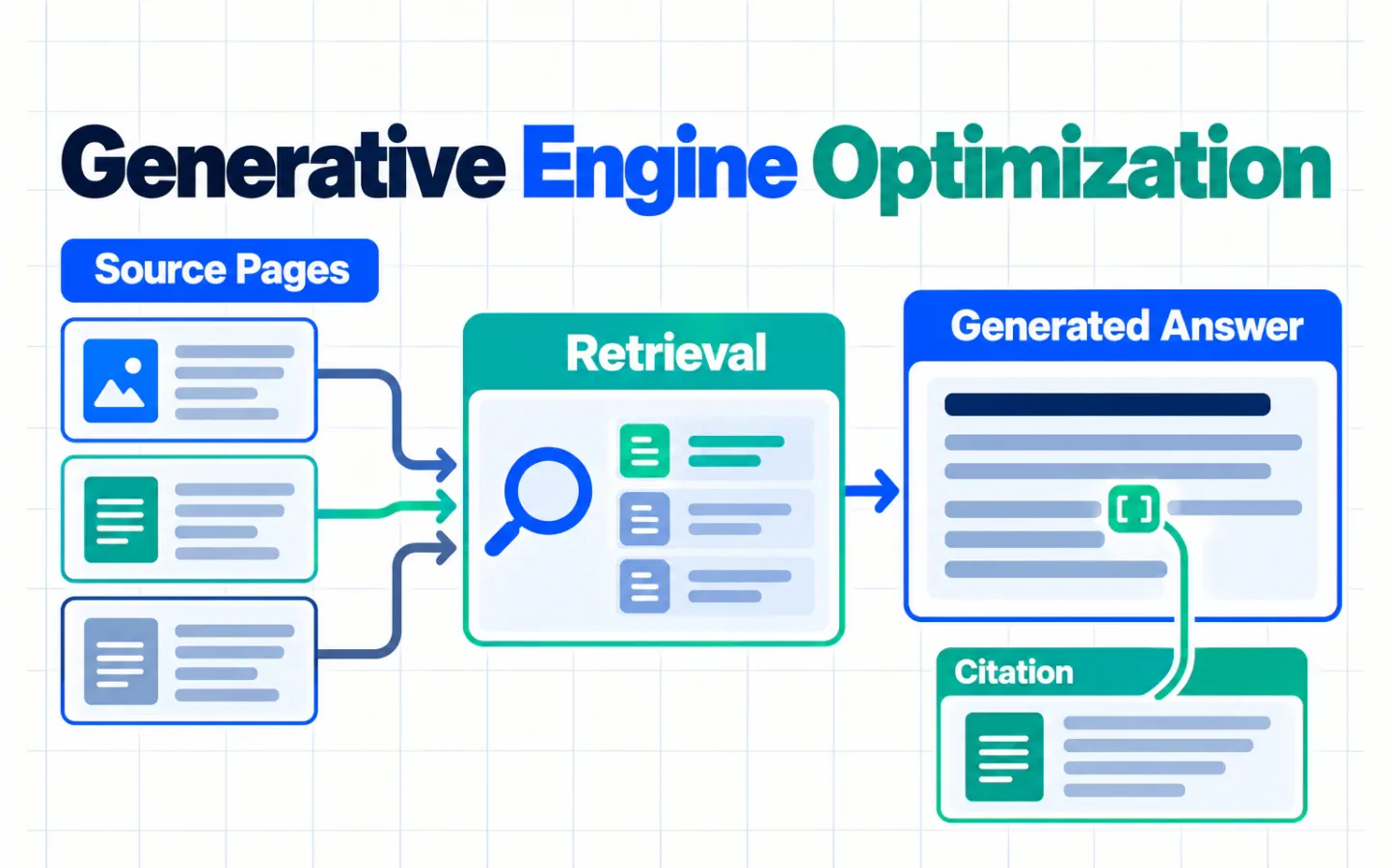
Generative engine optimization, or GEO, is the practice of improving whether a source, claim, or entity appears accurately in a generated answer. The observed result may be a linked citation, an attributed fact, a brand mention, or a recommendation. GEO cannot guarantee any of them.
This definition treats GEO as a measurement problem, not a collection of writing tricks. A team first makes reliable information eligible for discovery. It then tests whether a specific engine retrieves, uses, attributes, and represents that information correctly. Each stage can fail for a different reason.
GEO builds on SEO for search-connected systems, but its outputs need their own scorecard. Rankings and organic clicks remain useful. They do not reveal whether a generated response cited the page, mentioned the brand without a link, or repeated a claim inaccurately.
What Does GEO Mean in Search Marketing?
GEO means generative engine optimization. In search marketing, it describes work intended to improve visibility inside generated responses across AI search and answer products.
There is no universal technical standard that fixes the boundaries of GEO. Google’s AI-search optimization guide treats GEO and AEO as industry terms and says normal SEO guidance still applies to generative Search. Microsoft’s Webmaster Guidelines use GEO for grounding and citation eligibility. Other products expose different crawlers, indexes, controls, and citation interfaces.
That variation is why an operational definition helps. This guide counts four separate outcomes:
- A mention names the organization, product, person, or site.
- A citation links or attributes a claim to a source.
- Inclusion uses information from the source without necessarily naming it.
- Representation describes the entity or claim accurately or inaccurately.
Do not combine these events into one visibility score until the weights and denominator have a defensible reason. A citation can be wrong. A correct mention can send no visit. A referral visit can occur without a visible brand mention.
GEO in this article does not mean geographic targeting or local SEO.
How Does Generative Engine Optimization Work?
Generated answers differ by platform, but a five-stage diagnostic works across systems that retrieve web content.
- Eligibility: Can the system access, render, index, or otherwise discover the source under its published rules?
- Retrieval: Does the source enter the candidate set for the user’s question or a related subquery?
- Use: Does the response rely on a claim, passage, dataset, or entity from that source?
- Attribution: Does the interface name or link the source beside the supported claim?
- Action: Does the appearance lead to a qualified visit, branded search, signup, sale, or another useful outcome?
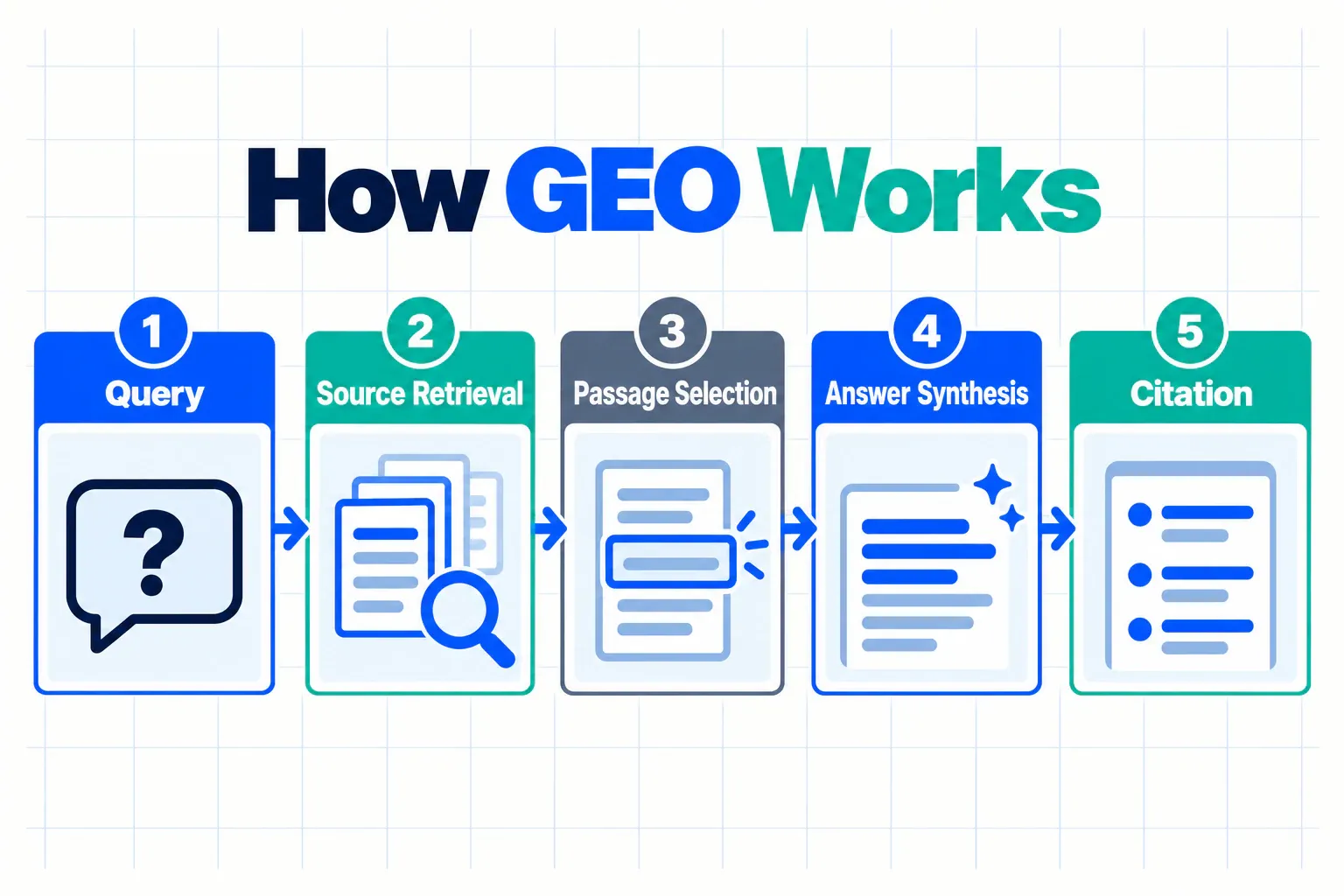
These stages are not a confirmed internal pipeline for every product. They are observable checkpoints for diagnosis. A blocked page has an eligibility problem. A page that appears in retrieval but never informs the response has a content or relevance problem. A used claim with no link has an attribution problem. Strong citations with no qualified actions point to task or offer fit.
Google documents that AI Overviews and AI Mode may use query fan-out to run related searches across subtopics and sources. Do not assume every assistant uses the same method or infer exact hidden queries from one visible answer. Save the engine, mode, prompt, locale, date, and response before diagnosing the stage.
A Citation Can Still Fail the Accuracy Test
Attribution and support are different. A response may display a source link while the adjacent sentence overstates, combines, or contradicts what that source says. The reverse can also happen when a response uses a fact but provides no visible attribution.
An EMNLP 2023 audit of four early generative search engines found that 51.5% of generated sentences were fully supported by citations and 74.5% of citations supported their associated claims. Those figures describe older systems under that study’s method, not current platform accuracy. Their lasting lesson is methodological: record whether a citation exists, whether it supports the nearby claim, and whether the response preserves the source’s scope. One yes-or-no “cited” field cannot capture all three.
GEO vs SEO: What’s the Difference?
SEO improves a page’s eligibility and performance in ranked search results. GEO measures whether generated responses retrieve, use, cite, mention, and accurately represent a source or entity.
| Question | SEO View | GEO View |
|---|---|---|
| Primary output | Ranked search result and qualified visit | Inclusion, citation, mention, or representation in a generated response |
| Main unit | URL and its relationship to the site | Source, claim, passage, dataset, and entity evidence |
| Typical diagnosis | Crawl, index, intent, authority, ranking, or click problem | Eligibility, retrieval, use, attribution, or accuracy problem |
| Core measures | Impressions, position, clicks, CTR, conversions | Citation rate, mention rate, accuracy, cited URLs, referrals, assisted actions |
The two views depend on each other for Google and Bing’s search-connected AI products. Google’s generative features use the Search index. Bing states that its crawl, indexing, structure, and authority foundations also support grounding eligibility. A GEO edit cannot rescue a page that the target system cannot access.
This section is intentionally compact. The full SEO vs GEO vs AEO comparison covers the pairwise differences, priorities, and shared workflow.
GEO vs AEO: Where Do They Overlap?
AEO and GEO overlap in clear answers, structured pages, source quality, and measurement. The useful difference in this guide is the output being tested.
AEO tests a bounded answer. For example, can the system select a complete definition and preserve its condition? GEO tests participation in a synthesis. For example, does a generated comparison retrieve the source, use its criteria, cite it, and describe the organization accurately?
The same page can support both. A technical guide may contain a two-sentence definition suited to a direct answer and an original benchmark suited to a multi-source synthesis. Creating separate AEO and GEO pages for the same task would usually add duplication rather than value.
Platform labels do not create a hard boundary. Google can show a direct response, a multi-source synthesis, or both inside one interface. Define the observed event before selecting a metric. The AEO guide covers bounded answer design, while the comparison guide owns the broader terminology decision.
What Makes Content Easy for AI Engines to Cite?
No published checklist guarantees a citation. The defensible goal is to reduce ambiguity and give a system material worth attributing.
Start with five content properties:
- A precise claim: State who, what, where, when, and under which condition.
- Traceable support: Link the claim to a primary document, method, calculation, transcript, or dataset.
- Visible scope: Put the sample, date, product version, locale, and exclusions beside the result.
- Distinct contribution: Add original evidence, first-hand experience, a useful tool, or a defensible editorial judgment.
- Stable identity: Use consistent names and clear authorship so the source and entity are not confused.
Compare “our tool is fast” with “the test completed a crawl of 10,000 canonical HTML URLs in 18 minutes on version 4.2, excluding images and PDFs.” The second statement can be checked, but it still needs a published method and environment before it becomes credible evidence.
Google’s AI optimization guide recommends unique, non-commodity, people-first content. It rejects the need for special AI schema, llms.txt, forced chunking, or manufactured mentions in Google Search. Bing recommends clear headings, independently verifiable facts, focused URLs, and important information near the top.
Research supports caution. The original GEO paper reported visibility gains of up to about 40% for some methods on its benchmark. The tests used controlled source sets and visibility proxies, not long-term traffic or conversions. A later NeurIPS benchmark found that many conversational SEO rewrites had no benefit or reduced document ranking in its tested settings. Treat every format change as a hypothesis.
How Do You Optimize a Website for GEO?
Work from dependency to experiment. This order prevents a writing change from hiding a technical or measurement failure.
1. Choose the target surface and task. Name the engine, product, locale, audience, and prompt family. “Improve AI visibility” is not a testable target.
2. Confirm platform-specific access. Check index eligibility, canonical URLs, status codes, rendered content, internal links, and crawler controls. OpenAI separates OAI-SearchBot from GPTBot, so search discovery and training controls are not interchangeable. Perplexity also documents separate search and user-triggered fetchers.
3. Map the claim set. List the facts and decisions the target audience needs. Give each material claim a source, owner, review date, and correction path. Remove unsupported precision.
4. Publish the answer with its evidence. Put the direct response near the relevant question, then keep scope, method, exceptions, and the next decision nearby. Use a table only for consistent comparisons and a process only when order matters.
5. Build discovery and corroboration. Add crawlable internal links from relevant pages. Keep organization, author, product, and policy information consistent. Earn external references because the work is useful, not to manufacture mentions.
6. Freeze a baseline and change one material variable. Capture responses and citations before the edit. Record the change date and allow time for recrawl or refresh. Repeat the same prompt set under the same observable conditions.
7. Review accuracy as well as presence. A new mention is not a win when the response assigns the wrong feature, person, price, or conclusion to the entity.
The source selection explainer covers retrieval and attribution in more detail.
How Do You Measure GEO Performance?
Define the observation before calculating a rate. One response should mean one saved answer from one prompt run, engine, mode, date, locale, and account condition. Fix the eligible prompt set and repetition count for the reporting window.
| Metric | Calculation | What It Shows |
|---|---|---|
| Citation rate | Responses with at least one site citation divided by eligible responses | How often the sample links the source |
| Mention rate | Responses naming the entity divided by eligible responses | How often the sample names the entity |
| Representation accuracy | Accurate reviewed mentions divided by mentions reviewed | Whether named facts remain correct |
| Cited URL coverage | Distinct cited URLs during the window | Which source pages participate |
| AI referral conversion rate | Qualified actions from identified AI referrals divided by those sessions | Value after a measurable visit |
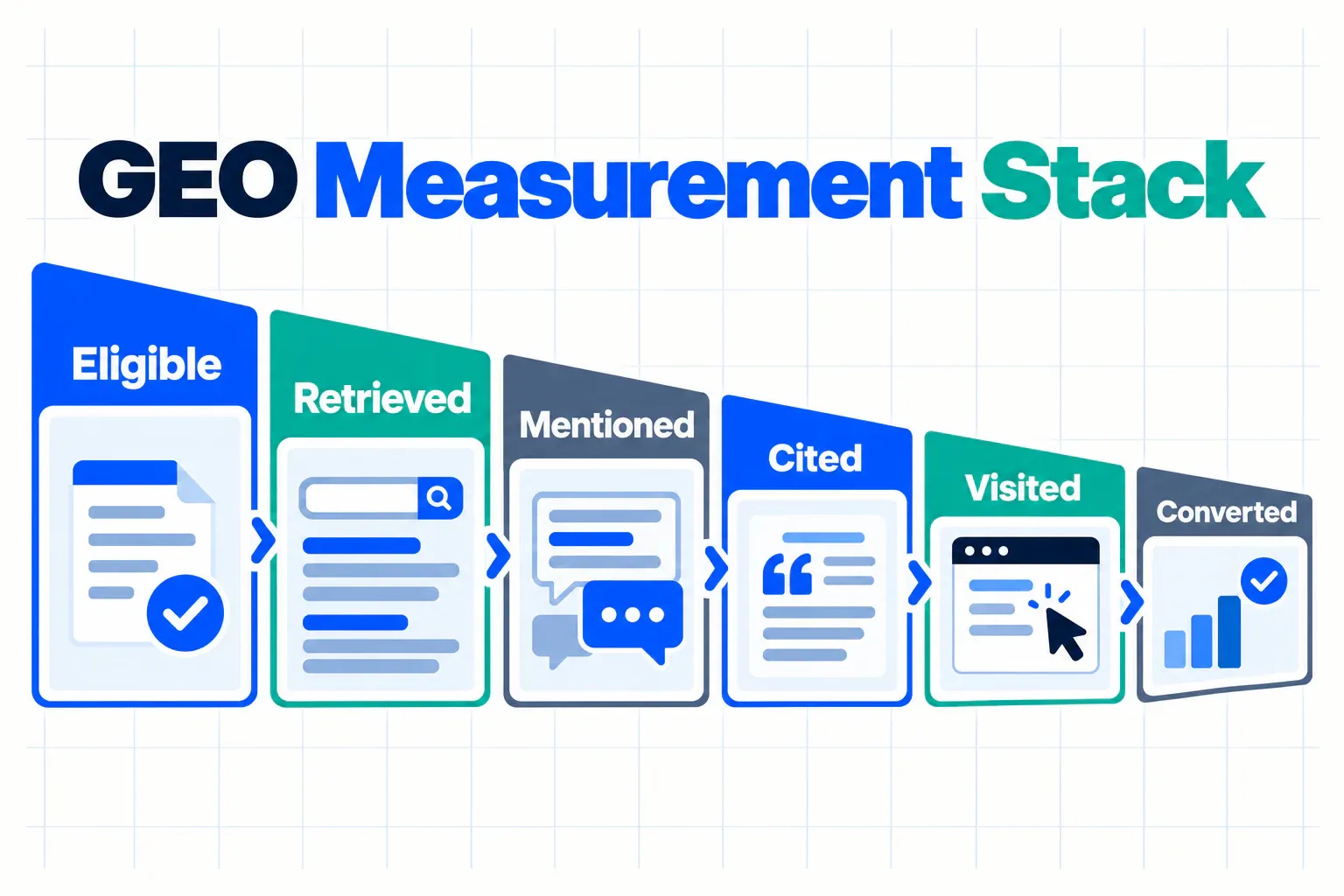
Count a response once for citation rate even when it contains several links to the domain. Count distinct cited URLs separately. Score accuracy against a versioned fact list so the review does not change after seeing the answer.
Google’s Generative AI performance report provides impressions with page, country, device, and date dimensions for supported Google features. An impression is not a citation or click. Bing’s AI Performance report includes total citations, cited pages, sampled grounding queries, and trends. Bing explicitly says citation activity does not indicate ranking, authority, or a page’s role in an answer.
GIndexa’s Running GEO Field Test
Since August 2026, GIndexa has checked fixed informational prompt families weekly across ChatGPT, Perplexity, Google AI Mode, and Claude. We saved the baseline before the test pages existed, then varied passage format, source specificity, and internal linking one at a time where possible.
| Fixed Inputs | Varied Inputs | Logged Outcomes |
|---|---|---|
| Prompt family, weekly schedule, publishing identity | Direct answer vs buildup, original data vs restatement, supported vs orphan page | Full response, shown sources, retrieval, mention, and direct citation |
The public experiment record remains marked running. Early observations show retrieval and mentions appearing before a direct citation, but the sample is not yet strong enough for a final claim or rate. Engine disagreement and week-to-week variation remain material limits.
This protocol shaped the separate metrics above. It also explains why we report raw counts by engine and prompt family rather than one blended GEO score. The AI visibility audit provides the capture fields for teams that want to reproduce the method.
Is GEO Replacing Traditional SEO?
No. GEO adds outcomes and diagnostics to SEO. It does not remove the need for crawlable pages, canonical URLs, search intent, useful content, internal links, authority, or a good destination.
The relationship is clearest in search-connected products. A page first needs a reliable discovery path. A system can then retrieve its content for a generated response. If the source participates, the interface may or may not attribute it. A person may or may not visit. SEO supports the early stages, while GEO makes the later stages visible enough to test.
The balance varies by business. A documentation-heavy software company may care about accurate citations inside complex comparisons. A local service may gain more from map visibility, current business details, and strong landing pages. A new publisher with basic index problems should fix those before funding a large prompt-monitoring program.
Choose the next action from the failed stage, not from the newest acronym.
Frequently Asked Questions About GEO
How Much Does GEO Cost?
The minimum cost is research and measurement time. A small team can start with a fixed prompt set, a spreadsheet, Search Console, Bing Webmaster Tools, and server or analytics data. Paid monitoring becomes useful when many prompts, markets, and engines make manual capture unreliable.
Which GEO Tools Do You Need?
Use platform reports for observed impressions or citations, normal technical SEO tools for access and index checks, analytics for referral outcomes, and a versioned log for saved responses. No single tool observes every stage or engine.
How Long Does GEO Take to Work?
There is no standard timeline. Discovery, recrawl, index refresh, prompt demand, engine behavior, and response variation all affect observation. Set a review window before changing the page, and avoid calling one appearance a durable result.
Can a Small Website Compete in GEO?
A small site can publish narrow, original evidence that larger pages lack, but domain size alone does not predict selection. Test a specific source and prompt set. Do not turn the possibility into a promise that small sites win faster.
Does Schema Markup Guarantee an AI Citation?
No. Accurate structured data can help a system understand visible content and can support eligibility for documented search features. Google documents no special schema that guarantees inclusion in its AI features.
What Is GEO? A Practical Definition
GEO is a testable effort to improve how a source, claim, or entity appears in generated answers. Start with search eligibility, publish distinct and verifiable evidence, then measure retrieval, use, attribution, accuracy, and downstream action separately. The label is useful only when it leads to a clearer diagnosis and a result the team can reproduce.