
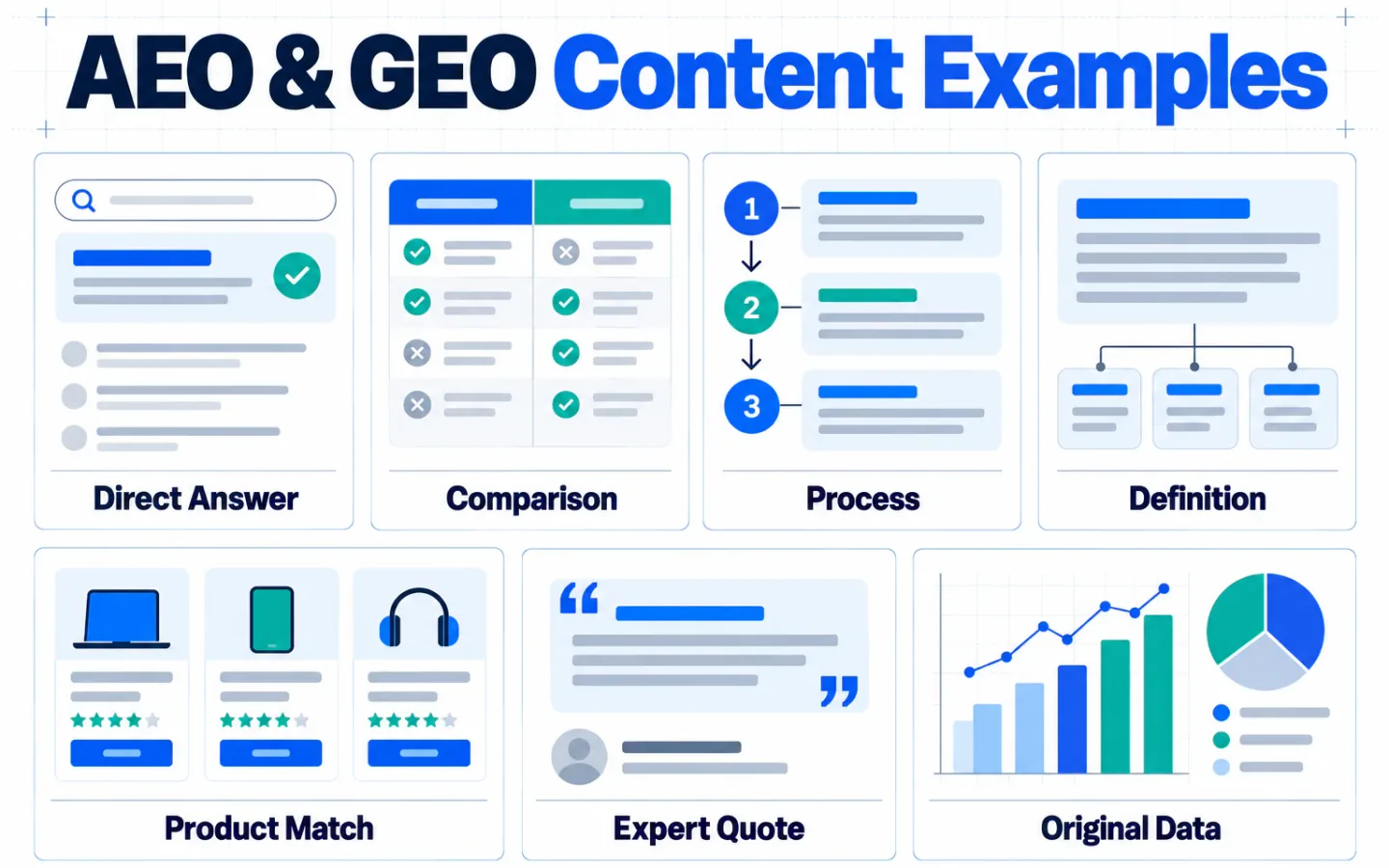
AEO- and GEO-ready content gives a reader a complete answer, then places the evidence needed to verify it nearby. The format can be a paragraph, table, process, comparison, expert comment, or data summary. The format alone does not earn an answer placement or citation.
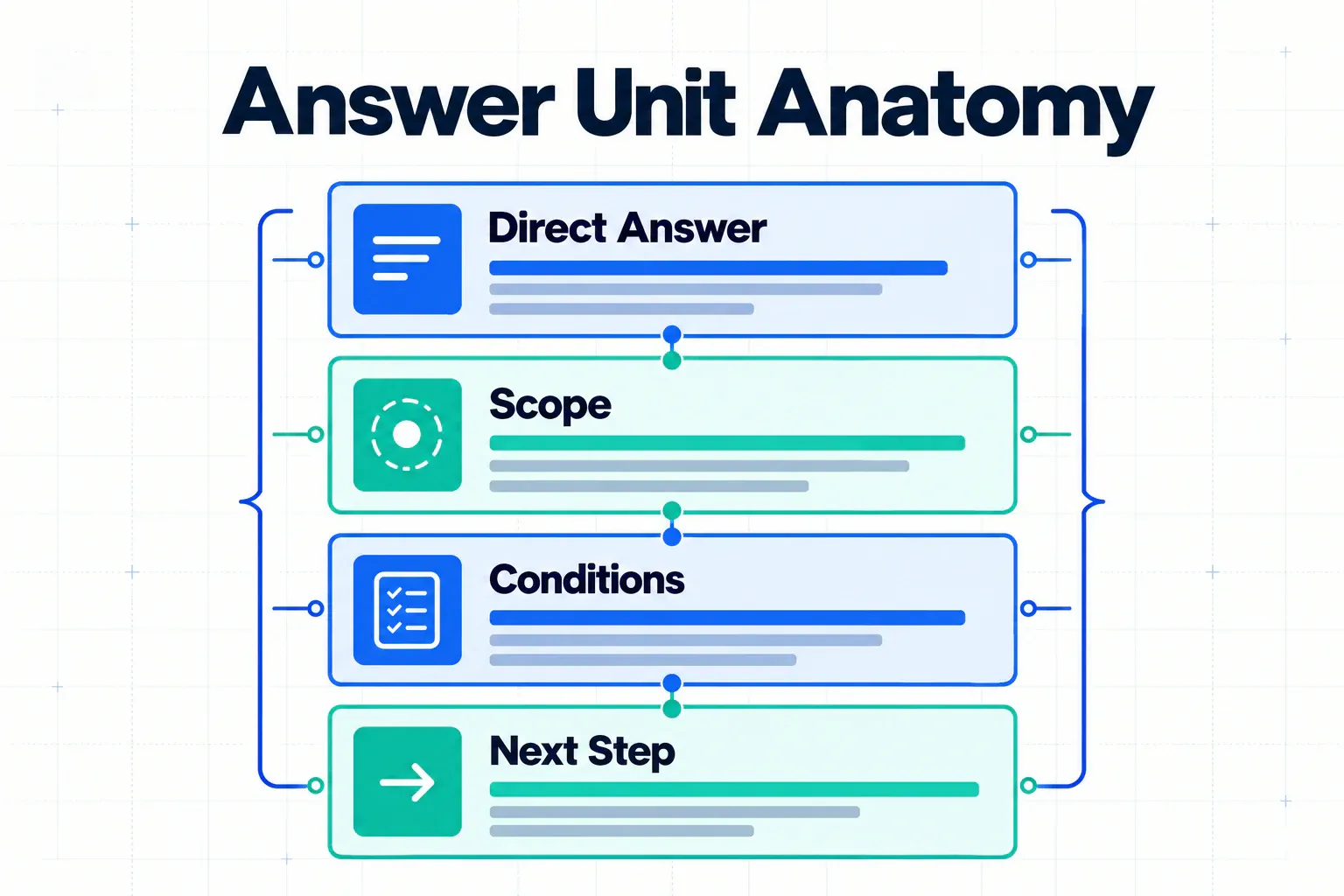
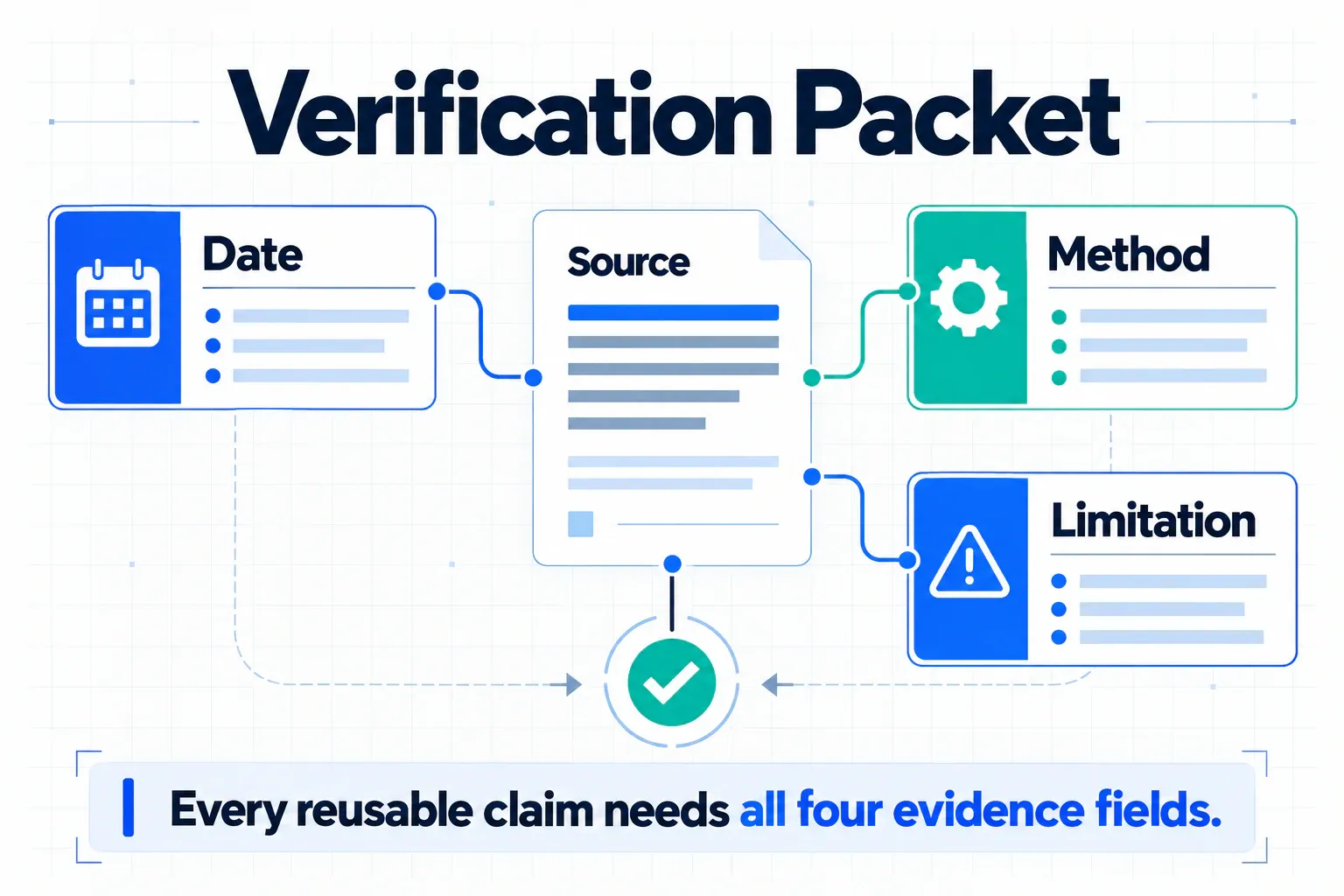
The seven examples below use one editorial model. Each has an answer unit, the smallest passage that resolves the question, and a verification packet, the scope, source, date, method, and limitation that keep the passage accurate. Examples 6 and 7 use a published expert statement and GIndexa first-party data. The other examples are annotated editorial demonstrations, not performance tests.
This model is deliberately stricter than “write short paragraphs for AI.” It produces content that remains useful even when no answer engine selects it.
What Does Content Built for AEO and GEO Look Like?
Content built for answer engines is easy to locate, understand, verify, and use without stripping away an important condition. It opens with the answer, names the subject clearly, supports non-obvious claims, and uses a format that matches the task.
This guide uses AEO for bounded answers and GEO for inclusion within generated explanations, comparisons, or recommendations. These are working definitions, not universal standards. The AEO guide and GEO explainer cover the terms in depth.
Google’s AI features documentation says normal SEO requirements still apply and describes no special schema or AI file that guarantees inclusion. Bing’s Webmaster Guidelines recommend explicit facts, clear structure, visible key information, and independently verifiable content for grounding eligibility. Neither platform promises selection.
Use the format that best answers the question. Do not convert a natural explanation into a table or FAQ solely because it looks easier for a machine to parse.
Choose the Format From the Evidence Shape
Pick a format after you know what the reader must inspect. Use a paragraph when one answer needs a qualification. Use a table when several options share the same attributes. Use numbered steps when order changes the outcome. Use a quote when a named person’s direct experience is the evidence. Use a data summary when the method and denominator matter as much as the finding.
Run a deletion test before publishing. Remove the table, list, quote, or statistic and ask what useful information disappears. If the same point survives unchanged in one sentence, the format may be decoration. If removing it hides the comparison axis, decision point, provenance, or uncertainty, the format is doing real work.
This test also controls page length. A page does not become more reusable by stacking every format. One strong answer block followed by a traceable source may serve the task better than a table, checklist, and FAQ that repeat it.
Example 1: A Direct Answer Block
A direct answer block works when the question has a stable response that can fit into two or three sentences. It should resolve the question first, then preserve the condition that changes the answer.
Weak version:
Canonical tags are very important for SEO. There are many situations where websites may have duplicate pages, so using them correctly can help search engines understand your site.
Improved version:
A canonical tag identifies the URL you prefer search engines to treat as representative when several URLs contain duplicate or very similar content. It is a strong signal, not a rule, so Google may choose another URL when other signals conflict. Use redirects when a page has permanently moved.
The improved block answers “What does a canonical tag do?” in its first sentence. The second sentence prevents a common overclaim. The final sentence gives the reader a decision boundary. Google’s canonicalization guidance supports those distinctions.
The answer unit is the first sentence. The verification packet is the qualification and official source. Keep both together so extraction does not turn a preference signal into a guarantee.
Example 2: A Comparison Table
Comparison tables work when every option can be judged through the same attributes. A table fails when its rows mix facts, opinions, and blank marketing language.
Weak version:
| Method | Verdict |
|---|---|
| 301 redirect | Best for SEO |
| Canonical tag | Good for duplicates |
Improved version:
| Question | 301 Redirect | Canonical Tag |
|---|---|---|
| Does the old URL remain available to users? | No, the request moves to the destination | Yes, both URLs may remain accessible |
| Primary job | Signal a permanent move | Consolidate duplicate or very similar URLs |
| What should internal links use? | The final destination | The preferred canonical URL |
| Important limit | A poor destination can still lose relevance | Search engines may select a different canonical |
The improved table defines one comparison axis per row. A reader can inspect one question across both options without decoding a score. Each row also states a limitation, which makes the table safer to quote outside the article.
For any commercial comparison, add the testing date, criteria, sample, who performed the review, and what was not tested. Google’s review guidance favors evidence of experience, quantitative measurements where appropriate, original research, and clear decision factors over thin summaries.
Example 3: A Step-by-Step Process
A process suits a task with a required order, decision points, and a verifiable finish. Numbering generic advice does not make it a process.
Weak version:
- Check the page.
- Fix the issue.
- Request indexing.
Improved version for an unexpectedly excluded page:
- Fetch the exact URL. Record the final status code, redirect chain, and rendered destination.
- Check access controls. Inspect robots.txt, the robots meta tag, and any
X-Robots-Tagheader. - Confirm the canonical. Compare the declared canonical with the URL that search tools report as selected.
- Verify useful rendered content. Confirm that the main answer appears in the HTML available to the crawler.
- Request validation only after the cause is fixed. Save the change date and recheck the same URL.
Each step begins with an action and produces evidence. Step two can stop the sequence if the page is intentionally excluded. Step five defines completion as a verified change, not a button click.
The answer unit is the ordered procedure. Its verification packet is the saved URL-level evidence, including the date and tool used. Keep optional background outside the steps so readers can execute the process without hunting for the next action.
Example 4: An Evidence-Backed Definition
A strong definition states what the term includes, what it excludes, and how the article will use it. This matters when industry terminology has no agreed technical standard.
Weak version:
GEO is the future of SEO and makes brands rank in ChatGPT.
Improved version:
Generative engine optimization, or GEO, is a working label for efforts to improve whether a source, claim, or entity appears in a generated response. An observed result may be a citation, an attributed claim, or a brand mention. GEO does not guarantee any of those outcomes, and platform behavior differs.
The definition avoids treating a marketing term as a protocol. It separates three observable events and gives the reader a measurement boundary. The original GEO paper introduced a benchmark and visibility measures, but its reported gains came from controlled test conditions. They were not traffic or conversion guarantees.
For contested terms, date the definition and name the source or editorial convention behind it. If sources disagree, state the disagreement instead of merging their claims into false certainty.
Example 5: A Product or Tool Comparison
Tool comparisons become reusable when selection rules appear before the recommendation. Start with the user’s constraint, test every option through the same method, and separate observed capability from editorial fit.
Consider a team choosing a keyword data source:
| Need | Search Console | Keyword Planner | Third-Party Keyword Database |
|---|---|---|---|
| Queries that already surfaced your site | Strong fit | Not designed for this job | Varies by platform |
| Demand estimates for topics you do not rank for | Limited | Provides rounded search estimates | Usually available through modeled datasets |
| Organic difficulty estimate | Not provided | Ad competition is not organic difficulty | Vendor-specific estimate |
| Main limitation | Covers your observed Google Search data | Estimates depend on settings and close variants | Method and coverage vary by provider |
This comparison does not crown a universal winner. It shows that the correct tool depends on whether the team needs observed first-party queries or market estimates. Google’s Search Console report documentation and Keyword Planner definitions support the platform-specific rows.
If you have not tested a product, do not imply hands-on experience. Mark vendor-reported features as vendor-reported, record the plan and date tested, and leave unknown cells unknown.
Example 6: An Expert Quote With Context
An expert quote helps when the speaker, relevance, source, date, and claim remain visible. Consider this statement from an official Google Search Central post:
“Focus on making unique, non-commodity content.”
John Mueller, Google Search Relations, May 21, 2025
The source post addresses success in Google’s classic and AI search experiences. Mueller’s role and the official publication make the statement relevant to Google Search guidance. Its scope does not prove that originality guarantees an AI citation, and it says nothing about another platform’s selection system.
The useful editorial implication is narrower: a page needs a contribution beyond rearranging facts already present in the results. That may be a test, dataset, tool, firsthand procedure, or defensible analysis.
Keep the complete source passage and publication record in the verification packet. Quote the exact words, distinguish the source’s claim from your interpretation, and disclose any relationship with an interviewed expert. Never invent or silently combine quotations.
Example 7: An Original Data Summary
Original data becomes useful when the result, denominator, method, and limitation travel together. GIndexa’s redirect study provides a real example:
From August 24 to September 15, 2026, we observed a root-to-www consolidation across two Search Console properties, Google crawl statistics, analytics, and about 5,200 referring links. The destination property’s rolling 28-day view recorded 8.23K clicks and 70.2K impressions while the retiring root property declined toward zero. Crawl demand also shifted toward the destination.
The full redirect case study publishes the source properties, 22-day observation period, implementation, and crawl evidence. The summary names what changed and what was measured rather than claiming that redirects never reduce traffic.
Its limits belong beside the result. This was one root-to-www consolidation without a randomized control. The rolling 28-day performance window overlaps the cutover, and other demand or ranking changes could affect the totals. The case supports what happened on this site under the documented implementation. It does not establish a universal loss rate.
Apply the same structure to AI visibility data. Define each eligible response, citation, mention, prompt version, engine, locale, date, and missing run. Bing’s AI Performance documentation also separates citation activity, cited pages, and sampled grounding queries. A citation count alone does not establish accuracy, traffic, or causation.
How the Same Content Changes for AEO vs GEO
The source material can stay the same while the diagnostic unit changes.
| Content Element | AEO-Shaped Test | GEO-Shaped Test |
|---|---|---|
| Direct definition | Was the complete answer selected and kept accurate? | Was the definition retrieved, used, cited, or paraphrased? |
| Comparison table | Did the answer preserve the decisive row and condition? | Did a generated comparison use the criteria and attribute the source? |
| Original dataset | Did the answer state the finding with its scope? | Did the response cite the study and represent its method correctly? |
| Expert comment | Did the answer preserve speaker and context? | Did the response connect the claim to the correct person and source? |
Do not create separate AEO and GEO versions of the same page by default. Publish one strong source, then measure answer selection, citations, mentions, and accuracy as separate events. The guide to what AI search citations reward covers source-level considerations.
A Reusable AEO and GEO Content Template
Use this structure as a brief, not a quota:
# [Title That Names the Reader's Task]

[Direct answer in two or three sentences. Include the condition that changes it.]

## [First Follow-Up Question]

[Answer unit]

[Evidence: source, method, date, scope, and limitation]

[Worked example or decision point]

## [Comparison or Process, Only if the Task Needs One]

[Table with consistent attributes OR ordered actions with a finish test]

## [Measurement or Next Decision]

[What to record, how to interpret it, and what action follows]
Add authorship, update history, canonical metadata, and relevant internal links in the publishing system. Use structured data only when a supported type matches visible content. Do not add repetitive questions, fake quotes, untested claims, or invented statistics to fill the template.
How to Audit Content Before Publishing
Run the audit at claim level, then page level.
| Check | Evidence to Inspect | Stop the Release When |
|---|---|---|
| Accuracy | Primary source, transcript, calculation, or test record | A material claim has no support |
| Extractability | Answer read without its surrounding paragraph | Removing context changes the meaning |
| Scope | Date, population, product version, locale, and exclusions | The wording generalizes beyond the evidence |
| Crawlability | Status, canonical, robots controls, rendered HTML, links | The intended page is blocked or inconsistent |
| Structure | Heading order, table axes, process decisions | Formatting hides the task or mixes attributes |
| Links | Live destinations and descriptive anchors | A source is broken or an internal target redirects |
| Measurement | Defined event, denominator, baseline, and review date | Success cannot be observed consistently |
Finish with a human read. If the page sounds like a stack of answer snippets, restore the transitions and context a real reader needs. Machine-friendly structure should improve the page, not turn it into a database export.
Frequently Asked Questions About AEO and GEO Content
Does Schema Markup Make Content AEO- or GEO-Ready?
No. Accurate structured data can help systems understand visible content and can create eligibility for supported search features. It does not guarantee a direct answer, citation, ranking, or visit.
Can AI-Written Content Work for AEO and GEO?
The production method matters less than accuracy, originality, and usefulness. Google’s spam policies warn against scaled content created mainly to manipulate rankings. A human editor must verify every material claim, source, example, and limitation.
Do AI Citations Guarantee Referral Traffic?
No. A citation is an appearance event. Track cited responses, referral sessions, and downstream actions separately because one can rise without the others.
AEO and GEO Content Examples Worth Reusing
The reusable pattern is not a special paragraph length or heading formula. Give each question a complete answer unit, attach a verification packet, and choose the format that fits the task. These AEO and GEO content examples work because readers can act on them and editors can audit them, even when an answer engine never selects the page.