
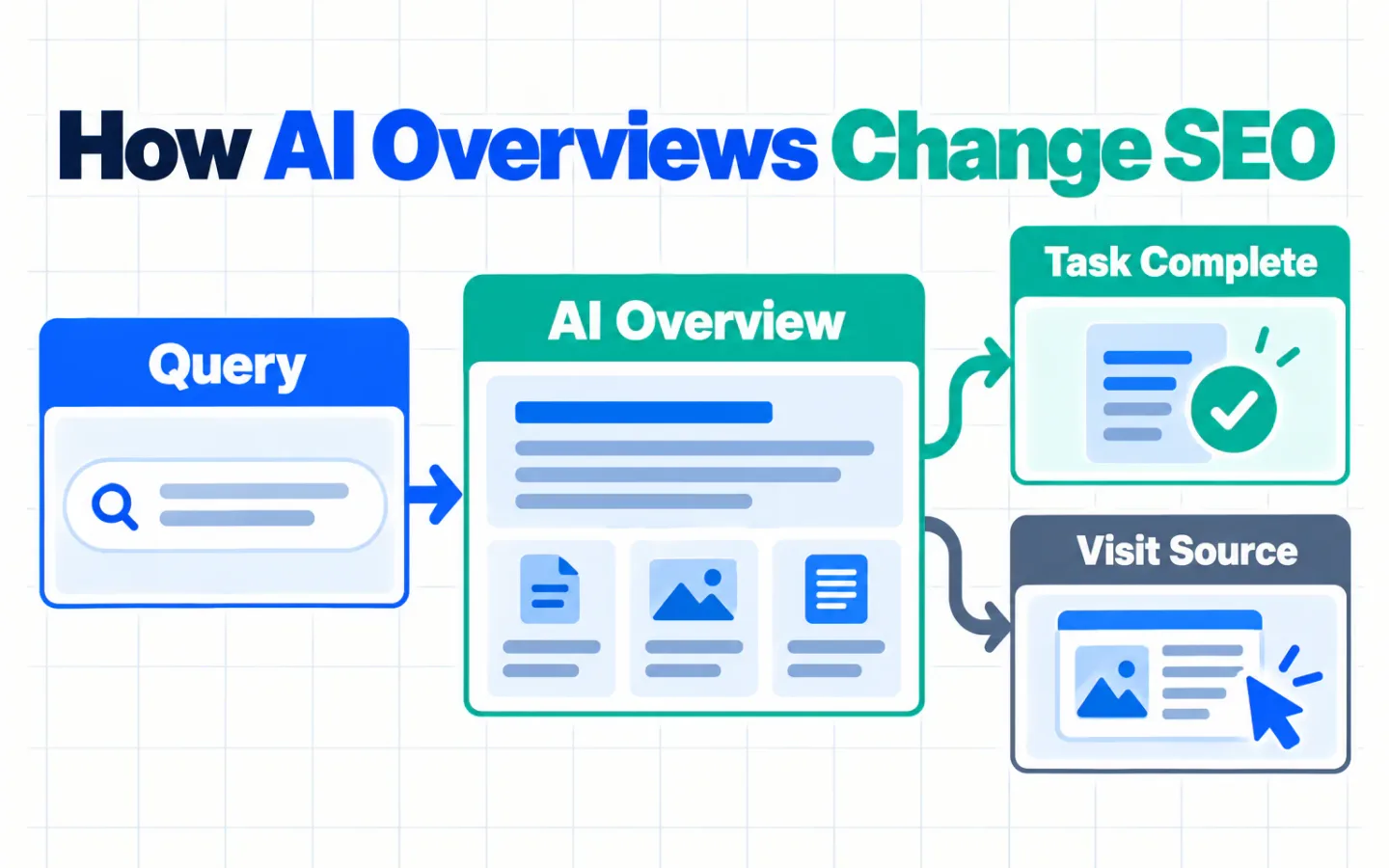
AI Overviews change SEO by answering part of the query before a user visits a website. That can reduce clicks when the summary completes the task, while increasing the value of visits that continue to a source. The effect is not uniform. It depends on query type, interface, device, source placement, and whether the user still needs experience, data, a tool, or a transaction.
Traditional SEO still matters because Google’s AI features use the Search index and normal search eligibility. The strategic change is broader: rankings and total clicks can no longer describe the full journey. Teams need to measure exposure by query type, create pages a summary cannot fully replace, and separate AI visibility from referral traffic and business outcomes.
How Generated Answers Change the Search Results Page
An AI Overview is a generated summary that can appear within ordinary Google results. It may answer the opening question, cite supporting pages, and lead into follow-up exploration. AI Mode is a more conversational search experience built around generated responses. They are related products, but they are not the same interface.
Google’s AI features documentation says both experiences may use query fan-out, where the system runs related searches across subtopics and sources. The models, techniques, and links can vary between responses. An AI Overview also appears only when Google’s systems determine that it adds value.
The journey can therefore change from:
query -> ranked result -> website -> next question
to:
query -> generated summary -> follow-up or cited source -> website when more work remains
That final condition matters. A definition may end inside the summary. A software trial, calculator, detailed method, original dataset, or purchase still requires a destination. SEO strategy should distinguish summary-complete tasks from tasks that need a site.
Do AI Overviews Reduce Organic Clicks?
Many exposed searches lose external clicks, but published percentages use incompatible units. GIndexa recalculated the reported figures below without pooling them into one headline estimate.
| Evidence and Window | Published Result | GIndexa Normalization | Main Limit |
|---|---|---|---|
| Pew browser data, 900 US adults and 68,879 searches, March 2025 | Traditional-result clicks occurred in 8% of visits with a summary and 15% without one. Summary links received 1%. | The difference is minus 7 percentage points, or 46.7% relative to the 15% comparison rate. | Observational visits, one country, and one month do not establish causation. |
| Preregistered field experiment, 1,100 participants who searched, 2026 preprint | Exposure to the delivered No-AI condition raised external CTR by 8.8 points in a local treatment estimate. Assignment to forced AI Mode reduced it by 18.8 points. | Both figures are percentage points, but they use different causal estimands. | AI hiding succeeded for only part of assigned browsing, and the preprint reflects one product version. |
| Ahrefs, 150,000 informational keywords with Overviews and 150,000 informational controls, March 2024 to March 2025 | Position-one desktop CTR was 34.5% below the matched forecast. | The 34.5% is relative, not a 34.5-point loss. | Current SERP labels applied to history, updates, and informational selection limit causal claims. |
| Semrush and Datos, more than 200,000 keywords tracked January to October 2025, with a matched May to October subset | Zero-click rate moved from 33.75% before an Overview to 31.53% after. | Zero-click fell 2.22 points in this cohort, the opposite of a simple universal-loss claim. | Proprietary sampling and intent mix prevent broad inference. |
Google separately reported stable overall organic click volume and slightly higher click quality without publishing its sample or method. The conflict is informative: user-level visits, keyword CTR, zero-click behavior, experiments, and company totals answer different questions.
Build a Matched Exposure Cohort
For your site, mark the first observed Overview date for stable query-page pairs. Match exposed and comparison groups by intent, device, country, position range, and seasonality. Freeze pre-period and post-period windows, then compare clicks and CTR within each group.
Log ranking changes, site releases, Google updates, and query-mix shifts. If a page also moves from position two to six, the CTR change cannot be assigned to the Overview alone. Report the site result as an estimate with uncertainty, not as proof unless exposure was randomized.
Which Queries Face the Most Click Risk?
No permanent list exists because triggering and interfaces change. Use a task-replacement test instead. Ask whether a concise synthesis can complete the user’s job without a visit.
| Query Shape | Summary Substitution Risk | Why a Visit May Still Happen |
|---|---|---|
| Stable definition or short factual answer | High | The summary may complete the task |
| Basic steps with few conditions | Medium to high | Users may need screenshots, troubleshooting, or confirmation |
| Multi-factor comparison | Medium | Buyers need criteria, current prices, testing, and fit details |
| Original research or current data | Lower substitution, higher citation potential | The full method, tables, and limits remain on the source |
| Interactive calculation or tool | Low | The user must perform an action |
| Transactional or navigational task | Low | Completion requires the destination |
| First-hand review or complex implementation | Lower | Experience, evidence, and edge cases exceed a short summary |
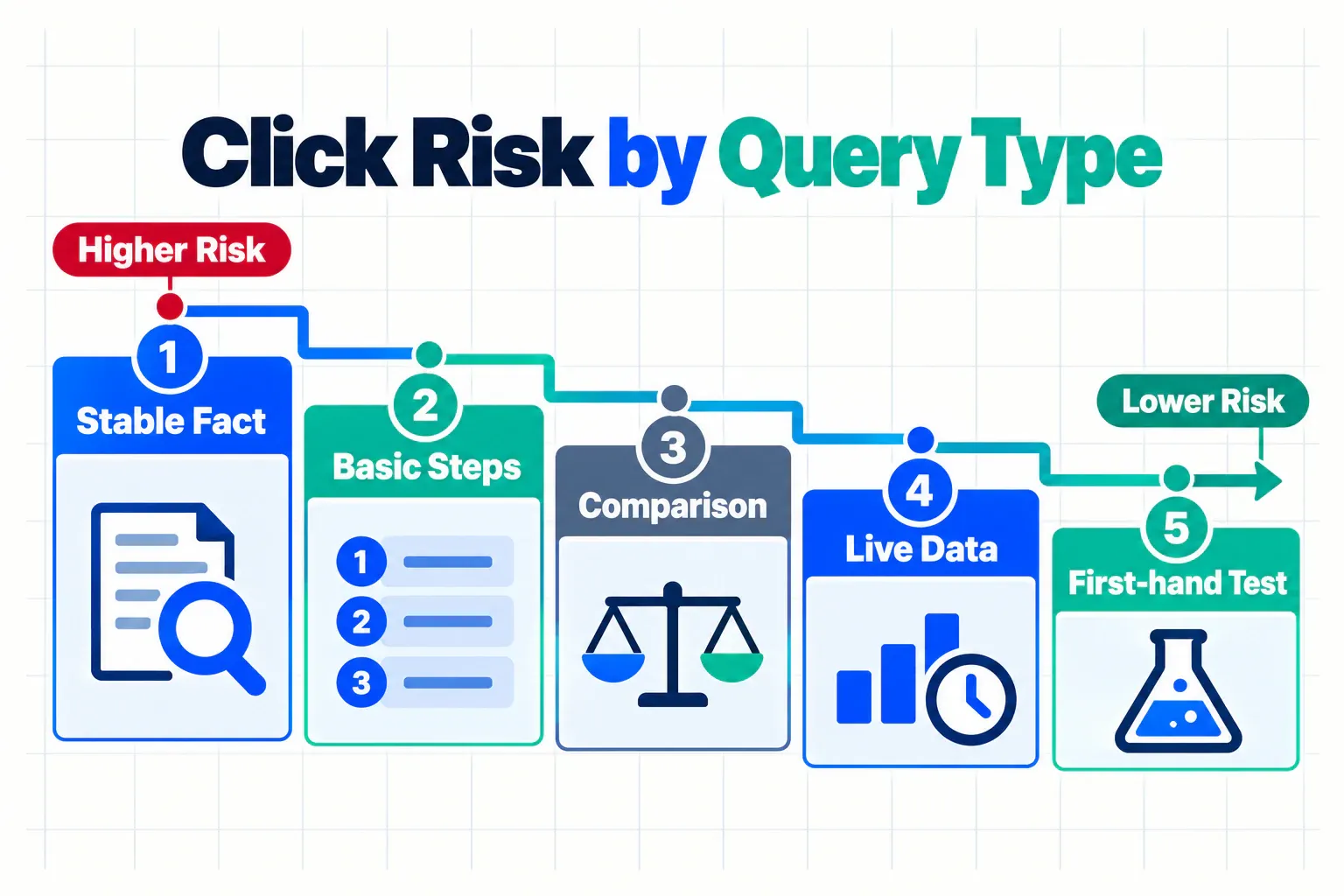
This matrix is an editorial diagnostic, not a Google ranking model. Validate it against your own results. Save the query, device, country, date, AI feature, cited pages, and whether the task ended on Google.
Prioritize pages where high-value demand meets high substitution risk. A broad definition with low business value may not deserve a rescue project. A comparison that drives qualified trials probably does.
The response also changes by site type. A SaaS team should protect implementation guides, API examples, and trials that a summary cannot execute. A publisher should attach original interviews, datasets, and methods to exposed explainers. An ecommerce team should keep live availability, configuration, and verified product evidence current. A YMYL publisher needs dated sources, named review responsibility, and correction controls before it worries about citation volume. These are different production jobs, even when all four sites see the same AI Overview interface.
How Blog Traffic Changes When Answers Stay on Google
Informational blogs carry the most obvious exposure because many posts answer questions that a summary can compress. The failure usually appears as a widening gap between impressions and visits, not as an immediate loss of ranking.
Segment blog queries into three groups:
- Summary-complete queries need one fact or definition.
- Summary-start queries lead to a method, decision, or deeper explanation.
- Site-required queries need a tool, dataset, template, community, or transaction.
For each group, compare CTR by page, device, country, and similar position ranges before and after exposure. Do not compare the sitewide CTR of unrelated query mixes. Search Console position also needs care because Google counts an AI Overview as one search position and assigns that position to its links under the current metric rules.
A useful impact estimate is:
exposed impressions x matched CTR change x value per visit
Use a range, not one forecast. Mark the exposure date and interface changes. This model shows whether the real risk comes from reach, click behavior, or the value of affected visits.
Is Traditional SEO Still Important After AI Mode?
Yes. Google states that pages need to be indexed, eligible to appear with a snippet, and included under the site-level Search generative AI control before they can support links in its AI features. There are no additional technical requirements and no special schema required for inclusion.
That keeps the familiar dependency chain intact:
- The crawler must reach and render the page.
- Google must be able to index a canonical version.
- The page must match a useful search task.
- The content and site must provide signals that make the result competitive.
- A generated feature may then choose to use or link to it.
An AI formatting tactic cannot repair a blocked page, weak intent match, duplicate URL, or unsupported claim. The broader SEO strategy that compounds remains the base.
Google’s generative AI optimization guide also says llms.txt, special AI markup, and forced content chunking are not required for Google Search. Treat claims that one file or paragraph formula guarantees visibility as sales claims, not platform guidance.
How to Structure Pages for Generated Answers
Structure should help readers find and verify the answer. It cannot guarantee selection.
Open each important section with the result, then supply scope, evidence, exceptions, and a next decision. Use descriptive headings when they improve navigation. Build tables only from consistent attributes. Keep facts in crawlable text, and ensure structured data matches visible content.
Weak version:
AI search is rapidly changing the search environment, and businesses must adapt their content to stay visible in this exciting new era.
Useful version:
An AI Overview can reduce external clicks when its summary completes the user’s task. Measure the effect by query group, because a definition, comparison, and calculator have different reasons to earn a visit.
The second passage makes a bounded claim and gives the next action. It can stand alone without pretending every site faces the same loss.
Original evidence matters because a summary needs something specific to reuse. Publish the method and limits beside any result. The mechanics of source selection belong in the guide to what AI search citations reward, not in another list of speculative ranking factors.
How to Measure SEO When Rankings Are Not Enough
Keep each stage separate so an appearance cannot masquerade as a visit or conversion.
| Layer | Metric | Interpretation |
|---|---|---|
| Eligibility | Indexed canonical pages and relevant impressions | The page can participate in Search |
| Organic discovery | Query, page, position, clicks, and matched CTR | Users saw and selected a result |
| Generative exposure | AI feature impressions by page, country, device, and date | A site link appeared in a supported Google feature |
| Citation sample | Saved responses with a citation divided by eligible responses | Visibility in a fixed prompt sample |
| Business result | Qualified action or assisted conversion | The visit created measurable value |
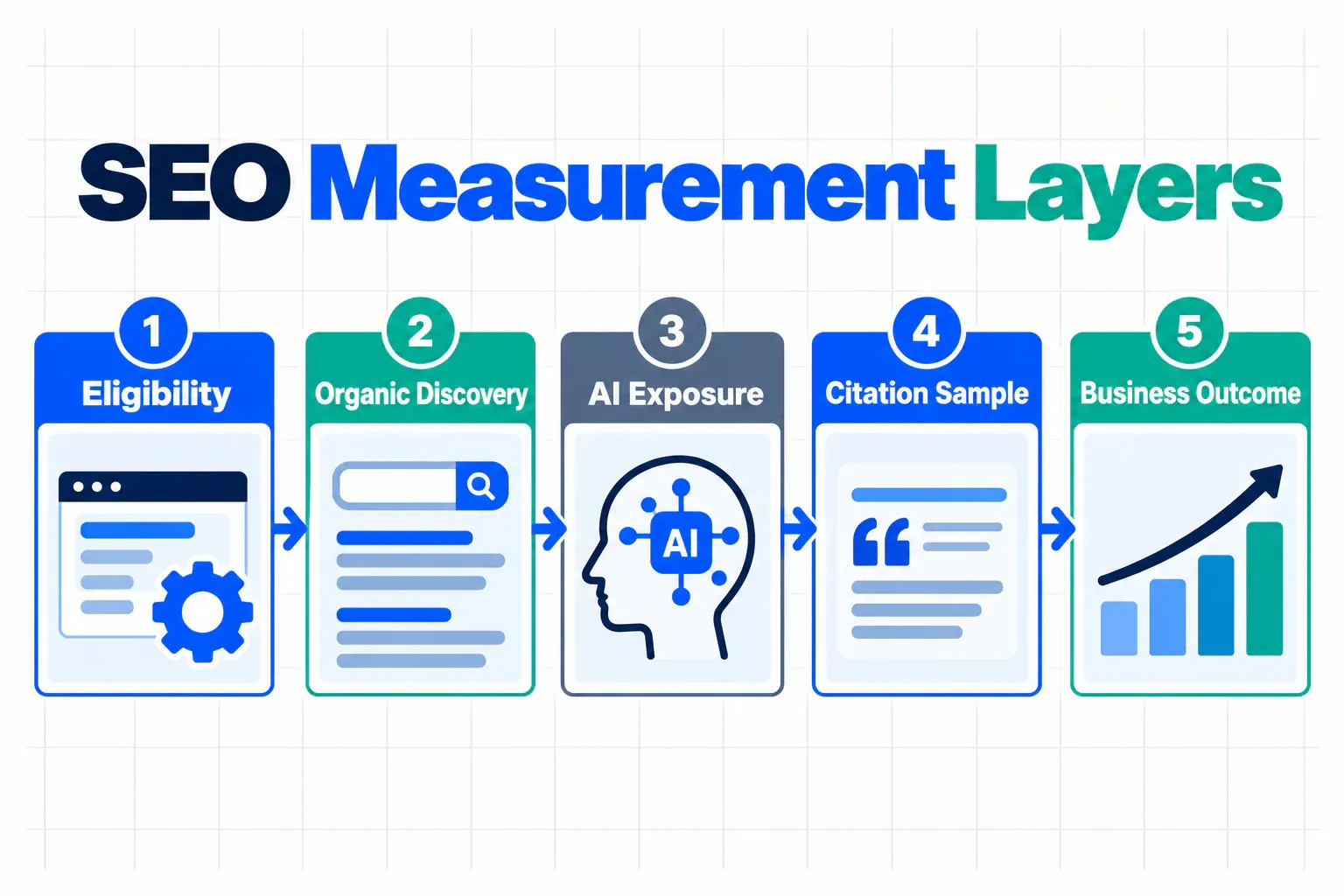
Google’s Generative AI performance report supplies impressions, not a separate click or CTR measure. It counts a shown site link, not every occurrence of an AI Overview, and its charts and tables aggregate differently.
Freeze prompts, engine modes, locale, account state, repetitions, and dates for manual tests. Annotate content releases, ranking changes, Google updates, and control changes. A visible page with falling CTR may need stronger site-required value. A cited page with an inaccurate claim needs correction, not more exposure.
Concerns About AI in SEO and Content Marketing
The main risks are operational, not abstract.
| Risk | Practical Response |
|---|---|
| Source traffic declines | Quantify exposed query groups and strengthen site-required value |
| Generated answers misstate a claim | Publish explicit facts, dates, entities, and correction paths, then monitor saved responses |
| Publishers produce interchangeable summaries | Require original evidence, experience, or a clear editorial decision in every brief |
| Visibility concentrates on a few sources | Track distinct cited URLs and diversify discovery beyond one platform |
| Attribution remains opaque | Separate platform reports, prompt samples, referrals, and conversions |
| Teams chase undocumented tricks | Test one change against a baseline and retain the negative result |
Publishers also need an explicit control decision. Google’s 2026 Search generative AI control can exclude a site from links and grounding in supported Google generative features without removing it from ordinary Search. That choice can reduce AI exposure and related traffic. It does not control model training, which uses a separate mechanism.
Frequently Asked Questions About AI Overviews and SEO
Is an AI Overview the Same as AI Mode?
No. An AI Overview appears within ordinary results when Google decides it adds value. AI Mode is a conversational search interface designed for generated responses and follow-up questions.
Does a Click From an AI Overview Count in Search Console?
Under Google’s current rules, clicking an external link counts as a click. An AI Overview impression and position follow the documented Search appearance rules, which Google may update as the product changes.
Should Publishers Block AI Overviews?
Decide from evidence. Compare AI feature exposure, referrals, conversions, subscription value, and content-control priorities. Exclusion can protect a policy choice, but it also removes opportunities for links and grounded visibility in those Google features.
How AI Overviews Change SEO: A 90-Day Response Plan
Days 1 to 30: Record a baseline. Group important queries by summary-complete, summary-start, and site-required tasks. Capture device, country, page, clicks, CTR, position, conversions, and visible AI features. Fix crawl, index, canonical, and intent problems first.
Days 31 to 60: Improve the highest-value exposed pages. Put the answer early, preserve conditions, add first-hand evidence, and strengthen the action that requires a visit. Do not rewrite every post or create fan-out variations.
Days 61 to 90: Compare matched query groups with the baseline. Add Google generative impressions and a fixed prompt sample. Record citations, referrals, and qualified actions separately. Keep changes that improve the reader’s task, document neutral results, and reverse edits that only made the page more formulaic.
AI Overviews change where some searches end and which signals teams must watch. They do not remove the need for accessible pages, clear intent, trustworthy evidence, and useful destinations. The durable response is to protect that foundation while measuring the new interface as its own layer.